
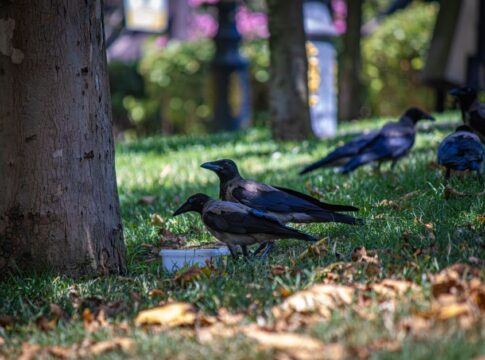
Why Crows Hold Funerals: Animal Behavior Mystery Solved
By Trivia Daily, Animals Desk — Published September 13, 2026
Table of Contents
- Key Takeaways
- Why Crows Hold Funerals: The Science Behind the Behavior
- The Intelligence Behind Crow Gatherings
- Comparing Crow Intelligence to Other Wildlife
- What Crow Funerals Teach Us About Nature
- Crow Behavior in Different Habitats
- Frequently Asked Questions
When a crow dies, something remarkable happens. Other crows gather around the body, calling loudly and appearing to mourn their fallen companion. For years, people observed this behavior and wondered: do crows hold funerals for their dead? Scientists have now uncovered the truth behind these haunting gatherings, and the answer reveals just how intelligent these creatures really are. Far from being simple mourning rituals, these “crow funerals” serve a crucial survival purpose that showcases the sophisticated nature of corvid intelligence.
The phenomenon isn’t just folklore. Crows genuinely congregate around deceased members of their species, creating noisy assemblies that can last for hours. But calling them funerals misses the point entirely. What looks like grief is actually a masterclass in animal learning and threat assessment.
Key Takeaways
- Crows gather around dead crows not to mourn, but to learn about potential dangers in their habitat and remember the location where death occurred.
- These gatherings involve loud calling that alerts other crows in the area to come investigate the threat, creating a community-wide learning experience.
- Crows can remember human faces associated with dead crows for years, demonstrating remarkable long-term memory and threat recognition.
- This behavior helps the entire crow population avoid predators and dangerous locations, providing a survival advantage to the species.
- Similar behavior has been observed in other intelligent animals including elephants, dolphins, and some primate species.
- The gatherings typically last between 15 minutes to several hours, depending on the perceived threat level and number of crows involved.
Why Crows Hold Funerals: The Science Behind the Behavior
Researchers have conducted careful experiments to understand what drives crows to gather around their dead. The key insight? These assemblies function as danger-learning events. When crows encounter a dead member of their species, they’re hardwired to treat it as a red flag. Something killed this bird, and that something might still be nearby.
The behavior unfolds in a predictable pattern. One crow spots the body and begins calling—a distinctive alarm vocalization that other crows recognize immediately. More crows arrive. They circle overhead, perch in nearby trees, and vocalize intensely. Some approach the body cautiously. The entire event creates a vivid, emotionally charged memory that embeds crucial information: this place is dangerous.
Studies using taxidermied crows have demonstrated just how specific this learning becomes. When researchers presented crows with a mounted dead crow while wearing a particular mask, the living crows not only mobbed the area but remembered that specific human face. Years later, those same crows would scold and dive-bomb anyone wearing that mask, even if no dead crow was present. The animals had formed a lasting association between the face and danger.
The Intelligence Behind Crow Gatherings
This behavior reveals multiple layers of cognitive sophistication. Crows must recognize death itself—no small feat in the animal kingdom. They must communicate the discovery to others through specific vocalizations. They need the memory capacity to store and recall threatening locations and associated cues. And they demonstrate something resembling teaching, as experienced crows pass on danger information to younger, naive birds.
Corvids, the family that includes crows, ravens, jays, and magpies, rank among the most intelligent animals on Earth. Their brain-to-body ratio rivals that of great apes. They use tools, solve multi-step problems, and even engage in play. The funeral behavior fits perfectly into this picture of animal intelligence. It’s not mystical mourning—it’s practical, life-saving education.
The social structure of crow communities makes this behavior even more valuable. Crows live in complex societies with family groups that recognize and remember each other. When one crow learns about a danger, that knowledge can spread through social networks. Young crows learning from adults can avoid threats they’ve never personally encountered. This cultural transmission of information gives crow populations a significant survival edge.
Comparing Crow Intelligence to Other Wildlife
| Species | Response to Dead | Memory Duration | Social Learning |
|---|---|---|---|
| Crows | Gather, vocalize, investigate | Years | Extensive |
| Elephants | Touch bones, stand vigil | Decades | Extensive |
| Dolphins | Support dying individuals | Years | Moderate |
| Chimpanzees | Inspect, groom body | Years | Extensive |
| Magpies | Place grass near body | Unknown | Moderate |
What Crow Funerals Teach Us About Nature
The misunderstanding about crow funerals highlights how easily humans project their own emotions onto wildlife. We see birds gathering around a body and imagine grief, sadness, and ritual. The reality is simultaneously more mundane and more impressive. Crows have evolved a sophisticated danger-detection system that happens to involve their dead.
This doesn’t mean crows lack emotion entirely. They form pair bonds, cooperate in raising young, and show signs of stress when separated from family members. But the funeral behavior specifically serves threat assessment rather than emotional processing. Evolution shaped this response because it works—crows that learn from death scenes survive better than those that ignore them.
The behavior also demonstrates how nature solves problems with elegant efficiency. Rather than each crow learning about every danger through personal experience—a potentially fatal approach—the species has developed a way to turn every death into a community learning opportunity. One crow’s misfortune becomes a lesson for dozens or even hundreds of others.
Crow Behavior in Different Habitats
Urban crows display this funeral behavior just as readily as their rural counterparts, though the threats they learn about differ. City crows might associate danger with specific streets, buildings, or vehicles. Rural crows learn about predators like hawks, owls, and foxes. The behavior adapts to the environment while maintaining its core function.
Interestingly, crows in areas with heavy human activity have learned to distinguish between people who pose threats and those who don’t. They recognize individual humans, remember which ones have interfered with nests or harmed crows, and spread that information through their social networks. This remarkable facial recognition ability extends the funeral behavior’s protective value into everyday life.
Frequently Asked Questions
Do crows actually feel sad when another crow dies?
While crows may experience emotions, the funeral gatherings primarily serve as danger-learning events rather than mourning rituals. The behavior is driven by survival instinct—investigating what caused the death to avoid similar threats—though this doesn’t rule out some emotional component that science hasn’t yet fully measured.
How long can crows remember a dangerous person or place?
Crows can remember threatening human faces and dangerous locations for at least five years, and possibly much longer. They can also teach their offspring to recognize these threats, meaning the memory can persist across generations even if the original witness dies.
Do other birds hold funerals like crows?
Ravens, jays, and magpies—all corvids—show similar behavior around dead members of their species. Some other intelligent bird species display related responses, but the elaborate gathering and vocalization pattern is most pronounced in the corvid family.
Will crows gather around any dead bird or only other crows?
Crows respond most strongly to dead crows, though they may show interest in dead ravens or other corvids. They generally ignore dead birds of other species unless those birds are prey items, demonstrating that the funeral behavior is specifically triggered by recognizing their own kind.
The next time you see crows gathering noisily around something on the ground, you’re witnessing evolution in action. These clever creatures are running a real-time threat assessment seminar, turning tragedy into education. In a world full of dangers, crows have learned that the dead can teach the living—a lesson that keeps their populations thriving across every continent except Antarctica.