
11 Surprising Facts About the Eiffel Tower Construction
By Trivia Daily, Staff Writer — Published September 19, 2026
Table of Contents
- Key Takeaways
- The First Eiffel Tower Construction Challenge: Building on Soft Ground
- Prefabrication: The Secret to Record-Breaking Speed
- Interesting Details About the Tower’s Assembly Process
- Comparing the Eiffel Tower to Other 19th-Century Structures
- The 11 Most Surprising Eiffel Tower Construction Facts
- Frequently Asked Questions
Standing tall over Paris since 1889, the Eiffel Tower wasn’t always the beloved icon it is today. During its construction, critics called it an eyesore, a metal monstrosity that would ruin the city’s skyline. Yet the engineering marvel that Gustave Eiffel and his team created revolutionized architecture and became one of the world’s most recognizable structures. The eiffel tower construction involved innovations, risks, and surprising details that even frequent visitors rarely know about.
The iron lattice tower took just over two years to build—a remarkably short timeline for such an ambitious project. What makes this feat even more astonishing? The precision, safety measures, and clever design choices that went into every rivet and beam. These fascinating facts reveal the incredible story behind Paris’s most famous landmark.
Key Takeaways
- The Eiffel Tower was assembled in just 2 years, 2 months, and 5 days using prefabricated parts—record-breaking speed for its era.
- Only one worker died during construction, an extraordinary safety record for a 19th-century project of this scale.
- The tower uses over 2.5 million rivets to hold together 18,038 individual iron pieces, each custom-designed for its specific location.
- Gustave Eiffel included a private apartment at the top for himself, complete with furnishings where he entertained famous guests.
- The structure was originally intended to stand for only 20 years before being dismantled.
- Workers used innovative hydraulic jacks to ensure perfect alignment as the four massive legs rose to meet at the first platform.
The First Eiffel Tower Construction Challenge: Building on Soft Ground
The foundation work began in January 1887, and engineers immediately faced a critical problem. Two of the tower’s four legs would sit on solid ground, but the other two would rest near the Seine River on much softer soil. Gustave Eiffel’s team solved this by digging deeper foundations for the riverside legs—going down roughly 15 meters compared to just 9 meters for the other two. They used compressed air caissons, watertight chambers that allowed workers to excavate below the water table. Each of the tower’s four support pillars rests on a massive concrete foundation block.
This uneven foundation design was crucial. The tower needed to distribute its weight evenly despite the varying ground conditions. The solution worked flawlessly—the tower has never experienced significant settling or structural issues related to its foundation in over 130 years.
Prefabrication: The Secret to Record-Breaking Speed
How did workers assemble a 300-meter tower in just over two years? The answer lies in meticulous planning and prefabrication. Every single iron component was designed, measured, and manufactured in Eiffel’s factory on the outskirts of Paris before being transported to the construction site. Each of the 18,038 pieces had its own unique specifications and designated position in the structure.
Workers on site simply had to bolt the pre-drilled pieces together like an enormous three-dimensional puzzle. This approach minimized errors and dramatically reduced construction time. The precision was remarkable—holes lined up perfectly, and adjustments were rarely needed. This level of prefabrication was revolutionary for the 1880s and set new standards for large-scale construction projects.
Interesting Details About the Tower’s Assembly Process
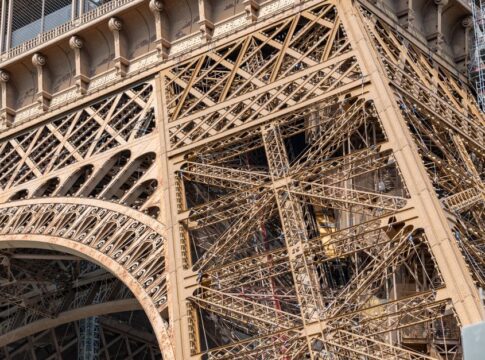
The construction methodology evolved as the tower grew taller. For the lower sections, workers used conventional scaffolding. But as the structure rose beyond practical scaffolding heights, Eiffel employed a brilliant solution: the tower’s own framework became the support system for construction. Small steam-powered cranes mounted on the tower itself lifted materials and workers to ever-greater heights.
Wooden scaffolding was only used up to the first platform at 57 meters. Above that point, workers relied on the partially completed iron structure and temporary wooden frameworks that could be moved upward as construction progressed. The four massive legs had to meet precisely at the first platform—any misalignment would have been catastrophic. Eiffel used hydraulic jacks at the base of each leg, allowing engineers to make tiny adjustments until the alignment was perfect.
Comparing the Eiffel Tower to Other 19th-Century Structures
| Structure | Height | Construction Period | Material |
|---|---|---|---|
| Eiffel Tower | 300 meters (324m with antenna) | 1887–1889 | Wrought iron |
| Washington Monument | 169 meters | 1848–1884 | Marble, granite, bluestone |
| Cologne Cathedral | 157 meters | 1248–1880 | Stone |
| Ulm Minster | 161 meters | 1377–1890 | Stone |
The Eiffel Tower shattered height records, becoming the world’s tallest human-made structure and holding that title until 1930. What’s more impressive is the construction speed—decades faster than comparable stone structures.
The 11 Most Surprising Eiffel Tower Construction Facts
1. Only One Fatality During Construction—An Exceptional Safety Record
In an era when workplace deaths were common on major construction projects, the Eiffel Tower’s safety record was extraordinary. Only one worker died during the entire construction process, and that death occurred during off-hours work, not during the main construction period. Eiffel implemented strict safety protocols, including the use of movable safety screens and careful supervision. For comparison, many large 19th-century projects saw dozens of deaths.
2. Over 2.5 Million Rivets Hold the Tower Together
The tower contains approximately 2.5 million rivets connecting the 18,038 iron pieces. These weren’t simple bolts—each rivet required a team of four workers. One person heated the rivet until it glowed red, another positioned it in the pre-drilled hole, a third held it in place with a bucking bar, and the fourth hammered it into shape. As the rivet cooled, it contracted, creating an incredibly tight seal. This labor-intensive process required exceptional coordination and skill.
3. The Tower Was Designed to Be Temporary
When constructed for the 1889 Exposition Universelle (World’s Fair), the Eiffel Tower had a 20-year permit. City officials planned to dismantle it in 1909. What saved it? Its usefulness as a radio transmission tower. Eiffel installed scientific equipment at the summit, including wireless telegraph transmitters, proving the structure’s value beyond aesthetics. The military applications of radio communication made the tower indispensable, securing its permanent status.
4. Gustave Eiffel Built Himself a Secret Apartment at the Top
At the tower’s summit, Gustave Eiffel created a private apartment for himself, complete with wooden furniture, wallpaper, and a grand piano. He used this space to entertain distinguished guests and conduct scientific experiments. Thomas Edison visited the apartment in 1889. While not truly secret—it was mentioned in contemporary accounts—the apartment wasn’t open to the public and added to Eiffel’s mystique. Today, visitors can view a recreation of this space.
5. The Iron Framework Weighs Only 7,300 Tons
Despite its massive appearance, the iron lattice structure weighs just 7,300 metric tons. The entire tower, including the framework and non-metal components, weighs about 10,000 tons. This relatively light weight was intentional—Eiffel designed an open lattice structure that would minimize wind resistance while maximizing strength. If you melted down all the tower’s metal and poured it into the base area, it would create a layer only about 6 centimeters thick.
6. Workers Used Innovative Hydraulic Jacks for Perfect Alignment
The most critical moment in construction came when the four legs had to meet precisely at the first platform, 57 meters above ground. Even a small misalignment would have been disastrous. Eiffel installed hydraulic jacks in sandstone blocks beneath each leg’s support. These jacks allowed engineers to make minute adjustments—raising or lowering each leg by tiny increments—until the alignment was perfect. Once positioned correctly, workers inserted permanent metal wedges, and the jacks were removed.
7. Protestors Called It a “Metal Asparagus” and Worse
Before and during construction, prominent Parisians—including writers, artists, and architects—signed petitions condemning the tower. They called it a “metal asparagus,” a “tragic street lamp,” and a “hateful column of bolted sheet metal.” Novelist Guy de Maupassant reportedly ate lunch in the tower’s restaurant regularly because it was the one place in Paris where he couldn’t see the tower. The criticism was fierce, but public opinion shifted once people saw the completed structure.
8. Construction Required Unprecedented Mathematical Precision
Engineers created over 5,300 detailed drawings showing every component’s exact specifications. Maurice Koechlin and Émile Nouguier, two engineers in Eiffel’s firm, performed extensive calculations to ensure the tower could withstand wind forces. They calculated the precise curve of the tower’s legs—a shape that provides maximum stability against wind while using minimal material. Every measurement had to be exact because the prefabricated pieces couldn’t be easily modified on site.
9. The Tower Sways in Strong Winds
The tower’s open lattice design allows wind to pass through, but the structure still moves. In strong winds, the top can sway up to 15 centimeters from center. Temperature changes cause even more dramatic movement—on hot days, the sun-facing side expands, causing the tower to lean away from the sun by up to 18 centimeters. Eiffel’s design anticipated these movements, incorporating flexibility that prevents structural damage. The tower has weathered every storm since 1889 without significant issues.
10. Workers Assembled Parts Without Modern Power Tools
The entire tower was built using hand tools, steam-powered cranes, and human muscle. Workers tightened millions of rivets by hand, climbed without modern safety harnesses, and positioned massive iron beams using relatively simple hoisting equipment. The tallest steam crane could only reach partway up the structure, so workers manhandled components into position at dizzying heights. The achievement is even more impressive considering the technological limitations of the 1880s.
11. Paint Protection Was Part of the Original Design
Eiffel knew that iron exposed to weather would rust quickly, so he specified that the tower be painted with a protective coating before assembly. The original color was red-brown. The tower has been repainted 18 times since construction, requiring about 60 tons of paint each time. Today, a team of painters works continuously on a seven-year cycle, ensuring every surface gets a fresh coat regularly. The current color, “Eiffel Tower Brown,” uses three shades—darkest at the bottom, lightest at the top—to create a uniform appearance against the sky.
Frequently Asked Questions
How long did it take to build the Eiffel Tower?
The Eiffel Tower took exactly 2 years, 2 months, and 5 days to construct, from January 1887 to March 1889. This included foundation work and the complete assembly of all iron components to the summit.
How many workers built the Eiffel Tower?
Between 150 and 300 workers were employed on site at any given time during construction. The number varied depending on the construction phase, with more workers needed during the intensive riveting and assembly periods.
Why was the Eiffel Tower built?
The tower was built as the entrance arch for the 1889 Exposition Universelle, a world’s fair celebrating the 100th anniversary of the French Revolution. It was meant to demonstrate French engineering prowess and industrial capability.
Did Gustave Eiffel design the Eiffel Tower himself?
While Gustave Eiffel’s company built the tower and he held the patent, the initial design came from engineers Maurice Koechlin and Émile Nouguier, who worked for Eiffel. Architect Stephen Sauvestre refined the aesthetics, and Eiffel championed and perfected the project.
The eiffel tower construction remains one of history’s most remarkable engineering achievements—a testament to human ingenuity, mathematical precision, and bold vision. Every rivet, every iron beam, every calculated curve tells the story of workers and engineers who built something unprecedented. Next time you see a photograph of the tower, remember that it almost didn’t exist at all, saved from demolition by the dawn of the radio age and the vision of those who saw beyond temporary exhibitions to lasting legacy.