
The Hidden Story of How Pineapples Got Their Name
By Trivia Daily, Staff Writer — Published September 29, 2026
Table of Contents
- Key Takeaways
- The Hidden Story of Pineapples and the Original Pine Connection
- Why English Went Rogue With Fruit Naming
- The Botanical Reality Behind the Name
- Comparing Pineapple Names Across Languages
- From Exotic Luxury to Everyday Fruit
- Frequently Asked Questions
The pineapple is one of the most recognizable tropical fruits in the world, yet its name tells a story that few people know. This spiky, sweet fruit didn’t get its curious moniker by accident—it’s the result of European explorers encountering something entirely new and reaching for the only comparison they had. The hidden story of pineapples reveals how language, exploration, and botanical confusion combined to give us one of the most misleading fruit names in history. Discover the surprising facts behind this everyday wonder.
The name “pineapple” doesn’t mean the fruit grows on pine trees or tastes like apples. The truth is far more interesting.
Key Takeaways
- The word “pineapple” originally referred to what we now call pine cones, not the tropical fruit.
- European explorers named the fruit “pineapple” because its appearance reminded them of pine cones, and it had sweet flesh like an apple.
- Almost every other language calls the fruit some variation of “ananas,” derived from the indigenous Tupi word.
- The pineapple is actually a composite fruit made up of many individual berries fused together around a central core.
- English is one of the few languages that doesn’t use the “ananas” naming convention for this tropical fruit.
- Pineapples became symbols of wealth and hospitality in colonial America, sometimes rented out for display at parties.
The Hidden Story of Pineapples and the Original Pine Connection
Before Europeans encountered the tropical fruit we know today, the word “pineapple” had a completely different meaning. In Middle English and early Modern English, people used “pineapple” to describe what we now simply call a pine cone. The term made perfect sense: the cone came from a pine tree and resembled a kind of fruit or apple in its rounded, segmented appearance.
When Spanish and Portuguese explorers reached the Americas in the late 15th and early 16th centuries, they encountered a strange, spiky fruit cultivated by indigenous peoples. The Tupi people of South America called it “nanas,” meaning “excellent fruit.” This word spread through indigenous languages as “ananas.” European explorers adopted this term in various forms—the Spanish used “ananás,” the Portuguese “ananás,” and the French “ananas.”
But English speakers took a different path. When English explorers saw the fruit, its rough, segmented exterior immediately reminded them of pine cones. The sweet, juicy flesh inside was apple-like in its pleasant taste. Combining these two observations, they called it a “pineapple”—essentially meaning “pine cone with apple-like fruit inside.” The name stuck in English, even as most of the world continued using variations of “ananas.”
Why English Went Rogue With Fruit Naming
English is nearly alone among major languages in calling this fruit a pineapple. Spanish, Portuguese, French, German, Dutch, Italian, Russian, and dozens of other languages all use some form of “ananas.” This linguistic split reveals fascinating trivia about how English developed differently from its European cousins during the age of exploration.
Several factors contributed to this divergence. English explorers often arrived later than their Spanish and Portuguese counterparts, encountering the fruit through different routes and contexts. The English also had a strong tradition of descriptive compound words—combining familiar terms to describe new things. “Butterfly,” “blackberry,” and “dragonfly” all follow this pattern. “Pineapple” fit naturally into this linguistic habit.
The amazing part? By the time “pineapple” became standard in English for the tropical fruit, the original meaning—pine cone—gradually faded from common use. Today, hardly anyone calls a pine cone a pineapple, though the term persisted in some dialects into the 19th century.
The Botanical Reality Behind the Name
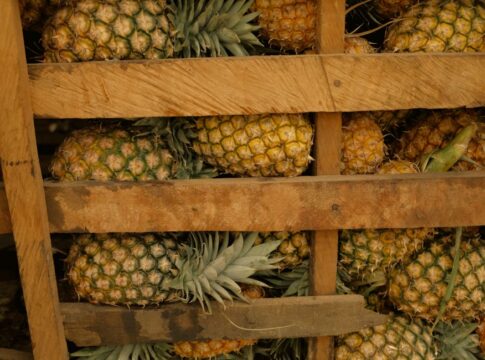
Understanding what a pineapple actually is makes the naming story even more curious. The pineapple isn’t a single fruit at all—it’s a composite or multiple fruit. Each of those hexagonal segments on the outside represents an individual berry that has fused with its neighbors around a central stem.
The pineapple plant produces dozens of small purple flowers, each of which develops into a tiny fruit. These fruitlets merge together as they grow, creating the single large structure we recognize. The tough, spiky exterior that reminded explorers of pine cones is actually the remnants of these flower parts and protective bracts. This botanical structure is similar to how mulberries and figs develop, though the pineapple’s version is far more dramatic.
This composite nature also explains why pineapples don’t have seeds in the way most fruits do. Commercial pineapples are cultivated to be seedless through careful breeding, and the plants reproduce through shoots or crowns rather than seeds. The “eyes” that must be carefully cut away when preparing a pineapple are the bases of those original flowers.
Comparing Pineapple Names Across Languages
| Language | Word for Pineapple | Origin |
|---|---|---|
| English | Pineapple | Pine cone + apple (descriptive) |
| Spanish | Piña or Ananás | Pine cone or from Tupi “nanas” |
| French | Ananas | From Tupi “nanas” |
| German | Ananas | From Tupi “nanas” |
| Portuguese | Ananás | From Tupi “nanas” |
| Italian | Ananas | From Tupi “nanas” |
| Russian | Ананас (Ananas) | From Tupi “nanas” |
From Exotic Luxury to Everyday Fruit
The pineapple’s journey from rare curiosity to grocery store staple is itself a remarkable story. In 17th and 18th century Europe and colonial America, pineapples were extraordinarily expensive symbols of wealth and hospitality. They couldn’t be grown locally in cold climates, and transporting them across the Atlantic before refrigeration meant many rotted in transit.
Wealthy families displayed pineapples as centerpieces at dinner parties. Some were so valuable that they weren’t even eaten—they were rented out for display, passed from party to party until they decomposed. Architectural pineapple motifs appeared on gateposts, door frames, and furniture as symbols of welcome and prosperity. Christopher Wren even incorporated pineapple finials into his designs for prominent buildings in London.
The development of steamships, refrigeration, and eventually commercial cultivation in Hawaii and other tropical regions transformed the pineapple from luxury to commonplace. James Dole pioneered large-scale pineapple production in Hawaii in the early 20th century, making canned pineapple affordable and widely available. Today, countries like Costa Rica, the Philippines, and Thailand are major producers, and the fruit that once symbolized extreme wealth costs just a few dollars.
Frequently Asked Questions
Why is it called a pineapple if it’s not an apple or a pine?
Early English speakers named it “pineapple” because its exterior resembled a pine cone and its sweet flesh tasted somewhat like an apple. The word “apple” was historically used more broadly to refer to many types of fruit, not just the apples we know today.
What do other countries call pineapples?
Most languages call the fruit some variation of “ananas,” derived from the indigenous Tupi word “nanas” meaning “excellent fruit.” English and Spanish (which uses “piña”) are exceptions to this nearly universal naming pattern.
Are pineapples actually berries?
Pineapples are composite fruits made up of many individual berries that have fused together around a central core. Each hexagonal section on the outside represents one of these merged berries, all developing from separate flowers on the same plant.
Can pineapples grow on trees?
No, pineapples grow from the center of a low-growing plant with long, spiky leaves. The fruit develops at ground level on a central stem, and each plant typically produces only one or two pineapples before sending out shoots that become new plants.
The next time you slice into a pineapple, you’re cutting into centuries of linguistic history, botanical wonder, and cultural evolution. This fruit that once cost a fortune now sits in fruit bowls worldwide, its name still carrying the echo of an explorer’s first astonished comparison to a pine cone.