
7 Strange Facts About Axolotls Regenerating Body Parts
By Trivia Daily, Animals Desk — Published October 3, 2026
Table of Contents
- Key Takeaways
- Understanding the Strange Axolotls Regenerating Complex Body Structures
- The Habitat Crisis Threatening These Remarkable Creatures
- What Science Learns From Axolotl Regeneration
- Frequently Asked Questions
When you think of animals with extraordinary abilities, you might picture chameleons changing color or cheetahs sprinting at incredible speeds. But deep in the lakes of Mexico lives a creature with a superpower that seems straight out of science fiction: the axolotl can regenerate entire limbs, organs, and even portions of its brain. These strange axolotls regenerating lost body parts have captivated scientists for decades, and their remarkable healing abilities continue to reveal secrets about tissue repair that could one day benefit human medicine.
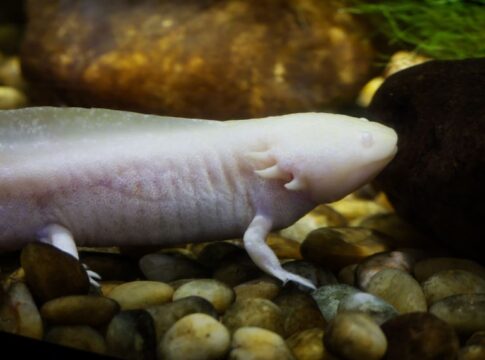
This salamander species retains its juvenile features throughout its life, spending its entire existence underwater with feathery external gills and a permanent smile. Yet beneath that adorable appearance lies one of nature’s most sophisticated biological repair systems.
Key Takeaways
- Axolotls can regenerate complete limbs, including bones, muscles, nerves, and blood vessels, without scarring.
- They can regrow the same body part multiple times throughout their lifetime with perfect accuracy.
- Unlike most animals, axolotls can regenerate portions of their heart, spinal cord, and brain tissue.
- The regeneration process involves cells reverting to a stem-cell-like state at the injury site.
- Axolotls are critically endangered in the wild, found only in the remnants of Lake Xochimilco near Mexico City.
- Scientists study axolotl regeneration to understand potential applications for human tissue repair and wound healing.
Understanding the Strange Axolotls Regenerating Complex Body Structures
Most animals form scar tissue when injured, essentially creating a biological patch job that closes wounds but doesn’t restore original function. Axolotls take an entirely different approach. When an axolotl loses a limb, specialized cells migrate to the wound site and form a structure called a blastema—a mass of cells that can differentiate into all the various tissue types needed to rebuild the missing part. This isn’t a simplified replacement; it’s a perfect reconstruction down to the finest details.
The process takes several weeks to complete. Within days of losing a limb, the wound closes and the blastema forms. Over the following weeks, this cluster of cells gradually organizes itself into bone, muscle, nerve, skin, and blood vessels in precisely the right arrangement. The regenerated limb functions identically to the original, with full sensation and motor control. Scientists have documented axolotls regenerating the same limb dozens of times without any degradation in quality or function.
1. They Can Regrow Perfect Copies of Lost Limbs Down to the Fingerprints
When an axolotl regenerates a limb, it doesn’t create a generic replacement. The new limb matches the original in every microscopic detail, including the unique pattern of ridges on the digits that function like fingerprints. Researchers have tested this by mapping the exact structure of an axolotl’s limb, amputating it, and then comparing the regenerated version. The match is extraordinary—even the arrangement of individual nerve pathways and blood vessels follows the original blueprint. This precision suggests the animal’s cells retain detailed positional information, essentially remembering where they belong in the body’s overall architecture.
2. Their Hearts Can Repair Themselves After Major Damage
While many animals can regenerate skin or heal minor wounds, cardiac tissue regeneration is exceptionally rare in vertebrates. Axolotls can regrow damaged heart tissue, including muscle cells and the structures that regulate heartbeat. When researchers remove portions of an axolotl’s heart, the animal generates new cardiac muscle cells to replace what was lost. The regenerated tissue integrates seamlessly with existing heart muscle and resumes normal function. This ability stands in stark contrast to mammals, where heart attacks leave permanent scar tissue that weakens the organ. Scientists studying this phenomenon hope to identify the genetic switches that enable cardiac regeneration.
3. They Regenerate Functional Spinal Cord Tissue After Severe Injuries
Spinal cord injuries in mammals typically result in permanent paralysis because nerve tissue in the central nervous system cannot regenerate effectively. Axolotls defy this limitation. When their spinal cords are severed, they can regenerate the complex network of neurons, support cells, and connections necessary for transmitting signals between brain and body. Within weeks, paralyzed axolotls regain full mobility. The regenerated spinal cord restores both motor function and sensory perception, demonstrating that the newly formed neural pathways successfully reconnect in the correct configuration. This remarkable ability has made axolotls a primary focus for researchers investigating treatments for human spinal injuries.
4. Portions of Their Brains Can Regenerate After Tissue Loss
Brain regeneration represents one of the most astonishing aspects of axolotl biology. These creatures can regrow parts of their brain after injury, including regions responsible for complex behaviors. The regenerated brain tissue doesn’t just fill space—it restores function. Axolotls that have regenerated brain tissue demonstrate normal feeding behavior, mating responses, and environmental awareness. While the extent of regeneration has limits and doesn’t extend to all brain regions equally, the fact that any functional brain regeneration occurs in a vertebrate challenges long-held assumptions about neural repair. The mechanisms underlying this process remain an active area of research.
5. They Never Form Scar Tissue During Regeneration
One of the most medically significant aspects of axolotl regeneration is the complete absence of scarring. When mammals heal wounds, fibroblast cells rush to the injury site and create collagen-rich scar tissue—a quick fix that closes the wound but lacks the structure and function of original tissue. Axolotls suppress this scar-forming response. Instead of fibroblasts creating a permanent patch, the animal’s cells reorganize into the blastema and rebuild authentic tissue. Understanding how axolotls prevent scar formation could revolutionize treatment for burns, surgical wounds, and chronic injuries in humans, where excessive scarring often causes complications and loss of function.
6. Their Immune Systems Work Differently to Enable Regeneration
The axolotl immune system plays a crucial but counterintuitive role in regeneration. Rather than mounting an aggressive inflammatory response that would promote scarring, axolotl immune cells help coordinate the regeneration process. Certain immune cells arrive at injury sites and release signals that encourage tissue regeneration rather than scar formation. Researchers have found that if you suppress the axolotl immune system, regeneration is impaired. This discovery challenges the traditional view of inflammation as purely detrimental to healing and suggests that the type of immune response matters more than its intensity. The balance between fighting infection and enabling regeneration represents a delicate evolutionary achievement.
7. They Retain Regenerative Ability Throughout Their Entire Lifespan
Many animals that can regenerate tissue lose this ability as they age. Tadpoles, for instance, can regenerate tails, but adult frogs cannot. Axolotls maintain their regenerative powers from hatching through old age, which can span ten to fifteen years. An elderly axolotl regenerates limbs with the same precision and speed as a juvenile. This lifelong retention of regenerative ability relates to their neotenic lifestyle—they remain in a perpetually juvenile state, never undergoing the metamorphosis that transforms most salamanders into terrestrial adults. By studying how axolotls preserve regenerative capacity throughout life, scientists hope to understand why mammals lose similar abilities during development and whether those capabilities could be reactivated.
The Habitat Crisis Threatening These Remarkable Creatures
Despite their extraordinary biology, axolotls face a grim future in the wild. This species exists naturally only in the lake complex of Xochimilco, south of Mexico City, and possibly in a few connected waterways. Urban expansion, pollution, and the introduction of invasive fish species have devastated their habitat. Recent surveys suggest that wild axolotl populations have declined by more than ninety percent over the past few decades, earning them a critically endangered status.
The contrast between their abundance in laboratories and near-extinction in nature is striking. Thousands of axolotls live in research facilities worldwide, where they contribute to scientific understanding of regeneration, development, and genetics. Meanwhile, their wild counterparts struggle to survive in increasingly polluted canals. Conservation efforts are underway to restore water quality and establish protected areas, but the species’ survival in its natural habitat remains uncertain.
What Science Learns From Axolotl Regeneration
The axolotl has become a cornerstone species in regenerative medicine research. By studying the genes active during regeneration, scientists have identified hundreds of molecular signals that control the process. Some of these genetic pathways exist in humans but remain inactive after early development. Researchers are investigating whether these dormant pathways could be reactivated to promote healing in human tissues.
The National Institutes of Health and numerous universities maintain axolotl colonies specifically for regeneration studies. Recent advances in genetic sequencing have allowed researchers to map the entire axolotl genome, despite it being ten times larger than the human genome. This genetic roadmap provides crucial insights into which genes enable regeneration and how they’re regulated. While human limb regeneration remains science fiction, understanding axolotl biology has already influenced treatments for wound healing and tissue engineering.
| Body Part | Regeneration Time | Functional Recovery |
|---|---|---|
| Limb | 4-6 weeks | Complete with full sensation and mobility |
| Tail | 3-4 weeks | Full spinal cord and muscle function restored |
| Heart tissue | 2-3 months | Normal cardiac rhythm and pumping capacity |
| Spinal cord | 6-8 weeks | Complete restoration of motor and sensory function |
Frequently Asked Questions
Can axolotls regenerate their heads?
Axolotls cannot regenerate their entire heads, but they can regenerate portions of their jaw, eyes, and even parts of their brain tissue. Complete head regeneration would require recreating the central control systems of the body, which exceeds even their remarkable capabilities.
How many times can an axolotl regenerate the same body part?
Axolotls can regenerate the same limb or body part many times throughout their lives without any apparent limit. Scientists have documented individual axolotls regenerating the same limb more than fifty times with consistent quality and no degradation in the regeneration process.
Do axolotls feel pain when they lose a limb?
Axolotls possess nerve cells and pain receptors, so they likely experience some form of sensation when injured. However, their nervous system appears adapted to injury, and they show relatively little behavioral distress during the regeneration process compared to other animals with similar injuries.
Are there other animals that can regenerate as well as axolotls?
Some animals match or exceed certain aspects of axolotl regeneration. Planarian flatworms can regenerate entire bodies from tiny fragments, and some sea stars can regrow from a single arm. However, among vertebrates, axolotls possess the most comprehensive regenerative abilities, making them especially relevant for medical research.
The axolotl’s regenerative abilities remind us that biology still holds solutions to problems we consider unsolvable. These smiling salamanders, clinging to existence in Mexico’s polluted waterways, carry genetic instructions that could one day help humans heal from injuries we currently consider permanent. That such a critically endangered creature might hold keys to human medical breakthroughs adds urgency to conservation efforts—and wonder to their remarkable story.