
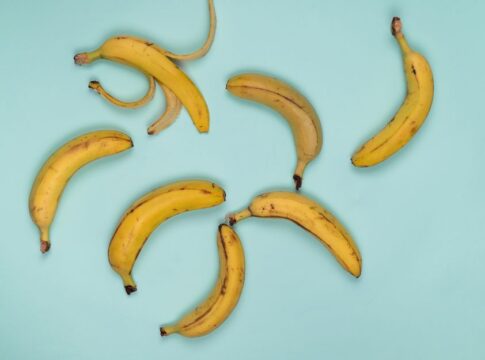
The Hidden Reason Bananas Are Curved Instead of Straight
By Trivia Daily, Staff Writer — Published October 5, 2026
Table of Contents
- Key Takeaways
- The Hidden Reason Bananas Curve: Understanding Negative Geotropism
- From Flower to Fruit: The Banana Growth Timeline
- Cultivated vs. Wild Bananas: A Surprising Comparison
- Common Myths About Banana Shape
- The Science of Everyday Wonders
- Frequently Asked Questions
Every banana you’ve ever eaten shares a distinctive curved shape. This isn’t random chance or a quirk of selective breeding—it’s the result of an amazing natural process called negative geotropism. The hidden reason bananas curve has everything to do with their relationship with the sun and gravity, creating one of nature’s most elegant examples of plant behavior. This interesting fact reveals how even the most ordinary fruits harbor surprising trivia about their growth.
Unlike most fruits that hang downward toward the ground, bananas defy expectations. Their curve tells the story of their journey from flower to fruit, driven by forces invisible to the casual observer.
Key Takeaways
- Bananas curve due to negative geotropism, a process where the fruit grows upward against gravity toward sunlight.
- Banana plants produce flowers that initially point downward, but the developing fruit gradually turns upward as it matures.
- The curvature develops over several weeks as the banana responds to light through phototropism and fights against gravitational pull.
- Wild bananas contain large, hard seeds, unlike the seedless cultivated varieties we eat today.
- The Cavendish variety accounts for roughly 47% of global banana production and demonstrates the characteristic curve most clearly.
- Bananas are technically berries in botanical classification, while strawberries are not.
The Hidden Reason Bananas Curve: Understanding Negative Geotropism
When banana flowers first emerge from the plant, they hang downward in clusters. The weight of the developing flower stalk naturally points toward the ground. But something remarkable happens as the tiny bananas begin to form.
Each individual banana fruit responds to sunlight through a process called phototropism. The cells on the shaded side of the banana grow faster than those on the sun-facing side. This uneven growth causes the fruit to bend upward. Simultaneously, the banana fights against gravity’s downward pull—a behavior scientists call negative geotropism.
The result? That familiar curve. The bottom of the bunch curves most dramatically because those fruits have the longest distance to travel in their upward journey. Top bananas show less pronounced curves since they start closer to vertical.
This growth pattern serves a practical purpose. By growing upward, bananas position themselves to receive maximum sunlight, which helps them ripen evenly. The elevated position also protects developing fruit from ground-dwelling pests and reduces contact with moisture that could promote fungal growth.
From Flower to Fruit: The Banana Growth Timeline
The banana plant produces a single enormous flower structure called an inflorescence. This purple-red bud contains rows of small flowers arranged in clusters called “hands”—which is why we refer to a bunch of bananas as a hand.
Female flowers develop first, appearing in the upper tiers of the inflorescence. These become the bananas we eat. Male flowers develop later at the tip. The entire process from flower emergence to harvest-ready fruit takes approximately three to four months, depending on temperature and growing conditions.
During the first few weeks after the flowers are pollinated, the tiny bananas remain relatively straight. The characteristic curve develops gradually as the fruit lengthens and gains weight. By harvest time, the transformation is complete—each banana has traced an upward arc in its quest for sunlight.
The Role of Hormones in Banana Development
Plant hormones called auxins orchestrate the curving process. These chemical messengers accumulate on the lower, shaded side of each developing banana. Auxins stimulate cell elongation, causing those cells to grow longer than the cells on the upper side. This differential growth rate creates the bend.
The same hormone system helps many plants orient themselves toward light. Sunflowers track the sun across the sky using auxins. Seedlings bend toward windows. Bananas simply take this universal plant behavior and create their distinctive shape.
Cultivated vs. Wild Bananas: A Surprising Comparison
| Characteristic | Cultivated Bananas | Wild Bananas |
|---|---|---|
| Seeds | Virtually seedless (tiny black specks) | Large, hard seeds throughout flesh |
| Reproduction | Cloned from parent plant shoots | Reproduce sexually via seeds |
| Curvature | Pronounced, uniform curve | Variable, often irregular curves |
| Edible Flesh | Abundant, sweet, soft | Limited, often starchy and tough |
Modern bananas are the product of thousands of years of human cultivation. Ancient farmers in Southeast Asia selectively bred varieties with minimal seeds and maximum flesh. Today’s commercial bananas are seedless and sterile—they cannot reproduce without human intervention. Farmers propagate new banana plants by transplanting shoots that sprout from the base of existing plants.
Common Myths About Banana Shape
Some people believe bananas curve to fit more easily into shipping boxes. This is backwards—boxes are designed to accommodate the natural curve, not the other way around. The shape existed millions of years before human packaging.
Another misconception suggests that banana trees grow in curved patterns. Bananas don’t grow on trees at all. The banana plant is actually the world’s largest herb, and its “trunk” is not wood but tightly packed leaf stalks. The fruit develops from a single flowering stalk that emerges from the center of these leaves.
Some claim that different banana varieties grow straight. While curvature intensity varies slightly among varieties, all banana cultivars exhibit the upward curve to some degree. Plantains, cooking bananas, and dessert bananas all share this fundamental growth characteristic.
The Science of Everyday Wonders
Bananas demonstrate how seemingly simple objects contain hidden complexity. The curve you see represents the intersection of light, gravity, hormones, and evolutionary advantage. Each banana documents its own growth history in its shape.
Scientists study banana development not just for agricultural purposes but to understand fundamental plant biology. The mechanisms that curve bananas operate in countless other plants, from sprouting seeds to flowering vines. Research into these processes has applications in crop optimization, understanding plant responses to environmental stress, and even space agriculture.
The banana’s journey from downward-hanging flower to upward-curving fruit mirrors larger patterns in nature—organisms don’t passively accept their environment but actively respond to it. That curve is a record of countless cellular decisions, each one moving the fruit incrementally toward the light.
Frequently Asked Questions
Do bananas grow upside down?
Bananas grow upward toward the sun, which appears upside down compared to how we typically hold them to eat. The stem end that attaches to the plant points up, while the flowering end points down, creating the natural curve.
Why are some bananas more curved than others?
Bananas at the bottom of a bunch curve more dramatically because they must bend farther to reach sunlight. Growing conditions, including temperature and light intensity, also affect the degree of curvature.
Are there any straight bananas?
All banana varieties curve to some extent due to negative geotropism, though the degree varies. Occasionally, individual bananas may appear straighter due to restricted growth or unusual positioning on the bunch, but perfectly straight bananas are extremely rare in nature.
How long does it take for a banana to develop its curve?
The distinctive curve develops gradually over approximately two to three months as the fruit grows and matures. The bending process begins shortly after the flowers are pollinated and continues until the banana reaches full size.
Next time you peel a banana, take a moment to appreciate its shape. That curve represents a quiet triumph—a fruit that refused to hang its head, instead reaching persistently toward the light. In the architecture of something so ordinary lies a reminder that even familiar objects reward closer curiosity.