
Dragon Myths: What Dinosaur Fossils Inspired the Legend
By Trivia Daily, Staff Writer — Published September 13, 2026
Table of Contents
- Key Takeaways
- How Dragon Myths and Dinosaur Fossils Connect Across Cultures
- The Protoceratops-Griffin Connection
- Which Dinosaurs Most Likely Inspired Dragon Stories
- Physical Evidence of Ancient Fossil Discovery
- Why Dragon Legends Vary by Region
- Frequently Asked Questions
Long before paleontology became a science, people stumbled upon enormous bones jutting from hillsides and riverbanks. Without the framework to understand these remains as prehistoric creatures, ancient cultures wove them into their most enduring legends. The connection between dragon myths and dinosaur fossils reveals a fascinating intersection of natural history and human imagination, where real bones sparked stories of fire-breathing monsters across every continent.
These discoveries weren’t random curiosities. They were startling encounters with physical evidence of something massive, reptilian, and utterly unlike any living animal. No wonder civilizations from China to Greece invented dragons to explain them.
Key Takeaways
- Ancient people discovered large fossilized bones centuries before modern paleontology existed, interpreting them through mythological frameworks rather than scientific ones.
- Protoceratops skulls found along the Silk Road likely influenced griffin legends, with their beaked faces and four-legged stance matching artistic depictions.
- Chinese dragon mythology may have been reinforced by abundant dinosaur fossils in regions like Sichuan and Inner Mongolia, where locals called them “dragon bones.”
- Giant sauropod vertebrae and limb bones could easily be mistaken for the remains of serpentine monsters when discovered without context.
- The cyclops legend possibly originated from dwarf elephant skulls, demonstrating how fossil misinterpretation shaped multiple mythical creatures beyond dragons.
- Medieval Europeans encountering Ice Age megafauna bones and occasional dinosaur fossils incorporated them into existing dragon folklore, creating a feedback loop between discovery and myth.
How Dragon Myths and Dinosaur Fossils Connect Across Cultures
The global distribution of dragon legends mirrors the global distribution of fossils. Every major civilization developed dragon stories, and nearly all had access to large fossil deposits. In China, traditional medicine practitioners have ground up “dragon bones” for millennia—bones that modern analysis confirms are often dinosaur fossils. The Chinese word for dinosaur, konglong, literally translates to “terrible dragon.”
European dragons typically appeared as winged, four-legged reptiles. Compare this to the theropod dinosaurs whose fossils dot European landscapes. A partial skeleton of a large carnivore, with its massive hind legs, smaller forelimbs, and elongated skull, could reasonably suggest a creature matching medieval dragon descriptions. The wings? Pure imagination filling the gaps.
Greek historian Herodotus described flying serpents in Arabia whose bones he claimed to have seen. While his “flying serpents” were mythical, the bones were real. The Arabian Peninsula contains numerous fossil beds from marine reptiles and early mammals that could have fueled such accounts.
The Protoceratops-Griffin Connection
One of the most compelling cases links griffins to dinosaur fossils. Griffins—creatures with eagle heads, lion bodies, and sometimes wings—dominated ancient Near Eastern and Greek art. Their legendary home? The gold-rich regions of Central Asia, particularly around the Altai Mountains and Gobi Desert.
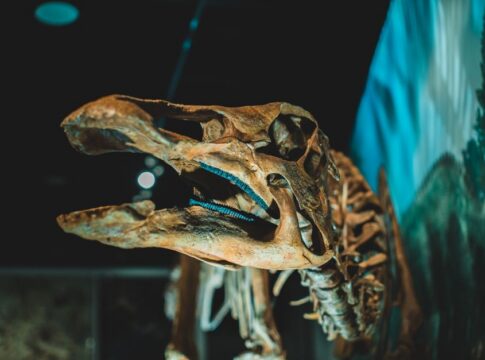
These exact regions contain abundant Protoceratops fossils. This dinosaur possessed a prominent beak, a quadrupedal stance, and a distinctive frill that could resemble wings when partially exposed in eroded stone. Ancient gold miners working these areas would have regularly encountered these remains. The griffin myth may represent humanity’s first attempt at paleontological reconstruction.
Adrienne Mayor, a folklorist and historian of ancient science, has extensively documented how ancient peoples collected, traded, and displayed fossils. They recognized these objects as organic remains, even if they misidentified the source animals. Temples and treasuries sometimes housed notable specimens as sacred relics.
Which Dinosaurs Most Likely Inspired Dragon Stories
Not all dinosaurs make equally convincing dragons. Certain types of fossils, particularly when partially exposed or fragmentary, would have been especially provocative to pre-scientific observers.
| Dinosaur Type | Dragon-Like Features | Geographic Distribution |
|---|---|---|
| Sauropods (long-necked giants) | Enormous vertebrae and ribs suggesting serpentine bodies; massive size | Worldwide, especially abundant in Asia and North America |
| Theropods (carnivorous bipeds) | Sharp teeth, large claws, fearsome skulls; upright posture | All continents including Europe and China |
| Ceratopsians (horned dinosaurs) | Beaked faces, horns, bony frills; quadrupedal stance | Central Asia, North America |
| Pterosaurs (flying reptiles) | Actual wings, reptilian features, varied sizes | Coastal and inland areas worldwide |
The Role of Marine Reptiles
Plesiosaurs and mosasaurs deserve special mention. These marine reptiles, while not dinosaurs, left fossils in sedimentary rocks across Europe, Asia, and the Americas. Their long necks, flippers, and serpentine bodies align remarkably well with sea serpent legends. Coastal communities finding these remains would naturally connect them to maritime monster stories.
Physical Evidence of Ancient Fossil Discovery
Archaeological evidence confirms ancient peoples actively collected fossils. At a 10,000-year-old site in Wyoming, researchers found a cache of fossils deliberately gathered by Paleoindians. Ancient Greek sites have yielded fossil collections displayed alongside pottery and tools. Roman natural historian Pliny the Elder described massive bones on display in temples, attributed to giants and heroes.
In China, oracle bone inscriptions reference “dragon bones” as early as the Shang Dynasty, over three millennia ago. These weren’t metaphorical—they were literal fossilized remains used in divination and medicine. When modern scientists traced the sources, they found dinosaur fossils.
The interpretation matters as much as the discovery. Ancient observers possessed keen intelligence and observational skills. They simply lacked the evolutionary framework and geological timescale we take for granted. Dragons weren’t stupid explanations—they were logical attempts to categorize evidence within existing knowledge systems.
Why Dragon Legends Vary by Region
Chinese dragons are typically wingless, serpentine, and benevolent. European dragons are winged, four-legged, and malevolent. These differences likely reflect both cultural values and regional fossil availability. China’s abundant sauropod fossils, with their long necks and tails, suggest serpentine forms. Europe’s theropod and pterosaur fossils might have inspired winged variants.
Climate and geology also matter. Desert regions with exposed sedimentary rock—like Central Asia and the American Southwest—yield more visible surface fossils. Forested or heavily vegetated areas hide them. This explains why dragon legends concentrate in certain geographic zones while remaining absent or minimal in others.
Frequently Asked Questions
Did ancient people really think dinosaur fossils were dragon bones?
Yes, extensive historical records document ancient cultures interpreting large fossils as remains of dragons, giants, or mythical beasts. Without modern paleontology, this was a reasonable explanation for bones unlike any living animal.
What is the oldest recorded dragon myth?
Dragon-like creatures appear in Mesopotamian art and texts dating to roughly 4,000 years ago, including the Babylonian chaos monster Tiamat. Chinese dragon references are similarly ancient, appearing in Shang Dynasty inscriptions from over 3,000 years ago.
Are there any dinosaur fossils that look exactly like traditional dragons?
No single dinosaur matches traditional dragon depictions perfectly, but partial fossils—especially when eroded, fragmented, or seen by observers unfamiliar with anatomy—could suggest dragon-like features when imagination filled the gaps.
Did medieval Europeans discover actual dinosaur fossils?
Almost certainly, though they didn’t recognize them as such. Europe contains numerous dinosaur fossil sites, and medieval records describe giant bones attributed to dragons, saints, or biblical figures like Goliath.
The next time you see a dragon in art or literature, remember it might carry an echo of an actual discovery—a moment when someone thousands of years ago stood before massive bones and tried to picture the living creature. They got the details wrong, but the wonder? That was entirely real.