
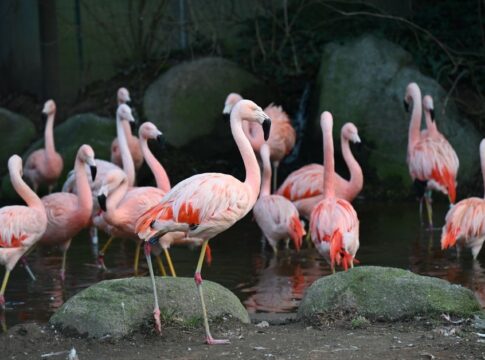
Why Flamingos Stand on One Leg: Behavior Mystery Solved
By Trivia Daily, Animals Desk — Published September 12, 2026
Table of Contents
- Key Takeaways
- The Biomechanics Behind Flamingos Stand Behavior
- Temperature Regulation in Aquatic Habitats
- Energy Conservation Across Species
- Debunking Common Myths About Flamingo Behavior
- Observations in Captivity Versus Nature
- Frequently Asked Questions
Flamingos are among the most instantly recognizable birds on the planet, with their vibrant pink plumage and impossibly long legs. But the behavior that truly captivates observers is their peculiar habit of standing on one leg for hours at a time. This flamingos stand behavior has puzzled scientists and nature enthusiasts for generations, sparking countless theories about why these elegant creatures adopt such an unusual posture. Recent research has finally cracked the code, revealing that the answer involves both energy conservation and thermoregulation in ways that challenge our assumptions about animal physiology.
Unlike most wildlife mysteries that remain shrouded in uncertainty, the flamingo’s one-legged stance has been rigorously studied through biomechanical experiments and field observations. The findings illuminate how these remarkable animals have evolved to thrive in their demanding habitat while expending minimal effort.
Key Takeaways
- Flamingos can stand on one leg with zero muscular effort due to a unique passive locking mechanism in their joints and ligaments.
- The behavior primarily conserves body heat by reducing the surface area exposed to cold water in their wetland habitat.
- Dead flamingos can remain standing on one leg, proving the posture requires no active muscle engagement.
- Both wild and captive flamingos display this behavior regardless of water temperature, suggesting multiple evolutionary advantages.
- The species can maintain the one-legged position even while sleeping, demonstrating remarkable biomechanical efficiency.
- Flamingos alternate legs throughout the day, preventing fatigue and maintaining circulation in both limbs.
The Biomechanics Behind Flamingos Stand Behavior
Scientists discovered the secret through an unexpected experiment. Researchers studied both living flamingos and deceased specimens, making a startling observation: dead flamingos could be positioned on one leg and remain upright without any muscular support. This macabre but illuminating test proved that the one-legged stance operates through passive biomechanics rather than active muscle control.
The key lies in the flamingo’s skeletal and ligament structure. When a flamingo shifts its body weight directly over one leg, the joints lock into place through a combination of gravity and specialized anatomy. The hip, knee, and ankle joints align in a configuration that requires zero muscular effort to maintain. Think of it as a biological kickstand—once engaged, the system holds firm without burning energy.
This passive mechanism allows flamingos to rest while standing, a crucial adaptation for creatures that spend most of their lives wading in water. The animals can even sleep in this position, with their heads tucked under their wings, all while maintaining perfect balance. Researchers at the Georgia Institute of Technology confirmed these findings by measuring muscle activity in standing flamingos, detecting virtually no electrical signals in the supporting leg.
Temperature Regulation in Aquatic Habitats
The thermoregulation hypothesis offers another compelling explanation for this behavior. Flamingos inhabit wetlands, lagoons, and shallow lakes where they spend hours foraging for algae, small crustaceans, and other food sources. Standing in water—even warm water—causes significant heat loss from the body, as water conducts heat away from skin far more efficiently than air.
By tucking one leg into their body feathers, flamingos reduce the surface area exposed to water by roughly half. This simple postural adjustment can dramatically decrease heat loss, allowing the animals to maintain their core body temperature without expending additional metabolic energy. The behavior becomes even more critical in cooler climates or during nighttime hours when water temperatures drop.
Field observations support this theory. Flamingos stand on one leg more frequently in colder conditions and less often when water temperatures rise. However, the behavior persists even in tropical environments, suggesting that heat conservation represents just one of several benefits. The multifunctional nature of this posture demonstrates how evolution crafts elegant solutions that serve multiple purposes simultaneously.
Energy Conservation Across Species
The flamingo’s strategy isn’t entirely unique in the animal kingdom, though their execution is particularly refined. Many wading birds, including herons and storks, occasionally adopt similar postures. The common thread connecting these species is their aquatic lifestyle and the physiological challenge of maintaining body temperature in water.
What sets flamingos apart is the frequency and duration of the behavior. While other birds might briefly stand on one leg, flamingos can maintain the position for hours without apparent discomfort or fatigue. This endurance stems from their specialized anatomy, which has been fine-tuned through millions of years of evolution in wetland habitats across Africa, Asia, the Americas, and Europe.
| Flamingo Species | Primary Habitat | Typical Water Temperature |
|---|---|---|
| Greater Flamingo | Mediterranean, Africa, Asia | 59–86°F (15–30°C) |
| American Flamingo | Caribbean, Galápagos | 75–86°F (24–30°C) |
| Chilean Flamingo | Temperate South America | 50–68°F (10–20°C) |
| Andean Flamingo | High-altitude lakes | 32–59°F (0–15°C) |
Debunking Common Myths About Flamingo Behavior
Several misconceptions about this behavior have circulated for years. One popular myth suggests that flamingos stand on one leg to rest the other, similar to how humans might shift weight between feet when standing for long periods. While alternating legs does occur, the biomechanical evidence shows that the standing leg requires no muscular effort, making “rest” an inaccurate description of the primary benefit.
Another theory proposed that the behavior aids in camouflage, making the flamingo’s silhouette resemble aquatic vegetation when viewed from certain angles. However, the vibrant pink coloration of most flamingo species makes them highly visible regardless of posture, undermining this explanation. The animals derive their distinctive color from carotenoid pigments in their diet of algae and small crustaceans, making concealment an unlikely evolutionary priority.
Some observers have speculated that the one-legged stance helps flamingos avoid predators by allowing faster escape responses. This theory lacks supporting evidence. In reality, flamingos rely on group vigilance and flight as their primary anti-predator strategies, with their leg position offering no discernible advantage when danger approaches.
Observations in Captivity Versus Nature
Flamingos in zoos and wildlife facilities display the one-legged behavior with the same frequency as their wild counterparts, providing researchers with valuable opportunities for controlled study. These captive populations have confirmed that the behavior is instinctive rather than learned, as young flamingos begin adopting the posture shortly after their legs develop sufficient strength and coordination.
The consistency across environments reinforces the conclusion that biomechanical efficiency and thermoregulation drive the behavior. Captive flamingos stand on one leg even when provided with heated pools or shallow water, though they may adjust the duration based on ambient conditions. This adaptability demonstrates the behavior’s deep integration into flamingo physiology and instinct.
Frequently Asked Questions
Do flamingos ever stand on both legs?
Yes, flamingos regularly stand on both legs, particularly when walking, feeding actively, or performing courtship displays. They switch between one-legged and two-legged stances throughout the day based on activity level and environmental conditions.
Can flamingos sleep while standing on one leg?
Flamingos frequently sleep while balanced on one leg, with their heads tucked beneath their wing feathers. The passive locking mechanism in their joints allows them to maintain this position without conscious effort or muscle fatigue, even during deep sleep.
Which leg do flamingos prefer to stand on?
Research indicates that individual flamingos may show slight preferences for one leg over the other, similar to human handedness. However, they regularly alternate between legs to maintain circulation and prevent any long-term imbalance.
Do baby flamingos stand on one leg?
Young flamingos begin experimenting with the one-legged stance as their legs strengthen and their coordination improves, typically within their first few months of life. The behavior becomes more consistent and prolonged as they mature and their skeletal structure fully develops.
The flamingo’s one-legged stance represents a masterclass in evolutionary efficiency—a behavior that simultaneously conserves energy, regulates temperature, and requires zero conscious effort to maintain. Next time you observe these pink creatures at a zoo or in the wild, you’re witnessing millions of years of adaptation distilled into a single, elegant posture that would topple most other animals in seconds.