
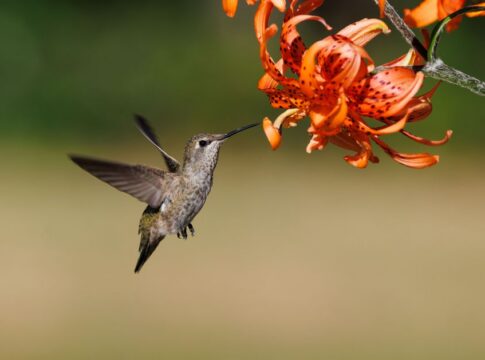
How Hummingbirds Remember Every Flower They Visit
By Trivia Daily, Animals Desk — Published October 27, 2026
Table of Contents
- Key Takeaways
- How Hummingbirds Remember Every Flower Through Brain Structure
- The Science Behind Flower Tracking Behavior
- Memory Differences Among Hummingbird Species and Sexes
- Comparing Memory Capabilities Across Animal Species
- How This Memory Shapes Hummingbird Ecology
- Frequently Asked Questions
A tiny hummingbird, weighing less than a nickel, can remember the exact location of hundreds of flowers scattered across several acres. Even more remarkable, these creatures recall not just where each bloom is, but when they last visited it and how long it will take for that flower to refill with nectar. This extraordinary feat of memory allows hummingbirds to optimize their feeding routes with the precision of a seasoned delivery driver, never wasting energy on depleted food sources.
The ability of hummingbirds to remember every flower they visit ranks among nature’s most impressive cognitive achievements. For an animal whose brain is roughly the size of a pea, the spatial memory and temporal tracking required to manage this mental map challenges our assumptions about intelligence in the animal kingdom.
Key Takeaways
- Hummingbirds possess exceptional spatial memory that allows them to track hundreds of individual flowers across their habitat and remember when each was last visited.
- These birds can recall the refill rates of different flower species, knowing precisely when nectar will be replenished after their last visit.
- The hippocampus in hummingbirds is proportionally larger than in other bird species, supporting their superior memory capabilities.
- Male and female hummingbirds may have different memory strengths, with some research suggesting females excel at spatial tasks during breeding season.
- Hummingbirds update their mental maps constantly, deleting flowers that have died and adding new blooms to their foraging routes.
- This memory system is so precise that hummingbirds can distinguish between flowers they visited five minutes ago versus five hours ago.
How Hummingbirds Remember Every Flower Through Brain Structure
The secret to hummingbird memory lies in a brain structure called the hippocampus, the same region humans use for spatial navigation and memory formation. In hummingbirds, this area is significantly enlarged compared to other birds of similar size. The hippocampus makes up a larger percentage of total brain volume in hummingbirds than in chickadees, sparrows, or most other avian species.
This enlarged hippocampus serves as a biological GPS and calendar combined. When a hummingbird visits a flower, neurons in this region encode multiple pieces of information: the flower’s location relative to landmarks, its color and shape, the quality and quantity of nectar available, and a timestamp of the visit. This neural encoding happens in real-time, requiring no conscious effort from the bird.
The energy demands of hovering flight make this memory system a survival necessity rather than a luxury. Hummingbirds burn calories at such an extreme rate that they must consume roughly half their body weight in nectar daily. Flying to an empty flower wastes precious energy reserves, so remembering feeding schedules becomes a matter of life and death.
The Science Behind Flower Tracking Behavior
Researchers have documented this remarkable memory through carefully controlled experiments. In one study design, scientists set up artificial feeders on a grid pattern and observed how hummingbirds learned and remembered the layout. The birds not only memorized feeder locations but also tracked which feeders they had already emptied, avoiding them until researchers refilled them.
What makes this behavior even more sophisticated is the concept of temporal memory. Different flower species refill their nectar at different rates. A trumpet creeper might replenish its nectar within an hour, while a columbine could take several hours. Hummingbirds learn these refill schedules and time their return visits accordingly, demonstrating an internal clock synchronized with floral biology.
This temporal awareness extends beyond simple waiting periods. Hummingbirds appear to categorize flowers into mental groups based on refill rates, creating efficient foraging circuits. They might visit fast-refilling flowers multiple times while making longer loops to check slower-refilling species, maximizing energy intake while minimizing flight costs.
Memory Differences Among Hummingbird Species and Sexes
Not all hummingbirds demonstrate identical memory capabilities. Among the hundreds of hummingbird species found throughout the Americas, those inhabiting complex environments with diverse floral resources tend to show enhanced spatial memory compared to species in simpler habitats. Tropical species navigating rainforest canopies with thousands of plant species face greater cognitive demands than desert specialists visiting a handful of cactus types.
Sexual differences in memory performance have also emerged in wildlife research. During breeding season, female hummingbirds, who bear sole responsibility for nest building and chick rearing, show enhanced spatial memory compared to males. This seasonal cognitive boost helps females remember not just flower locations but also the locations of spider webs, where they harvest silk for nest construction, and safe perching spots near their nests.
Male hummingbirds, meanwhile, invest cognitive resources differently. They must remember the boundaries of their territories, the locations of prime perches for courtship displays, and the feeding routes of rival males. Their memory systems are tuned to social and territorial information rather than pure foraging efficiency.
Comparing Memory Capabilities Across Animal Species
| Animal | Memory Specialty | Capacity |
|---|---|---|
| Hummingbirds | Spatial and temporal flower tracking | Hundreds of locations with timestamps |
| Clark’s Nutcracker | Seed cache locations | Up to 30,000 individual hiding spots |
| Honeybees | Flower patches and hive location | Multiple sites communicated through dance |
| Elephants | Water source locations across seasons | Dozens of sites over decades |
| Chimpanzees | Fruit tree locations and ripening schedules | Hundreds of trees across territory |
How This Memory Shapes Hummingbird Ecology
The memory prowess of hummingbirds creates fascinating ecological relationships with flowering plants. Many plant species have evolved to match their nectar production rates with hummingbird memory and foraging behavior. Flowers that refill quickly attract more frequent visits, increasing pollination success. Plants essentially exploit hummingbird memory to ensure reliable pollinator service.
This relationship runs both ways. Hummingbirds have evolved preferences for flower colors and shapes that are easy to remember and distinguish. Red tubular flowers dominate hummingbird-pollinated plant species, not because hummingbirds can’t see other colors, but because red stands out against green foliage and creates memorable visual landmarks.
The memory system also influences hummingbird migration patterns. Some species return to the same breeding territories year after year, remembering productive feeding areas from previous seasons. They time their arrival to coincide with peak flowering, suggesting they retain seasonal information across months of migration to distant wintering grounds.
Frequently Asked Questions
Do hummingbirds recognize individual humans?
Yes, hummingbirds can recognize and remember individual people, especially those who regularly refill their feeders. They distinguish between different humans based on appearance and behavior, often showing less fear toward familiar caretakers than strangers.
How long can hummingbirds remember flower locations?
Hummingbirds can remember flower locations for at least several months, and likely much longer. Some evidence suggests they retain spatial memories across migration cycles, remembering productive feeding sites from one breeding season to the next.
Do hummingbirds have better memories than other birds?
Hummingbirds excel at spatial and temporal memory related to food sources, but some bird species like Clark’s nutcrackers show even more impressive feats, remembering thousands of seed cache locations. Different species have evolved memory systems suited to their specific ecological needs.
Can hummingbirds remember artificial feeders as well as real flowers?
Hummingbirds remember artificial feeders with the same precision they apply to natural flowers, tracking locations, refill schedules, and even the specific people who maintain them. They quickly learn human patterns and may arrive at feeding stations just as someone steps outside to refill them.
The next time you watch a hummingbird dart from flower to flower with apparent randomness, consider the invisible mental map guiding each movement. Behind those rapid wingbeats lies a navigation computer that would impress any software engineer, proof that extraordinary intelligence comes in remarkably small packages.