
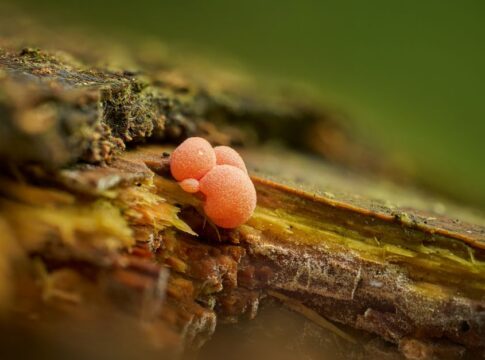
How Slime Molds Solve Mazes Without Having Brains
By Trivia Daily, Staff Writer — Published October 28, 2026
Table of Contents
- Key Takeaways
- How Slime Molds Solve Mazes Through Distributed Intelligence
- The Tokyo Subway Experiment That Amazed Scientists
- What Counts as Memory Without a Brain
- Comparing Slime Mold Intelligence to Other Systems
- Why This Matters Beyond Biology
- Frequently Asked Questions
Imagine a blob of yellow goo spreading across a petri dish, flowing around obstacles and finding the shortest path between two points—all without a single neuron. That’s exactly what slime molds do, and it’s one of nature’s most surprising demonstrations of intelligence without a brain. These remarkable organisms can navigate complex mazes, make decisions, and even appear to remember past experiences, challenging everything we thought we knew about what it takes to solve problems.
The most famous maze-solver among slime molds is Physarum polycephalum, a single-celled organism that can grow to cover several square feet. Scientists have watched in amazement as these creatures efficiently map out optimal routes through labyrinths that would challenge a mouse or even a human. It’s a fascinating glimpse into how biological systems can exhibit sophisticated behavior without centralized control.
Key Takeaways
- Slime molds solve mazes by spreading out through all available paths, then withdrawing from dead ends while reinforcing successful routes.
- Physarum polycephalum can recreate efficient transportation networks that mirror human-designed subway systems when food sources are placed at city locations.
- These organisms make decisions using chemical signals and oscillations in their cytoplasm rather than neurons or electrical impulses.
- Slime molds demonstrate a form of external memory by leaving behind slime trails that help them avoid revisiting areas they’ve already explored.
- Despite being single-celled, slime molds can “learn” to ignore harmless substances they initially avoided, showing a primitive form of habituation.
- Scientists have used slime mold behavior to design better algorithms for network optimization and routing problems.
How Slime Molds Solve Mazes Through Distributed Intelligence
When researchers place a slime mold at the entrance of a maze with food at the exit, something remarkable happens. The organism doesn’t think, plan, or strategize—it simply grows. The slime mold sends out tendrils in every direction, exploring all possible paths simultaneously. This parallel processing approach means the organism fills the entire maze relatively quickly.
Here’s where it gets interesting. As the slime mold encounters dead ends, those branches receive no reward signal in the form of nutrients. The organism responds by withdrawing cytoplasm from unsuccessful paths and reinforcing the tubes that lead toward food sources. Over several hours, the maze-filling network simplifies into a single, often remarkably efficient, route connecting the start point to the food.
The mechanism behind this behavior involves rhythmic contractions that pulse through the organism’s body. These oscillations help pump cytoplasm through the network of tubes. Paths that lead to nutrients receive positive feedback, strengthening those connections. Dead ends receive negative feedback. No central processor coordinates this activity—it’s entirely distributed across the organism’s body.
The Tokyo Subway Experiment That Amazed Scientists
One of the most striking demonstrations of slime mold problem-solving came from Japanese researchers who recreated the Tokyo metropolitan area on a petri dish. They placed oat flakes (a favorite slime mold food) at locations corresponding to major cities around Tokyo, with the slime mold starting at Tokyo’s position.
The results were startling. As the slime mold grew and optimized its network to connect all the food sources, it created a pattern that closely resembled the existing Tokyo rail system. The organism had independently arrived at a solution similar to what human engineers designed over decades, considering factors like efficiency, redundancy, and fault tolerance. The slime mold accomplished this feat in less than a day.
This wasn’t a fluke. Researchers have repeated similar experiments with other transportation networks, including rail systems in the United Kingdom and Canada, with comparable results. The slime molds consistently produce efficient networks that balance the competing needs of short routes and network robustness.
What Counts as Memory Without a Brain
Perhaps the most mind-blowing aspect of slime mold behavior is their apparent ability to remember. When a slime mold explores territory, it leaves behind a trail of extracellular slime. This slime acts as an external memory system, marking areas the organism has already investigated. When the slime mold encounters its own trail, it tends to avoid that direction, preventing wasted effort on redundant exploration.
Scientists have also observed habituation in slime molds. When repeatedly exposed to harmless but initially unpleasant substances like caffeine or salt, the organisms gradually reduce their avoidance behavior. They’ve “learned” that the substance poses no real threat. This primitive form of learning occurs without any neural tissue whatsoever.
The mechanism likely involves changes in the chemical composition of the slime mold’s cytoplasm or cell membrane. These changes persist for hours or even days, creating a biochemical form of memory that influences future behavior.
Comparing Slime Mold Intelligence to Other Systems
| System | Processing Method | Maze-Solving Time | Optimization Quality |
|---|---|---|---|
| Slime Mold | Distributed chemical signals | 4-8 hours | Near-optimal, robust networks |
| Ant Colony | Pheromone trails | Hours to days | Good paths, adaptive |
| Computer Algorithm | Digital calculation | Seconds to minutes | Optimal but requires programming |
| Mouse | Neural learning | Multiple trials over days | Eventually learns one path |
Why This Matters Beyond Biology
The implications of slime mold intelligence extend far beyond fascinating trivia. Computer scientists and engineers have developed algorithms inspired by slime mold behavior to solve complex network optimization problems. These bio-inspired approaches excel at finding efficient solutions when dealing with dynamic, changing conditions.
Applications include designing more resilient communication networks, optimizing supply chain logistics, and even planning evacuation routes in emergencies. The distributed, adaptive nature of slime mold decision-making offers advantages over traditional centralized computing approaches, particularly when dealing with incomplete information or changing environments.
Slime molds also force us to reconsider what we mean by intelligence. If a single-celled organism can solve problems, make decisions, and adapt to its environment, perhaps intelligence is less about having a brain and more about having effective mechanisms for processing information and responding to challenges. The definition becomes broader and more inclusive.
Frequently Asked Questions
Are slime molds actually mold or fungi?
No, despite the name, slime molds are not fungi or molds. They’re actually a type of protist, single-celled organisms that belong to their own distinct group. The name is a historical artifact from when they were misclassified.
Can slime molds solve any type of maze?
Slime molds excel at finding shortest-path solutions in two-dimensional mazes where they can physically explore all routes. They work best with mazes that have clear dead ends and food rewards, though their success depends on maze complexity and time available.
How long do slime molds live?
Individual slime molds can live for years under laboratory conditions if provided with adequate food and moisture. In nature, their lifespan varies depending on environmental conditions, but they can also form dormant spores that survive for decades until conditions improve.
Do slime molds have any practical uses for humans?
Beyond inspiring algorithms and network designs, slime molds are used in research on cell biology, drug testing, and understanding how cells coordinate without central control. They’re also being explored for bio-computing applications where living organisms perform calculations.
The next time you spot a patch of yellow slime on a rotting log in the forest, take a moment to appreciate the hidden complexity. That seemingly simple blob might be solving problems in ways that still puzzle scientists—no brain required, just billions of years of evolutionary refinement distilled into pure, elegant efficiency.