
7 Surprising Facts About Kraken Myths and Giant Squids
By Trivia Daily, Staff Writer — Published October 5, 2026
Table of Contents
- Key Takeaways
- Kraken Myths Giant Squids Inspired Across Cultures
- 1. Giant Squid Eyes Are the Largest in the Animal Kingdom
- 2. Scientists Didn’t Film a Living Giant Squid Until the 21st Century
- 3. Sperm Whales and Giant Squids Wage Epic Deep-Sea Battles
- 4. Colossal Squids Are Even More Formidable Than Giant Squids
- 5. Giant Squids Have Three Hearts and Blue Blood
- 6. Ancient Kraken Myths Influenced Naval Architecture
- 7. Giant Squid Beaks Are Harder Than Most Metals
- Frequently Asked Questions
For centuries, sailors whispered tales of monstrous tentacled beasts lurking in the ocean’s depths, capable of dragging entire ships to their doom. These kraken myths and giant squid legends seemed like pure fantasy—until science caught up. The real creatures behind the folklore turn out to be just as fascinating as the stories themselves, and in some ways, even stranger. What began as ancient maritime terror has become one of marine biology’s most captivating mysteries.
The line between myth and reality blurs when you discover what lives in the deep ocean. Giant squids exist, they’re enormous, and they’ve inspired generations of storytellers. But separating fact from fiction reveals surprising truths about both the legends and the animals that sparked them.
Key Takeaways
- Giant squids can grow to lengths exceeding 40 feet, with eyes the size of dinner plates—the largest in the animal kingdom.
- The kraken legend likely originated from real encounters with giant squids and colossal squids in the North Atlantic.
- Scientists didn’t capture video footage of a living giant squid in its natural habitat until 2012.
- Sperm whales hunt giant squids in the deep ocean, and their bodies often bear circular scars from squid suckers.
- Colossal squids are heavier and more aggressive than giant squids, with rotating hooks on their tentacles.
- Ancient Norse sailors described the kraken as an island-sized creature that created whirlpools when it submerged.
Kraken Myths Giant Squids Inspired Across Cultures
The kraken legend dominates Scandinavian folklore, but tentacled sea monsters appear in cultures worldwide. Norse sailors described a creature so massive that ships mistook its back for an island. When the beast descended, it supposedly created whirlpools powerful enough to suck vessels into the abyss. These accounts weren’t entirely imaginary—they likely stemmed from genuine sightings of giant squids surfacing in Norwegian waters.
Similar creatures populate other maritime traditions. Japanese folklore speaks of the Akkorokamui, a gigantic octopus-like being. Greek mythology featured the multi-headed Scylla. What’s remarkable is the consistency: cultures separated by thousands of miles all imagined enormous cephalopods as apex predators of the deep. This suggests sailors across the globe encountered something real enough to inspire similar nightmares.
The scientific name for the giant squid, Architeuthis dux, translates roughly to “ruling squid.” Even taxonomists acknowledged these animals’ legendary status. Before the mid-1800s, most scientists dismissed kraken stories as sailor superstition. Then bodies started washing ashore.
1. Giant Squid Eyes Are the Largest in the Animal Kingdom
A giant squid’s eye can measure up to 10 inches in diameter—about the size of a dinner plate or basketball. No other animal on Earth has eyes this large. Why such massive peepers? The answer lies in their habitat. Giant squids hunt in the mesopelagic and bathypelagic zones, where sunlight barely penetrates. These enormous eyes gather every available photon, allowing the squid to detect prey and predators in near-total darkness.
The eye structure is particularly adapted for spotting large moving objects from great distances. Scientists believe giant squids use their exceptional vision primarily to detect sperm whales, their main predator. In the deep ocean’s dim twilight, being able to see a whale’s silhouette from 400 feet away could mean the difference between escape and becoming lunch.
2. Scientists Didn’t Film a Living Giant Squid Until the 21st Century
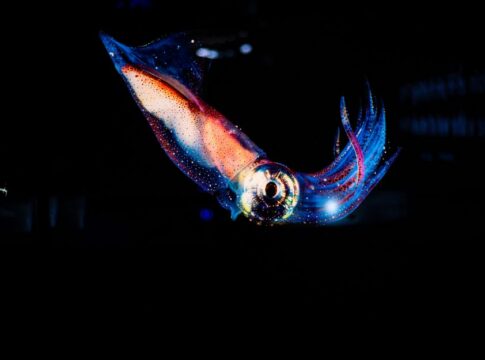
Despite centuries of legends, humanity captured video footage of a living giant squid in its natural deep-sea environment only in 2012. A team of researchers from Japan’s National Science Museum recorded the historic footage off the Ogasawara Islands, at depths around 2,000 feet. The squid measured roughly 10 feet long and displayed shimmering, silvery coloration that scientists had never observed in dead specimens.
Before this breakthrough, all knowledge of giant squids came from dead or dying animals—washed ashore, caught in fishing nets, or found in sperm whale stomachs. The 2012 footage revealed behaviors impossible to study from carcasses: how the animals move, hunt, and interact with their environment. It took thousands of hours of deep-sea filming and specialized camera equipment to achieve what had eluded marine biologists for generations.
3. Sperm Whales and Giant Squids Wage Epic Deep-Sea Battles
Sperm whales dive to depths exceeding 3,000 feet to hunt giant squids, their preferred prey. The evidence of these encounters is written on the whales’ bodies: circular scars from squid suckers, some several inches across, mark the skin of most adult sperm whales. These aren’t peaceful meals—the squids fight back ferociously.
Scientists have found giant squid beaks lodged in whale stomachs and throats. Occasionally, whales surface with fresh wounds or squid tentacles still attached. The battles occur in complete darkness, with the whale using echolocation to navigate and the squid relying on its enormous eyes. Some researchers believe the bioluminescent displays of certain deep-sea squids might actually attract sperm whales, turning the predator-prey relationship into a deadly game of underwater hide-and-seek.
4. Colossal Squids Are Even More Formidable Than Giant Squids
While giant squids capture public imagination, their cousin the colossal squid (Mesoplodon hamiltoni) might be even more impressive. Colossal squids are shorter in overall length but significantly heavier, with more robust bodies and thicker tentacles. Their most terrifying feature? Rotating hooks embedded in their suckers, capable of shredding prey.
| Feature | Giant Squid | Colossal Squid |
|---|---|---|
| Maximum Length | 43+ feet | 30-33 feet |
| Maximum Weight | 600 pounds | 1,000+ pounds |
| Eye Diameter | 10 inches | 11 inches |
| Tentacle Weapons | Suckers with teeth | Suckers with rotating hooks |
| Primary Habitat | Worldwide deep waters | Antarctic waters |
Colossal squids inhabit the deep Antarctic waters and are even rarer than giant squids. Only a handful of complete specimens have been recovered, mostly from the stomachs of sperm whales caught by whalers. The largest colossal squid on record was caught by New Zealand fishermen in 2007 and now resides at the Museum of New Zealand Te Papa Tongarewa.
5. Giant Squids Have Three Hearts and Blue Blood
Like other cephalopods, giant squids possess three hearts: two branchial hearts pump blood to the gills, while one systemic heart circulates it to the rest of the body. This arrangement efficiently delivers oxygen throughout their massive bodies. Their blood appears blue because it uses hemocyanin rather than hemoglobin to transport oxygen. Hemocyanin contains copper instead of iron, making it more efficient in cold, oxygen-poor deep-sea environments.
The squid’s nervous system is equally remarkable. Their brain is donut-shaped, with their esophagus passing directly through the center. This means swallowing anything too large could cause brain damage—which might explain why squids use their sharp beaks to cut food into small pieces before eating.
6. Ancient Kraken Myths Influenced Naval Architecture
Kraken legends weren’t just scary stories—they influenced how ships were designed and how sailors behaved at sea. Norwegian and Icelandic fishing communities avoided certain waters during specific seasons, believing krakens were more active then. Some historians suggest these “kraken zones” might have actually been areas where giant squids surfaced to spawn or feed, making the superstitions accidentally accurate.
Ship captains sometimes designed vessels with reinforced hulls specifically to withstand “kraken attacks.” While no giant squid has ever intentionally attacked a ship, smaller vessels have reported encounters with large squids that approached boats at night, possibly attracted by lights. These rare interactions kept the legends alive well into the age of steam power.
7. Giant Squid Beaks Are Harder Than Most Metals
A giant squid’s beak is one of nature’s engineering marvels. Made primarily of chitin, proteins, and water, it’s harder than most metals at its tip yet gradually becomes softer toward the base where it attaches to soft tissue. This gradient prevents the squid from injuring itself with its own weapon—a problem that would occur if a completely hard beak connected to completely soft tissue.
The beak can slice through fish, crustaceans, and even other squids with ease. Scientists study giant squid beaks to develop better synthetic materials, particularly for medical implants that need to interface between hard and soft tissues. The beak’s structure has inspired designs for everything from surgical tools to industrial cutting implements.
Frequently Asked Questions
Has a giant squid ever attacked a human?
There are no verified accounts of giant squids attacking humans. These animals live in deep waters far from where people swim or dive, and they typically flee from anything unfamiliar. The creatures are elusive and avoid surface activity.
How deep do giant squids live?
Giant squids typically inhabit depths between 1,000 and 3,000 feet, though they occasionally venture deeper or surface at night. They prefer the mesopelagic zone where light fades but doesn’t completely disappear, allowing their massive eyes to function effectively.
What do giant squids eat?
Giant squids primarily feed on deep-sea fish, smaller squids, and occasionally crustaceans. They’re ambush predators that use their two long feeding tentacles to snatch prey, then bring it to their eight shorter arms and sharp beak for processing.
Are giant squids endangered?
Scientists don’t have enough data to determine giant squid population numbers or conservation status. Because they live in deep, remote ocean areas and are rarely observed, assessing their population health remains extremely difficult. They’re not currently listed as endangered.
The next time you hear a kraken story, remember that reality rivals fiction. Somewhere in the ocean’s depths, creatures with eyes the size of dinner plates and tentacles longer than a bus hunt in total darkness, just as they have for millions of years. We’ve barely begun to understand them.