
7 Bizarre Facts About How Lightning Strikes the Earth
By Trivia Daily, Staff Writer — Published August 6, 2026
Table of Contents
- Key Takeaways
- The Bizarre Lightning Strikes That Travel Upward
- Understanding Lightning’s Extreme Temperature
- How Lightning Forms and Travels
- Comparing Lightning Strike Statistics
- Frequently Asked Questions
Lightning has fascinated humanity for millennia, yet this natural phenomenon remains one of the most misunderstood forces on our planet. Every second, roughly 100 lightning bolts strike the Earth’s surface, and the bizarre lightning strikes that occur reveal surprising truths about physics, nature, and the incredible power of our atmosphere. From reverse bolts that shoot upward into space to strikes that can forge glass in sand, lightning delivers some of the most amazing facts in all of science.
What you think you know about lightning might be completely wrong. These seven facts explore the strange, counterintuitive, and downright weird ways that electrical storms interact with our world.
Key Takeaways
- Lightning can strike upward from the ground toward the sky, not just downward from clouds.
- The heat from a lightning bolt is approximately five times hotter than the surface of the Sun.
- Certain trees are struck by lightning far more frequently than others due to their internal moisture and height.
- Lightning can create natural glass formations called fulgurites when it strikes sand or soil.
- Humans can survive direct lightning strikes, though the electrical current follows specific pathways through the body.
- Volcanic eruptions can generate their own lightning within ash clouds.
The Bizarre Lightning Strikes That Travel Upward
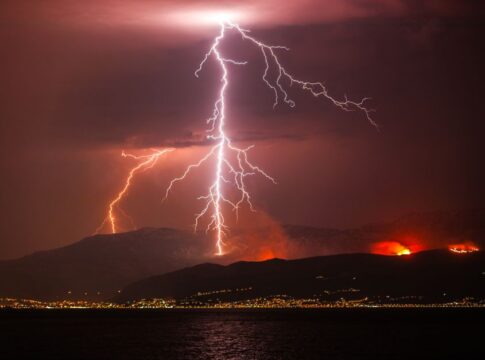
Most people picture lightning as a brilliant fork descending from storm clouds to the ground. The reality is far stranger. Ground-to-cloud lightning, also called upward lightning, begins at the Earth’s surface and travels skyward. This reversed phenomenon typically occurs from tall structures like skyscrapers, radio towers, and mountain peaks. The Empire State Building in New York City experiences upward lightning strikes approximately 20 to 25 times each year.
The mechanism behind upward strikes reveals fascinating physics. When a strong electric field develops during a thunderstorm, pointed objects on the ground can initiate an upward-moving leader. This invisible channel of ionized air creates a pathway for the main discharge. Scientists have documented these upward strikes using high-speed cameras, confirming that not all lightning follows the cloud-to-ground pattern we imagine.
Understanding Lightning’s Extreme Temperature
Here’s a mind-blowing fact: a lightning bolt can heat the surrounding air to approximately 30,000 Kelvin—that’s about 53,540 degrees Fahrenheit. To put this in perspective, the surface of the Sun reaches only about 10,000 Kelvin. This extreme heat occurs in a fraction of a second, creating the explosive expansion of air we hear as thunder.
The temperature doesn’t last long, but its effects are dramatic. This intense heat can instantly vaporize moisture in tree trunks, causing the water to expand as steam and literally explode the tree from the inside. The rapid heating and cooling also produces the distinctive cracking sound that accompanies nearby strikes. According to the National Weather Service, this extreme temperature is what makes lightning so dangerous to anything in its path.
1. Lightning Creates Glass Sculptures Underground
When lightning strikes sandy soil or beach sand, something remarkable happens. The electrical discharge can reach temperatures high enough to melt silica, the primary component of sand. As the bolt travels through the ground, it fuses the sand particles together, creating hollow, branching tubes of natural glass called fulgurites. These fragile formations can extend several feet underground, preserving the exact path the lightning took through the earth.
Fulgurites vary in size from a few inches to over 15 feet in length, though most are quite small and fragile. Their internal surface is typically smooth glass, while the exterior remains rough and sandy. Collectors prize these natural artifacts, and scientists study them to understand ancient lightning activity. Some fulgurites found in the Sahara Desert are thousands of years old, offering a geological record of prehistoric storms.
2. Trees Have Different Lightning Strike Vulnerabilities
Not all trees face equal risk during thunderstorms. Oak trees are struck by lightning far more frequently than beech trees, even when growing side by side in the same forest. This isn’t random chance—it’s physics. The difference lies in moisture content, sap composition, and bark characteristics. Oak trees contain more moisture and minerals that conduct electricity better than the oils found in beech bark.
The old saying “Beware the oak, it draws the stroke; avoid the ash, it courts the flash; creep under the thorn, it will save you from harm” contains kernels of truth. Pine and oak trees, being tall and often containing significant moisture, attract more strikes. However, seeking shelter under any tree during a thunderstorm remains dangerous regardless of species. The National Oceanic and Atmospheric Administration warns that side flashes from a struck tree can still be fatal to anyone nearby.
3. Volcanic Lightning Defies Normal Storm Patterns
During explosive volcanic eruptions, lightning can form within the ash cloud itself—no traditional thunderstorm required. This phenomenon, called volcanic lightning or dirty thunderstorms, occurs when rock fragments, ash particles, and ice particles collide within the eruption plume. These collisions generate static electricity, similar to rubbing a balloon on your hair, but on a catastrophic scale.
The 2010 eruption of Eyjafjallajökull in Iceland produced spectacular volcanic lightning displays captured by photographers worldwide. These electrical storms can occur mere minutes after an eruption begins, sometimes even before the ash cloud fully develops. Scientists study this phenomenon not just for its dramatic beauty, but because the electrical activity might help predict volcanic behavior and ash dispersal patterns.
4. Humans Can Survive Direct Lightning Strikes
Approximately 90 percent of people struck by lightning survive the encounter, though many suffer serious long-term effects. This surprisingly high survival rate occurs because lightning doesn’t always pass directly through the body’s vital organs. Instead, the current often travels over the skin’s surface in a phenomenon called external flashover, where moisture on the skin provides a lower-resistance path than internal organs.
Survivors frequently display Lichtenberg figures—fernlike patterns on the skin that resemble the branching structure of lightning itself. These marks typically fade within days. However, lightning strike survivors may experience ongoing neurological problems, memory issues, personality changes, and chronic pain. The immediate danger comes from cardiac arrest or respiratory failure caused by the electrical shock disrupting the heart’s rhythm or paralyzing breathing muscles.
5. Lightning Strikes Produce Antimatter
In one of the most bizarre discoveries about lightning in recent decades, scientists have confirmed that thunderstorms produce antimatter. When lightning strikes, it generates gamma rays so powerful they can create positrons—the antimatter counterpart of electrons. These positrons exist for only a fraction of a second before annihilating when they encounter regular matter, releasing detectable gamma ray bursts.
Researchers using satellites and ground-based detectors have measured these gamma ray flashes, called terrestrial gamma ray flashes (TGFs). Some of these bursts are among the most energetic natural phenomena on Earth. NASA satellites have recorded thousands of these events, revealing that thunderstorms are essentially natural particle accelerators producing exotic physics previously thought to require massive laboratory equipment.
6. Ball Lightning Remains Scientifically Mysterious
Ball lightning—glowing spheres that float through the air during thunderstorms—has been reported for centuries but remains poorly understood. Witnesses describe luminous balls ranging from golf ball to beach ball size, floating horizontally, passing through walls, and sometimes exploding. Despite thousands of eyewitness accounts, scientists have rarely captured ball lightning on instruments or camera.
The rarity and unpredictability of ball lightning have made it extremely difficult to study. Various theories propose it might be burning silicon vapor, plasma confined by magnetic fields, or even quantum effects. In 2012, Chinese researchers accidentally recorded ball lightning’s spectrum during a regular lightning study, providing the first spectroscopic analysis. Their data suggested the sphere contained silicon, iron, and calcium—supporting the vaporized soil theory. Still, ball lightning keeps most of its secrets.
7. Lightning Strikes the Same Places Repeatedly
The saying “lightning never strikes the same place twice” is completely false. Lightning frequently strikes the same locations multiple times, especially tall, isolated structures. The Empire State Building gets hit dozens of times annually. Lake Maracaibo in Venezuela experiences lightning on approximately 260 nights per year, making it the lightning capital of the world with an average of 28 lightning flashes per minute during peak activity.
This concentration occurs because lightning follows the path of least resistance. Tall buildings, mountain peaks, and towers provide that path. Roy Sullivan, a U.S. park ranger, was struck by lightning seven times throughout his career and survived each encounter—a record documented by Guinness World Records. His experience proves that certain people in certain locations face dramatically higher strike risk than the general population.
How Lightning Forms and Travels
Lightning begins with charge separation within storm clouds. Ice crystals and water droplets collide as updrafts and downdrafts move them through the cloud. These collisions strip electrons from some particles, creating regions of positive and negative charge. When the electrical potential difference becomes large enough—typically hundreds of millions of volts—the insulating capacity of air breaks down.
A stepped leader, an invisible channel of ionized air, descends from the cloud in a zigzag pattern. When it nears the ground, upward streamers rise from elevated objects. The connection creates a conductive path, and the main discharge—the visible lightning bolt—travels upward along this channel at speeds up to one-third the speed of light. The entire process, from initial charge separation to final strike, happens in milliseconds.
Comparing Lightning Strike Statistics
| Lightning Characteristic | Measurement |
|---|---|
| Peak Temperature | ~30,000 Kelvin (53,540°F) |
| Current in Main Discharge | 20,000 to 200,000 amperes |
| Speed of Lightning | ~100,000 miles per second (1/3 light speed) |
| Duration of Flash | 0.0002 seconds (200 microseconds) |
| Global Strike Frequency | ~100 strikes per second |
| Energy per Strike | ~1 billion joules |
Frequently Asked Questions
Can lightning strike the same person twice?
Yes, lightning can definitely strike the same person multiple times. Roy Sullivan, a park ranger, was struck seven separate times during his lifetime and survived all encounters. People who work outdoors in elevated areas face higher repeated strike risk.
Why does lightning appear to zigzag?
Lightning zigzags because the stepped leader searches for the path of least resistance through air. Air isn’t uniformly conductive, so the electrical discharge follows pockets of ionized air, moisture, and dust particles, creating the characteristic branching, jagged appearance.
Is it safe to use a cell phone during a thunderstorm?
Using a cell phone indoors during a thunderstorm is safe. However, corded phones connected to landlines can conduct electricity if lightning strikes phone lines. Outdoors, the phone itself doesn’t attract lightning, but being outside during a storm is inherently dangerous regardless of what you’re holding.
How far away can you be killed by lightning?
Lightning can kill or injure people up to 100 feet away from the actual strike point through ground current. This occurs because electricity spreads outward through the ground from the strike location. Keeping your feet together reduces the voltage difference across your body if you’re caught in the open.
Lightning remains one of nature’s most powerful and least predictable forces. Despite centuries of observation and decades of sophisticated research, these electrical giants continue to surprise us with new behaviors and effects. Every storm brings fresh mysteries, and every strike leaves evidence of physics operating at extremes we can barely replicate in laboratories. The next time dark clouds gather and thunder rolls, remember you’re witnessing one of Earth’s most ancient and bizarre spectacles.