









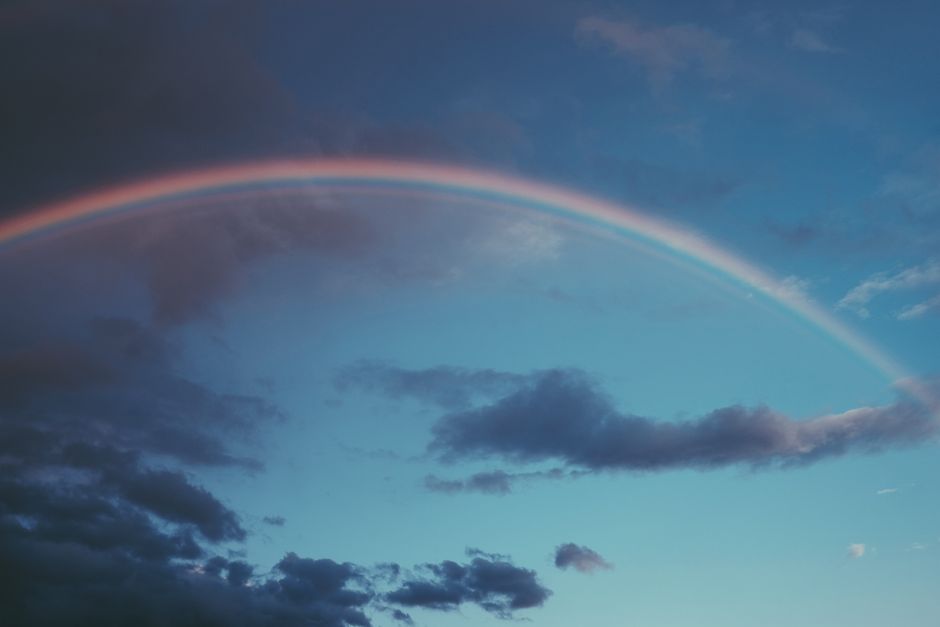
7 Surprising Facts About How Rainbows Form in the Sky
By TriviaOwl, Staff Writer — Published August 6, 2026
Table of Contents
- Key Takeaways
- Understanding How Rainbows Form in the Sky
- The Seven Surprising Facts
- The Physics Behind the Colors
- Beyond Water Droplets
- Frequently Asked Questions
Most of us stop in our tracks when a rainbow arcs across the sky after a rainstorm. These luminous bands of color seem almost magical, suspended in mid-air. But the truth about how rainbows form is even more fascinating than the myths we grew up believing. The science behind this everyday wonder involves precise angles, millions of water droplets acting as tiny prisms, and light behaving in ways that reveal the hidden spectrum always present in sunlight.
What you're seeing isn't actually "out there" in the sky at all—it's a personal light show created by the unique position of your eyes relative to the sun and rain. Ready to discover some amazing trivia that will change how you see rainbows forever?
Key Takeaways
- Rainbows are not physical objects but optical phenomena that appear at a specific angle of 42 degrees from the antisolar point.
- Every person sees their own unique rainbow because the light rays entering each observer's eyes come from different water droplets.
- Double rainbows feature reversed color order in the outer arc due to light reflecting twice inside water droplets.
- You can never reach the end of a rainbow because it moves with you, maintaining that constant 42-degree angle.
- Complete circular rainbows exist, though we typically see only the upper half from ground level.
- Rainbows can form from any water source, including waterfalls, garden sprinklers, and ocean spray.
Understanding How Rainbows Form in the Sky
The basic mechanics are straightforward but elegant. Sunlight enters a spherical raindrop and slows down as it moves from air into the denser water. This change in speed causes the light to bend—a process called refraction. White sunlight is actually composed of all visible colors, and each wavelength bends at a slightly different angle. Red light bends the least, violet the most.
Inside the droplet, light bounces off the back surface like a mirror. Then it exits the front of the droplet, bending again. This double refraction, combined with one internal reflection, separates white light into its component colors. The angle at which this colorful light exits the droplet is remarkably consistent: roughly 42 degrees from the line between the sun and your eye. That's why rainbows always appear in the same part of the sky relative to the sun's position.
Millions of raindrops create the full arc you see. Each droplet contributes just one color to your eye, but with countless droplets at varying heights, you perceive a continuous spectrum stretching across the sky.
The Seven Surprising Facts
1. No Two People Ever See the Exact Same Rainbow
Your rainbow is uniquely yours. Since rainbows appear at a specific angle from your line of sight to the sun, the water droplets creating the colors you see are different from those creating the rainbow for someone standing even a few feet away. Each observer's eyes receive light from their own set of droplets. Stand next to a friend during a rainbow, and you're both seeing different optical phenomena—though they look identical. This personal nature of rainbows means photographing "the same rainbow" from different positions actually captures light from entirely different water droplets.
2. Rainbows Are Actually Full Circles, Not Arcs
The rainbow you see from the ground is only half the story. Rainbows are complete circles centered on the antisolar point—the spot directly opposite the sun from your perspective. We typically see only the upper arc because the ground blocks the lower half. Pilots and passengers in aircraft, however, can witness circular rainbows, sometimes called "glory" rings when seen around the shadow of the plane on clouds below. Mountain climbers occasionally spot circular rainbows when looking down into misty valleys with the sun behind them. The geometry never changes; only your vantage point determines how much of the circle becomes visible.
3. You Can Never Reach a Rainbow's End
The pot of gold remains forever out of reach, and physics explains why. A rainbow isn't a physical object at a fixed location—it's an optical effect that exists only in relation to your position. As you move toward where the rainbow appears to touch the ground, the antisolar point moves with you, and so does the rainbow. The 42-degree angle between you, the water droplets, and the sun stays constant. You could chase a rainbow for miles and never get closer. It's similar to how you can't catch your own shadow. The rainbow is always the same angular distance away, making it impossible to reach by definition.
4. Double Rainbows Have Reversed Color Order for a Reason
When you spot a fainter, larger rainbow outside the primary arc, look closely at the colors. They're reversed—red on the inside, violet on the outside. This secondary rainbow forms when sunlight reflects twice inside water droplets instead of once. That extra reflection flips the light path, reversing the color sequence. The secondary rainbow appears at about 51 degrees from the antisolar point, roughly 9 degrees wider than the primary bow. The double reflection also causes more light to scatter and escape, which explains why secondary rainbows are dimmer. The dark band between the two rainbows, called Alexander's band, appears darker because less scattered light reaches your eyes from that region.
5. Rainbows Only Appear When the Sun Is Behind You and Below 42 Degrees
Timing and position matter. You must have the sun at your back and water droplets in front of you. But there's another constraint: the sun cannot be higher than 42 degrees above the horizon. Since rainbows appear at a 42-degree angle from the antisolar point, a sun higher than 42 degrees would place the rainbow below the horizon where you can't see it. This is why rainbows are most common in early morning or late afternoon. At midday in summer, the sun climbs too high in many locations, making rainbows impossible until evening. During winter, when the sun stays lower, rainbows can appear throughout more of the day.
6. Moonbows Are Real Rainbows Created by Moonlight
Rainbows don't require sunlight—any bright light source works. Moonbows, or lunar rainbows, form the same way as solar rainbows but use moonlight instead. They're rare because moonlight is much dimmer than sunlight, requiring a nearly full moon and very dark skies to be visible. Moonbows usually appear white or faintly colored to the human eye because our color-detecting cone cells need bright light to function. Camera sensors, more sensitive than human eyes, can capture the colors in long-exposure photographs. Famous moonbow locations include Yosemite Falls, Victoria Falls, and Cumberland Falls in Kentucky, where mist and darkness combine regularly after sunset.
7. Red Rainbows Occur During Sunrise and Sunset
Not all rainbows display the full spectrum. During sunrise or sunset, when the sun is very low on the horizon, its light travels through more atmosphere. Blue and green wavelengths scatter away, leaving predominantly red and orange light—the same effect that creates colorful sunrises and sunsets. When this reddened light enters water droplets, it produces a rainbow dominated by red, orange, and occasionally yellow hues, with the cooler colors absent or extremely faint. These monochromatic rainbows are less common but spectacular, casting an eerie, warm glow. They represent an interesting intersection of two optical phenomena: Rayleigh scattering and rainbow formation.
The Physics Behind the Colors
| Color | Wavelength (nanometers) | Refraction Angle | Position in Rainbow |
|---|---|---|---|
| Red | 620–750 | Smallest bend | Outer edge |
| Orange | 590–620 | Slight bend | Second from outer |
| Yellow | 570–590 | Moderate bend | Middle-outer |
| Green | 495–570 | Moderate bend | Middle |
| Blue | 450–495 | Greater bend | Middle-inner |
| Violet | 380–450 | Greatest bend | Inner edge |
The color sequence in a rainbow always follows the same order because it's determined by wavelength. Longer wavelengths (red) refract less than shorter wavelengths (violet). This consistent pattern is one reason rainbows have held such symbolic meaning across cultures—they're predictable, beautiful, and universal.
Beyond Water Droplets
While rain creates the most familiar rainbows, any suspended water droplets will do. Garden sprinklers produce miniature rainbows on sunny days. Waterfalls generate persistent rainbows in their mist, sometimes visible for hours. Ocean spray near coastlines can create rainbows when conditions align. Fountains, car washes, and even your garden hose held at the right angle can reveal these colorful arcs. The principle remains identical regardless of the water source: spherical droplets, backlit by a bright light, with an observer positioned to see the refracted light at the critical angle.
Frequently Asked Questions
Can you see a rainbow from space?
No, astronauts in orbit cannot see rainbows on Earth's surface because rainbows require the observer to be between the light source and the water droplets. From space, the sun and rain are not positioned correctly relative to the observer's eyes to create the necessary geometry.
Why do rainbows have seven colors?
Rainbows actually contain a continuous spectrum of colors blending into each other. The tradition of naming seven colors comes from Isaac Newton, who divided the spectrum into seven to match the seven notes of the musical scale. In reality, colors like indigo are difficult to distinguish, and many cultures recognize different numbers of rainbow colors.
Can rainbows appear without rain?
Yes, any airborne water droplets can create rainbows. Fog, mist from waterfalls, fountain spray, and even morning dew on grass can produce rainbow effects when sunlight hits at the proper angle. Rain is simply the most common source of the necessary suspended water droplets.
What is a triple rainbow?
Triple rainbows are extremely rare phenomena where a third, even fainter arc appears. They form when light reflects three times inside water droplets. The third arc appears on the same side of the sky as the sun, making it much harder to spot against the bright background. Only a handful of triple rainbow photographs have been scientifically verified.
Next time you spot a rainbow, remember you're witnessing a precise alignment of light, water, and geometry that's been creating wonder for as long as humans have looked at the sky. That shimmering arc isn't just beautiful—it's a visible demonstration of how light reveals the hidden colors always traveling alongside us, waiting for the right moment to split into their brilliant, individual wavelengths.