
Medusa Myth: The Hidden Meaning Behind the Snake Hair
By Trivia Daily, Staff Writer — Published October 2, 2026
Table of Contents
- Key Takeaways
- The Medusa Myth Hidden in Plain Sight: From Beauty to Beast
- Why Snakes? The Symbolism Behind the Serpents
- The Gorgoneion: Medusa as Protection
- Perseus and the Pattern of Conquest
- Modern Meanings: Reclaiming the Monster
- Frequently Asked Questions
Most people know Medusa as the monster with snakes for hair whose gaze could turn you to stone. But the Medusa myth hidden beneath this terrifying image reveals surprising layers of meaning that ancient Greeks understood far better than we do today. What began as a story about a beautiful woman transformed into a beast actually served as a complex symbol touching on themes of female power, protection, and the dangers of male desire. You might discover that this ancient tale contains more interesting facts about Greek culture than any straightforward history lesson.
The snake-haired Gorgon wasn’t always a villain in Greek mythology. Her image appeared on shields, temples, and city gates not to frighten citizens but to protect them. This curious contradiction opens the door to understanding what Medusa truly represented in the ancient world.
Key Takeaways
- Medusa was originally a beautiful mortal woman who served as a priestess in Athena’s temple before her transformation into a Gorgon
- Her snake hair and petrifying gaze symbolized both danger and protection in ancient Greek culture, making her image a powerful apotropaic charm
- The Medusa head, called a Gorgoneion, appeared throughout ancient Greece on shields, buildings, and coins as a protective talisman
- Snakes held dual meanings in Greek mythology, representing both death and rebirth, wisdom and danger
- Perseus’s slaying of Medusa follows a pattern of hero myths where male figures conquer powerful female entities
- Modern interpretations view Medusa as a symbol of female rage and victimhood transformed into dangerous power
The Medusa Myth Hidden in Plain Sight: From Beauty to Beast
According to the Roman poet Ovid’s version, Medusa started life as a stunning maiden with beautiful hair. She served as a priestess in the temple of Athena, goddess of wisdom and war. Poseidon, god of the sea, assaulted Medusa within Athena’s sacred temple. Rather than punishing Poseidon, Athena transformed Medusa into a creature so hideous that anyone who looked at her would turn to stone. Her lovely hair became a writhing mass of serpents.
This transformation reveals uncomfortable truths about ancient Greek attitudes toward women and victimhood. Medusa suffered punishment for being violated. Her beauty, which attracted unwanted attention, became weaponized into something that destroyed anyone who gazed upon her. The amazing paradox here is that Medusa simultaneously became more vulnerable—as a monster to be hunted—and more dangerous than ever before.
Why Snakes? The Symbolism Behind the Serpents
The Greeks didn’t choose snakes randomly. Serpents carried profound symbolic weight throughout ancient Mediterranean cultures. They represented death because of their venom. They symbolized rebirth because they shed their skin. They connected to the earth and underground realms, domains associated with female deities and mystery cults.
Snakes also guarded sacred spaces in Greek belief. The Athenian Acropolis housed a sacred serpent believed to protect the city. Temple complexes often kept live snakes as embodiments of protective spirits. By giving Medusa a crown of living serpents, the myth linked her to these guardian forces. Her hair didn’t just make her monstrous—it made her a living boundary marker between the safe and the forbidden.
The hissing, writhing snakes also evoked chaos and uncontrolled nature. Medusa embodied the wild, untamed feminine that Greek culture simultaneously feared and sought to contain through marriage, social rules, and mythology.
The Gorgoneion: Medusa as Protection
Here’s where the Medusa myth gets truly interesting. Despite being a monster, her image became one of ancient Greece’s most popular protective symbols. The Gorgoneion—a depiction of Medusa’s severed head—appeared everywhere in Greek art and architecture.
Warriors painted or embossed the Gorgoneion on their shields. The logic was simple but powerful: if Medusa’s face turned enemies to stone, her image might freeze attackers with fear. Temples displayed Gorgoneia on their pediments to ward off evil spirits and sacrilege. Even everyday objects like coins and pottery featured her face as an apotropaic charm—a device meant to avert evil.
This widespread use reveals a fascinating cultural belief. The same thing that endangered you could also protect you if properly controlled and displayed. Medusa’s severed head, once defeated by the hero Perseus, became a tool wielded by the righteous. Athena herself placed Medusa’s head on her shield, the Aegis, making the goddess even more formidable in battle.
Perseus and the Pattern of Conquest
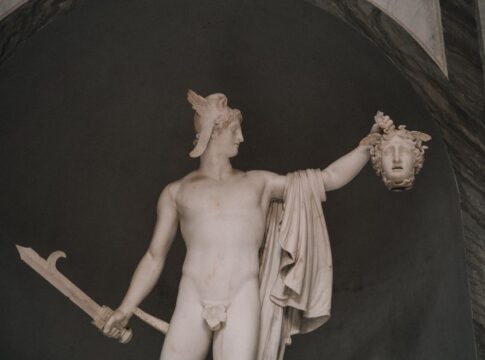
The hero Perseus killed Medusa by using his polished shield as a mirror, avoiding her direct gaze while he beheaded her. From her severed neck sprang Pegasus, the winged horse, and Chrysaor, a giant or warrior—both children of her assault by Poseidon. Even in death, Medusa remained productive, generating new mythical beings.
Perseus’s quest fits a broader pattern in Greek mythology where male heroes prove themselves by defeating powerful female figures or creatures. The Amazons, the Sphinx, the Harpies, and various monsters often had feminine characteristics. These myths reflected and reinforced cultural anxieties about female power and the need to control it.
Yet there’s an irony worth noting. Perseus couldn’t defeat Medusa through direct confrontation. He needed divine gifts: a mirrored shield from Athena, winged sandals from Hermes, and a cap of invisibility from Hades. Even with supernatural aid, he had to use cunning and avoid looking at her. The myth acknowledges that this female power, however monstrous, was genuinely formidable.
Modern Meanings: Reclaiming the Monster
Contemporary readers often reinterpret Medusa through different lenses. Feminist scholars view her as a victim of violence whose anger and pain became demonized. Her petrifying gaze represents the power of the female victim to make others confront uncomfortable truths—to freeze them with the reality of what was done to her.
The snakes become symbols of this transformation of pain into power. What was done to her couldn’t be undone, but it could be weaponized. Anyone attempting to victimize her again would face consequences. This reading makes Medusa less a monster and more a survivor who refuses to be looked at as merely an object.
Artists throughout history have wrestled with depicting Medusa. Some show her as terrifying, others as tragic, and some as both simultaneously. The 16th-century artist Caravaggio painted her severed head with an expression of shock and horror, making viewers confront the violence of her death rather than celebrating the hero’s triumph.
Frequently Asked Questions
Was Medusa born a monster or transformed into one?
In the most famous version by Ovid, Medusa was born a beautiful mortal woman and was transformed into a Gorgon as punishment after being assaulted by Poseidon in Athena’s temple. Earlier Greek sources sometimes describe her as born monstrous, making her one of three Gorgon sisters.
Why did Athena punish Medusa instead of Poseidon?
Ancient sources don’t provide a satisfying explanation, reflecting the patriarchal nature of Greek mythology where female victims often bore consequences for male violence. Some modern interpretations suggest Athena’s transformation gave Medusa defensive power, though this remains speculative.
What happened to Medusa’s head after Perseus killed her?
Perseus used Medusa’s severed head as a weapon, turning enemies to stone, before giving it to Athena. The goddess mounted it on her shield, the Aegis, where it remained as a permanent protective emblem and symbol of her power.
Were there other Gorgons besides Medusa?
Yes, Medusa had two immortal sisters named Stheno and Euryale who were also Gorgons with snake hair and petrifying gazes. Medusa was the only mortal Gorgon, which is why Perseus could kill her while her sisters remained alive and dangerous.
The enduring fascination with Medusa stems from her layered symbolism—victim and villain, beautiful and monstrous, dangerous and protective all at once. Those snakes writhing on her head continue to captivate us because they represent transformation itself, the way trauma and power can intertwine in ways that ancient Greeks understood might be more complex than simple monster stories suggest.