
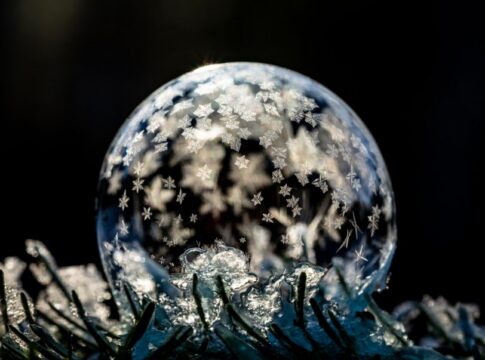
7 Strange Facts About How Snowflakes Form Unique Shapes
By Trivia Daily, Staff Writer — Published August 5, 2026
Table of Contents
- Key Takeaways
- How Strange Snowflakes Form: The Temperature-Shape Connection
- 1. Snowflakes Can Have Identical Twins
- 2. The Six-Sided Rule Has a Twelve-Sided Exception
- 3. Snowflakes Produce Measurable Sound When They Land
- 4. The Largest Snowflakes Were Dinner-Plate Sized
- 5. Snowflakes Can Form Without Clouds
- 6. Snowflake Branches Grow in Mathematical Harmony
- 7. Some Snowflakes Are Triangular, Not Hexagonal
- Snowflake Formation Across Different Conditions
- Frequently Asked Questions
Every winter, trillions of snowflakes drift from the sky, each one a miniature ice sculpture following rules we’re only beginning to understand. The popular saying that no two snowflakes are alike isn’t just poetic—it’s rooted in the astonishing physics of crystal formation. What’s truly surprising is that these delicate structures reveal strange facts about temperature, humidity, and molecular behavior that challenge our assumptions about how nature works. From snowflakes that form identical twins to crystals that grow in twelve-sided patterns, the process behind these winter wonders is far more curious than most people imagine.
The way strange snowflakes form involves a dance between water molecules and atmospheric conditions that creates an almost infinite variety of patterns. Scientists have studied ice crystal formation for centuries, yet new discoveries continue to emerge about why these tiny frozen structures behave so unpredictably.
Key Takeaways
- Snowflakes always have six sides or branches due to the hexagonal structure of ice molecules, but they can develop in countless variations.
- Temperature and humidity at different altitudes determine whether a snowflake becomes a column, plate, or needle shape.
- Identical twin snowflakes have been created in laboratory conditions, though finding natural duplicates remains nearly impossible.
- Some snowflakes can grow with twelve branches instead of six through a process called twinning.
- The largest snowflakes ever documented measured roughly fifteen inches across, formed when multiple crystals clumped together.
- Snowflakes make noise when they land, producing tiny acoustic signals that scientists can measure.
How Strange Snowflakes Form: The Temperature-Shape Connection
The shape of a snowflake depends almost entirely on the temperature and humidity it encounters during its journey through the clouds. Water vapor freezes onto a microscopic ice nucleus—often a speck of dust or pollen—and begins building outward. Between 32°F and 25°F, snowflakes tend to form thin plates. Drop the temperature to between 25°F and 18°F, and you’ll see columnar needles instead. Go even colder, between 18°F and 10°F, and plates return. This alternating pattern puzzled scientists for decades.
The phenomenon occurs because water molecules attach to ice surfaces differently depending on thermal energy. Warmer temperatures allow molecules to migrate across the crystal surface before locking into place, creating flat plates. Colder temperatures cause molecules to stick where they first land, building columns. A single snowflake might pass through multiple temperature zones as it falls, creating complex structures with both plate and column features. The Nakaya diagram, developed by Japanese physicist Ukichiro Nakaya in the 1930s, maps these temperature-shape relationships and remains a fundamental tool for understanding ice crystal formation.
1. Snowflakes Can Have Identical Twins
The notion that every snowflake is unique has been challenged by laboratory experiments. Physicist Kenneth Libbrecht at the California Institute of Technology has grown nearly identical snowflakes by controlling temperature and humidity with extreme precision. When two ice crystals form simultaneously in identical atmospheric conditions, they develop matching patterns branch by branch. The key word is “nearly”—at the molecular level, tiny imperfections still exist. But to the naked eye, these laboratory twins appear indistinguishable.
In nature, finding two identical snowflakes remains extraordinarily unlikely. Each crystal encounters billions of water molecules during formation, and the slightest variation in its path creates different growth patterns. A snowflake might tumble, changing which side receives more moisture. It might pass through a warmer pocket of air for a split second. These microscopic differences accumulate into visible uniqueness, making natural duplication functionally impossible despite being theoretically possible.
2. The Six-Sided Rule Has a Twelve-Sided Exception
Snowflakes famously have six-fold symmetry, a direct result of how water molecules bond in a hexagonal lattice. Oxygen atoms form the corners of hexagons, creating natural six-sided geometry. This isn’t random—it’s molecular architecture. Yet some snowflakes break this rule spectacularly by growing twelve branches instead of six.
These twelve-branched rarities form through a process called crystal twinning. Two separate ice crystals nucleate almost simultaneously and grow together at a 30-degree rotation from each other. The result looks like two six-pointed snowflakes overlaid, creating a twelve-pointed star. Researchers have documented these formations both in nature and in laboratory settings, though they remain uncommon. The conditions must be precisely right for two crystals to merge without disrupting each other’s growth patterns.
3. Snowflakes Produce Measurable Sound When They Land
Every snowflake generates acoustic signals as it settles, though the sound is far too quiet for human ears without amplification. Scientists studying snow acoustics have measured these tiny sonic signatures using sensitive microphones. When a snowflake contacts a surface, it releases a brief pulse of sound energy as its delicate structure compresses or breaks. Fresh snow landing on frozen ground creates a distinct acoustic profile different from snow falling on water or existing snowpack.
This phenomenon has practical applications. Researchers can analyze the acoustic characteristics of falling snow to determine crystal type, size, and accumulation rate without visual observation. The technique proves especially useful in whiteout conditions or darkness, when traditional snow measurement methods fail. Different snowflake shapes—needles versus plates versus columns—produce distinguishable sound patterns, essentially allowing scientists to “hear” what kind of snow is falling.
4. The Largest Snowflakes Were Dinner-Plate Sized
The Guinness World Records documents snowflakes measuring fifteen inches in diameter that fell at Fort Keogh, Montana, in 1887. These massive formations weren’t single crystals but rather aggregates—multiple snowflakes that stuck together during their descent. When atmospheric conditions create very light, fluffy crystals and temperatures hover near freezing, snowflakes become sticky. They collide and merge mid-air, sometimes forming clumps the size of your hand or larger.
True individual snowflake crystals rarely exceed half an inch across. The intricate branching patterns require extremely stable conditions to grow large without breaking. Strong winds, turbulence, or collisions with other crystals typically fracture delicate branches before they can reach impressive sizes. The largest confirmed single crystals measure around two to three inches in diameter, grown under perfect conditions of high humidity and gentle air currents.
5. Snowflakes Can Form Without Clouds
Most people associate snowflakes with clouds, but ice crystals can materialize directly from clear air under the right conditions. This phenomenon, called diamond dust, occurs when temperatures drop so low that water vapor in the air freezes instantly without first condensing into cloud droplets. The result is a sparkling mist of tiny ice crystals that shimmer in sunlight like suspended diamonds.
Diamond dust typically forms on extremely cold, calm days when temperatures fall below minus 20°F. The air must contain sufficient moisture and remain relatively still—wind disrupts the delicate formation process. These crystals are usually simpler than cloud-born snowflakes, often taking the form of small hexagonal plates or columns rather than elaborate dendritic structures. Arctic and Antarctic regions experience diamond dust regularly, while it remains rare in more temperate climates.
6. Snowflake Branches Grow in Mathematical Harmony
The six branches of a snowflake develop in remarkable synchronization, each mirroring the others despite being physically separate. This happens because all six arms experience nearly identical conditions simultaneously. As the snowflake falls and tumbles through the air, each branch encounters the same temperature and humidity at the same moment. When conditions favor rapid growth, all six branches extend together. When the snowflake passes through drier air, all six pause their growth simultaneously.
This synchronized development creates the intricate symmetry that makes snowflakes so visually striking. Minor differences do occur—no snowflake achieves perfect mathematical symmetry—but the overall pattern remains consistent across all branches. The phenomenon demonstrates how sensitive crystal growth is to environmental conditions. A change in humidity of just a few percent can alter the branching pattern, and because all six arms respond to that change together, they maintain their matching appearance throughout the crystal’s development.
7. Some Snowflakes Are Triangular, Not Hexagonal
While six-sided symmetry dominates snowflake geometry, triangular snow crystals do exist. These unusual formations develop when three of the six potential growth directions dominate while the alternating three remain suppressed. The result is a crystal with three prominent arms arranged 120 degrees apart, creating a triangular appearance rather than the familiar hexagonal star.
Triangular snowflakes form under specific temperature and supersaturation conditions that favor growth on alternating crystal faces. The phenomenon relates to subtle differences in how water molecules attach to different facets of the ice crystal. Certain atmospheric conditions make three of the six faces more receptive to growth than the others. These triangular crystals remain relatively rare compared to six-branched varieties, but researchers have documented and photographed numerous examples, confirming they’re a genuine variation rather than damaged hexagonal crystals.
Snowflake Formation Across Different Conditions
| Temperature Range | Humidity Level | Typical Crystal Shape | Common Features |
|---|---|---|---|
| 32°F to 25°F | High | Thin hexagonal plates | Broad, flat surfaces with minimal branching |
| 25°F to 18°F | Moderate to High | Needles and columns | Elongated structures, simple geometry |
| 18°F to 10°F | High | Plates with dendrites | Classic six-branched stars with intricate patterns |
| Below 10°F | Low to Moderate | Hollow columns | Prismatic shapes with hollow interiors |
Frequently Asked Questions
Why are snowflakes always six-sided?
Snowflakes have six-fold symmetry because water molecules naturally arrange themselves in hexagonal patterns when they freeze. The molecular structure of ice creates angles of 120 degrees between bonds, which produces six-sided geometry as the crystal grows outward from its center.
Can two snowflakes really be identical?
While extraordinarily unlikely in nature, scientists have created nearly identical snowflakes in controlled laboratory conditions. The vast number of molecular arrangements possible during natural formation makes finding natural duplicates essentially impossible, though not theoretically prohibited by physics.
What determines whether a snowflake will be simple or complex?
Temperature and humidity determine snowflake complexity. High humidity and temperatures around 5°F produce the most intricate dendritic patterns, while drier conditions or extreme cold create simpler columns and plates. The crystal’s path through varying atmospheric layers adds further complexity.
Do snowflakes form differently in different parts of the world?
Snowflakes follow the same physical principles everywhere, but regional climate patterns affect which types form most commonly. Arctic regions produce simpler crystals due to extreme cold and low humidity, while temperate zones with moisture-rich storms generate more elaborate branching patterns.
The next time snow falls, remember that each crystal carries a record of its journey through the atmosphere, written in ice. Those delicate branches didn’t form randomly—they’re frozen evidence of temperature shifts, humidity changes, and molecular physics playing out on a microscopic stage. Winter’s most common sight remains one of its most complex mysteries.