
Why Penguins Can Swim But Cannot Fly: The Evolution
By TriviaOwl, Animals Desk — Published August 4, 2026
Table of Contents
- Key Takeaways
- The Anatomical Trade-Off: Why Penguins Swim Cannot Fly
- From Sky to Sea: The Evolutionary Journey
- Masters of the Underwater World
- Diversity Among Flightless Species
- The Energy Economics of Evolution
- Frequently Asked Questions
Penguins are among the most distinctive birds on Earth, instantly recognizable by their tuxedo-like plumage and upright waddle. Yet these charismatic creatures have traded one of the most defining features of avian life—flight—for something entirely different. While most birds soar through the skies, penguins swim cannot fly at all, having evolved into underwater acrobats capable of “flying” through ocean waters at remarkable speeds. This evolutionary trade-off tells a fascinating story about adaptation, survival, and the remarkable flexibility of nature.
The transformation from flying bird to swimming specialist didn’t happen overnight. Over millions of years, penguins evolved in response to their environment, developing traits that made them supremely efficient hunters in cold, food-rich oceans. Understanding why penguins swim cannot fly requires exploring the anatomy, habitat, and evolutionary pressures that shaped these remarkable animals into the species we recognize today.
Key Takeaways
- Penguins evolved from flying ancestors but adapted their wings into rigid flippers optimized for underwater propulsion rather than flight.
- Dense, solid bones make penguins excellent divers but too heavy for flight, unlike the hollow bones found in flying birds.
- Penguin wings beat in a figure-eight pattern underwater, generating thrust similar to the mechanics used by flying birds in air.
- The evolutionary trade-off between swimming and flying occurs because the physical requirements for each ability are fundamentally incompatible.
- Some penguin species can swim at speeds exceeding 20 miles per hour and dive to depths of over 1,800 feet.
- All 18 recognized penguin species are flightless, ranging from the tiny Little Blue Penguin to the Emperor Penguin.
The Anatomical Trade-Off: Why Penguins Swim Cannot Fly
The answer to why penguins cannot fly lies in their anatomy. Flying requires lightweight bones, large wing surfaces relative to body weight, and powerful chest muscles that can flap wings rapidly through air. Penguins possess none of these traits. Instead, their bones are dense and solid, providing the weight necessary to counteract buoyancy when diving deep for fish, squid, and krill. This bone structure acts as natural ballast, helping them descend quickly and efficiently.
Their wings have transformed into stiff, flat flippers covered with scale-like feathers. These flippers cannot fold like a typical bird’s wing. They’re essentially fixed hydrofoils—rigid structures designed to slice through water with minimal drag. While a gull’s wing might measure ten times the width of its body when spread, a penguin’s flipper is compact and streamlined. The muscles that power these flippers are incredibly strong, comprising up to 30 percent of a penguin’s body weight, but they’re built for endurance swimming rather than the explosive power needed for takeoff.
The physics simply don’t support both abilities in one creature. Water is roughly 800 times denser than air, requiring completely different locomotion strategies. Wings optimized for air would be inefficient underwater, and flippers perfect for swimming would never generate enough lift to achieve flight. Evolution demanded a choice, and penguins chose the sea.
From Sky to Sea: The Evolutionary Journey
Penguins descended from flying seabirds that lived roughly 60 million years ago, not long after the extinction of the dinosaurs. Fossil evidence suggests that early penguin ancestors could fly, but as they adapted to exploit rich marine food sources in the Southern Hemisphere, they gradually became better swimmers and worse fliers. This transition likely occurred over millions of years, with each generation favoring traits that improved underwater hunting efficiency.
The environment played a crucial role. In the cold, nutrient-rich waters surrounding Antarctica and other southern regions, food was abundant beneath the waves but scarce on land. Birds that could dive deeper and swim faster had access to more prey. Those that spent energy maintaining flight capability were at a disadvantage compared to individuals who channeled all their resources into becoming aquatic specialists. Natural selection favored the swimmers.
Research comparing modern penguins with their closest flying relatives, such as petrels and albatrosses, reveals the dramatic physical changes that occurred. Flying seabirds have hollow, pneumatic bones filled with air sacs. Penguins have solid, heavy bones. Flying birds have asymmetrical feathers that create lift. Penguins have short, stiff feathers that reduce drag. Every aspect of penguin anatomy reflects their commitment to an aquatic lifestyle.
Masters of the Underwater World
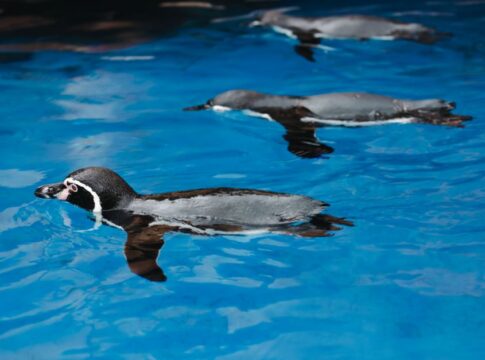
What penguins lost in aerial ability, they gained in aquatic prowess. These animals are phenomenal swimmers, using their wings to “fly” underwater with grace and speed that rivals many fish. The Gentoo Penguin holds the speed record among penguins, reaching velocities of approximately 22 miles per hour. Emperor Penguins can dive to depths exceeding 1,800 feet and hold their breath for over 20 minutes while hunting.
Their swimming technique resembles flight more than typical fish locomotion. Penguins beat their flippers in a figure-eight pattern, generating thrust on both the upstroke and downstroke—exactly how hummingbirds hover and how other birds fly. Their feet and tail act as rudders for steering, while their streamlined bodies minimize resistance. When penguins need extra speed, they employ a technique called porpoising, leaping out of the water repeatedly to breathe while maintaining momentum.
The underwater behavior of these creatures demonstrates remarkable adaptation. They can adjust their buoyancy by trapping air in their feathers before a dive, then releasing it gradually as they descend. Their eyes have adapted to see clearly both above and below water. Even their heart rate slows during deep dives, conserving oxygen for their brain and vital organs.
Diversity Among Flightless Species
All penguin species share the characteristic of flightlessness, but they vary dramatically in size, habitat, and behavior. The Emperor Penguin, the largest species, can stand nearly four feet tall and weigh up to 90 pounds. At the other extreme, the Little Blue Penguin measures just 13 inches tall and weighs about 2.2 pounds. Despite these differences, none can fly.
| Penguin Species | Height | Typical Diving Depth | Primary Habitat |
|---|---|---|---|
| Emperor Penguin | Up to 48 inches | 900–1,800 feet | Antarctic ice shelves |
| King Penguin | Up to 39 inches | 300–900 feet | Sub-Antarctic islands |
| Gentoo Penguin | Up to 35 inches | 150–650 feet | Antarctic Peninsula, sub-Antarctic |
| African Penguin | Up to 28 inches | 100–400 feet | Southern African coast |
| Little Blue Penguin | Up to 13 inches | 30–200 feet | Australia, New Zealand coasts |
Each species has adapted to its specific habitat and prey availability. African Penguins hunt in the warmer waters off South Africa and Namibia. Galápagos Penguins, the only species found north of the equator, survive in tropical conditions thanks to cold ocean currents. Yet whether they live in icy Antarctica or temperate coastal regions, all penguins share the fundamental inability to fly.
The Energy Economics of Evolution
Evolution operates on efficiency. Every trait an animal possesses requires energy to build and maintain. For seabirds that both fly and dive, like puffins or murres, there’s a constant compromise. These birds can do both activities, but they excel at neither. They expend enormous energy during flight because their bodies are heavier than purely aerial birds, and they’re less efficient swimmers than penguins because their wings must serve dual purposes.
Penguins eliminated this compromise entirely. By abandoning flight, they freed themselves from the constraints that limit diving birds. They could develop denser bones for deeper dives without worrying about becoming too heavy to fly. They could evolve powerful swimming muscles without concern for the weight penalty. They could adopt a body shape optimized purely for hydrodynamics. The result is an animal superbly adapted to its ecological niche, even if that meant sacrificing an ability most birds consider essential.
Frequently Asked Questions
Could penguins ever evolve to fly again?
While theoretically possible over millions of years, it’s highly unlikely. Penguins are so specialized for aquatic life that re-evolving flight would require reversing countless adaptations, and there’s no environmental pressure favoring such a change. Their current lifestyle is highly successful.
Are penguins the only flightless birds?
No, several bird species have lost the ability to fly, including ostriches, emus, cassowaries, and kiwis. However, penguins are unique among flightless birds for being specialized marine hunters. Most other flightless birds are terrestrial.
How fast can penguins swim compared to flying birds in air?
Penguins swim at speeds up to 22 miles per hour, which is relatively modest compared to birds in flight. However, water is much denser than air, making this achievement remarkable. Proportionally, penguins work much harder for their speed than flying birds do.
Do baby penguins ever try to fly?
Penguin chicks do not attempt flight. They’re born knowing they’re swimmers, and their instincts drive them toward water, not sky. Young penguins may flap their flippers while learning to swim, but this behavior is aquatic practice, not an attempt at flight.
The story of why penguins swim but cannot fly reveals evolution’s pragmatic approach to survival. These birds didn’t lose flight through some accident or misfortune—they traded it for something better suited to their environment. In the cold, food-rich waters of the Southern Hemisphere, wings became flippers, and the sky became irrelevant. Every penguin waddling across the ice or rocketing through the ocean depths is a living testament to the power of specialization and the endless creativity of natural selection.