




1 / 10 Questions
0 Points
Points won
0
Correct score
0%

More Questions

Ellis Island sits in the waters of which famous harbor?

Ellis Island sits in the waters of which famous harbor? Question 1: Ellis Island sits in the waters of which famous harbor? A. Upper New York...

11 Record-Breaking Facts About Redwood Trees Being Tallest

Redwood trees hold incredible height records that defy belief. Discover 11 fascinating facts about these towering giants and what makes them unique.

11 Strange Facts About Immortal Jellyfish Aging Backward

Immortal jellyfish can reverse their aging process and potentially live forever. Discover 11 bizarre facts about nature's most remarkable survival

More Articles

The Truth About Koalas Sleeping Twenty-Two Hours Daily

The Truth About Koalas Sleeping Twenty-Two Hours Daily

The Truth About Koalas Sleeping Twenty-Two Hours Daily

By Trivia Owl, Staff Writer — Published November 6, 2026

Table of Contents

Few animal facts capture our imagination quite like the claim that koalas sleep twenty-two hours every day. This fuzzy tidbit has spread across the internet, appearing in countless trivia lists and wildlife articles. But the truth about koalas sleeping habits is more nuanced than this catchy number suggests. While these iconic Australian marsupials do spend most of their time resting, the reality of their daily routine reveals fascinating adaptations to a unique dietary challenge.

Koalas don't actually sleep for twenty-two consecutive hours. Instead, they rest, doze, and engage in what scientists call "inactive behavior" for extended periods. This distinction matters when we explore the surprising biology behind their sedentary lifestyle.

Key Takeaways

  • Koalas rest or doze for 18 to 22 hours daily, though not all of this time qualifies as true sleep in the scientific sense.
  • Their low-energy lifestyle is a direct adaptation to their diet of eucalyptus leaves, which are toxic and nutritionally poor.
  • Eucalyptus leaves require enormous digestive effort, leaving koalas with minimal energy for other activities.
  • Koalas possess one of the smallest brain-to-body ratios among mammals, another energy-saving adaptation.
  • The exact amount of sleep varies by age, sex, and environmental conditions like temperature and food availability.
  • Wild koalas may be slightly more active than their zoo-dwelling counterparts due to the need to search for preferred eucalyptus species.

The Truth About Koalas Sleeping: Separating Rest from Sleep

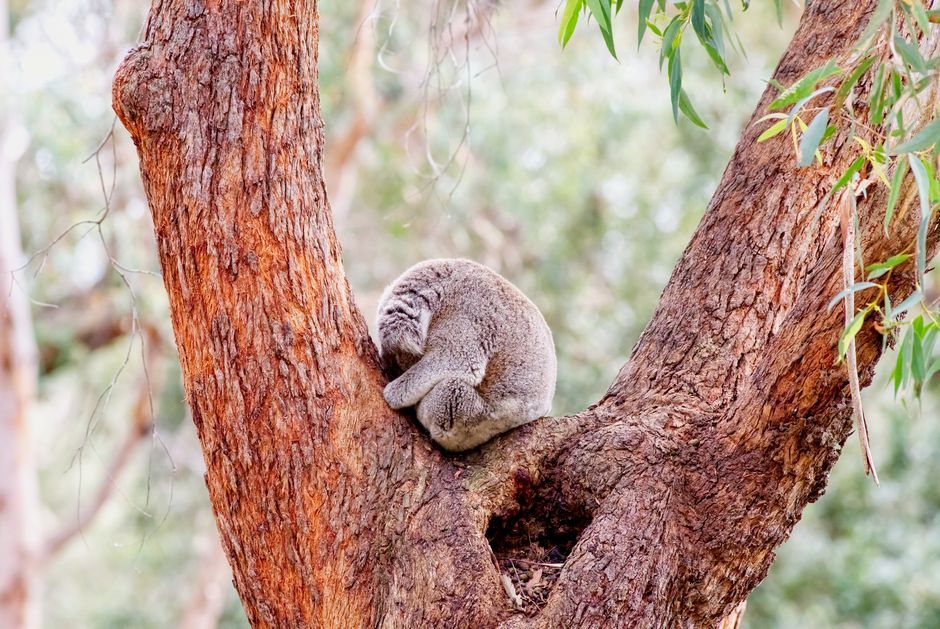
When researchers observe koalas in their natural habitat, they notice these marsupials remain motionless in tree forks for most of the day and night. The popular "twenty-two hours" figure represents total inactive time rather than deep sleep alone. Scientists distinguish between different states of rest. True sleep involves specific brain wave patterns and physiological changes. Koalas also spend considerable time in lighter dozing states or simply sitting still with eyes open, conserving energy without fully sleeping.

Studies using behavioral observation have found that koalas typically sleep between 14 and 18 hours daily, with the remaining inactive hours spent in restful wakefulness. The variation depends on individual koalas, seasonal changes, and environmental factors. During cooler weather, koalas may rest more to conserve body heat. In warmer conditions, they seek shaded positions in tree canopies and remain still to avoid overheating.

Why Eucalyptus Leaves Demand So Much Rest

The koala's extreme sedentary lifestyle makes perfect sense when you examine their diet. Eucalyptus leaves are among the least nutritious foods any mammal regularly consumes. These leaves contain high amounts of indigestible fiber, very little protein, and toxic compounds called terpenes and phenolic acids that most animals cannot tolerate. Koalas have evolved specialized digestive systems to process this challenging food source, but the effort comes at a steep metabolic cost.

A koala's digestive tract includes an exceptionally long cecum—a specialized organ where bacteria ferment the fibrous eucalyptus material. This fermentation process extracts whatever nutrients exist in the leaves, but it's incredibly slow and energy-intensive. The entire digestive process can take over 100 hours for a single meal to pass through completely. During this time, the koala's body dedicates tremendous resources to breaking down toxins and extracting minimal calories.

The energy yield from eucalyptus is so low that koalas must budget every calorie. They've evolved one of the slowest metabolic rates among mammals, operating at roughly half the rate expected for an animal of their size. This metabolic slowdown means less energy for movement, brain function, and other activities. Resting becomes not a luxury but a biological necessity.

Comparing Sleep Patterns Across Species

Animal Average Daily Sleep Primary Reason
Koala 14-18 hours (plus 2-4 hours resting) Low-energy diet, toxic food processing
Brown Bat 19-20 hours High metabolic rate requires recovery time
Giant Armadillo 18-19 hours Energy conservation, nocturnal hunting
Sloth 15-18 hours Low-energy diet of leaves
Human 7-9 hours Brain maintenance, memory consolidation
Giraffe 4-5 hours Predator vigilance, feeding time needs

The Koala Brain: Small by Design

One of the most interesting facts about koala biology relates to their brains. Relative to body size, koalas have unusually small brains—among the smallest brain-to-body ratios of any mammal. The brain accounts for only about 0.2% of their body weight, compared to roughly 2% in humans. Even more curious, the koala brain doesn't fill its entire skull cavity. It's surrounded by cerebrospinal fluid in a space that, in their ancestors, likely housed a larger brain.

This reduced brain size represents another energy-saving adaptation. Brain tissue is metabolically expensive, consuming significant calories even at rest. By maintaining a smaller brain, koalas reduce their baseline energy requirements. They retain sufficient cognitive function for their lifestyle—recognizing preferred eucalyptus species, navigating their home ranges, and managing social interactions—while minimizing the metabolic burden.

Myths and Misconceptions About Koala Behavior

The twenty-two-hour sleep claim isn't the only misconception about koalas. Many people believe koalas are constantly intoxicated or "drunk" on eucalyptus, explaining their sluggish behavior. This is false. While eucalyptus does contain compounds that affect the central nervous system, koalas have evolved mechanisms to process these safely. Their lethargy stems from energy conservation, not intoxication.

Another common myth suggests koalas never drink water, getting all moisture from eucalyptus leaves. The name "koala" allegedly derives from an Aboriginal word meaning "no drink." While koalas do obtain most of their water from leaves, they will drink from streams and other water sources, especially during droughts or heat waves. Researchers have documented this behavior more frequently in recent years as climate patterns shift.

Some people also assume koalas are bears, leading to the incorrect term "koala bear." Koalas are marsupials, more closely related to kangaroos and wombats than to any bear species. This confusion likely arose from their rounded, bear-like appearance and the tendency of early European settlers to describe unfamiliar Australian animals using familiar terms.

Frequently Asked Questions

Do koalas really sleep 22 hours a day?

Koalas rest or remain inactive for 18 to 22 hours daily, but they actually sleep for approximately 14 to 18 hours. The remaining inactive time is spent in restful wakefulness or light dozing rather than true sleep.

Why do koalas sleep so much compared to other animals?

Koalas sleep extensively because their diet of eucalyptus leaves provides very little energy and requires enormous digestive effort to process. Their bodies conserve every possible calorie by minimizing activity and maintaining an exceptionally slow metabolism.

Are baby koalas as sleepy as adults?

Young koalas, called joeys, are generally more active than adults as they explore their environment and learn which eucalyptus species to eat. However, they still rest considerably more than most young mammals due to their developing digestive systems and low-energy diet.

Do koalas in zoos sleep more than wild koalas?

Zoo koalas may rest slightly more than wild individuals because they don't need to search for food or navigate territories. Wild koalas must occasionally move between trees to find preferred eucalyptus leaves, adding a few extra active hours to their routine.

The next time you hear that koalas sleep twenty-two hours daily, you'll know there's more to the story. These remarkable marsupials have evolved an entire lifestyle around processing one of nature's least rewarding food sources, turning extreme rest into an elegant survival strategy. Their sleepy reputation isn't wrong—it's just wonderfully more complex than a single number suggests.
Top 10 Legendary Weapons

Top 10 Legendary Weapons

⏱️ 7 min read

Top 10 Legendary Weapons from Myths and Legends

Throughout human history, tales of mighty warriors and their extraordinary weapons have captivated imaginations across cultures. These legendary arms were not mere tools of war, but symbols of divine power, righteous authority, and heroic destiny. From the Norse realms to the courts of Camelot, from ancient Greece to feudal Japan, these weapons have transcended their physical forms to become enduring icons of mythology and folklore. This article explores ten of the most renowned legendary weapons that have shaped our collective mythological heritage and continue to inspire storytellers today.

1. Excalibur - The Sword of King Arthur

Perhaps no weapon in Western mythology is more iconic than Excalibur, the legendary sword of King Arthur. According to British legend, this magnificent blade was either pulled from a stone to prove Arthur's rightful claim to the throne or given to him by the mystical Lady of the Lake. Excalibur was said to possess a blade that could cut through any armor and a scabbard that prevented its bearer from bleeding, no matter how grievous their wounds. The sword represented divine kingship and the rightful rule of Britain, and its eventual return to the lake symbolized the end of Arthur's reign and the passing of an age of chivalry.

2. Mjölnir - Thor's Hammer

In Norse mythology, Mjölnir stands as one of the most powerful weapons ever created. Forged by the dwarf brothers Brokkr and Sindri, this hammer belonged to Thor, the god of thunder. Mjölnir could level mountains, was capable of returning to Thor's hand after being thrown, and could shrink to be carried inside his shirt. The hammer symbolized protection, consecration, and the power to both destroy and restore. Its distinctive short handle, the result of Loki's interference during its creation, became its identifying feature. Mjölnir was so heavy that only Thor could wield it, aided by his belt of strength and iron gloves.

3. Kusanagi-no-Tsurugi - The Grass-Cutting Sword

One of three Imperial Regalia of Japan, Kusanagi-no-Tsurugi holds profound significance in Japanese mythology. According to legend, the storm god Susanoo discovered the sword in the tail of the eight-headed serpent Yamata no Orochi after slaying the beast. The weapon later saved the warrior prince Yamato Takeru when enemies trapped him in a field and set it ablaze; using the sword, he cut down the grass and turned the fire back upon his attackers, thus earning its name. The blade represents valor and legitimacy in Japanese imperial succession and is said to be housed at Atsuta Shrine, though no one has seen it in centuries.

4. Gungnir - Odin's Spear

Gungnir, the spear of Odin, the All-Father of Norse mythology, was another masterwork created by the sons of Ivaldi, skilled dwarf craftsmen. This legendary weapon never missed its target and was said to be so sacred that oaths sworn upon it could never be broken. Inscribed with runes that gave it magical properties, Gungnir symbolized Odin's authority over gods and men alike. The spear was so perfectly balanced that it could strike any target regardless of the wielder's skill, and when thrown, it would fly over the heads of enemy armies, magically determining the outcome of battles.

5. Trident of Poseidon

The three-pronged spear wielded by Poseidon, Greek god of the seas, was an instrument of tremendous power over water and earthquakes. With this legendary trident, Poseidon could command the waves, summon storms, create springs from solid rock, and cause earthquakes by striking the ground. The weapon represented dominion over all aquatic realms and symbolized the unpredictable, sometimes destructive nature of the sea itself. In Roman mythology, Neptune wielded an equivalent weapon with similar properties. The trident's three prongs have been interpreted variously as representing the three properties of water or the three divisions of the world: sky, sea, and earth.

6. Sharur - The Smasher of Thousands

From ancient Sumerian and Akkadian mythology comes Sharur, the enchanted talking mace of Ninurta, the god of war and hunting. What made Sharur unique among legendary weapons was its intelligence and independence; it could speak, fly through the air, and scout enemy positions before battles. The weapon served as both counselor and warrior to its divine master, offering advice and then carrying out devastating attacks. Sharur could transform its shape and possessed the ability to pulverize mountains, earning its fearsome epithet. This weapon represents one of the earliest examples of a sentient magical artifact in recorded mythology.

7. Gáe Bulg - The Spear of Cú Chulainn

In Irish mythology, the hero Cú Chulainn wielded Gáe Bulg, a spear made from the bones of a sea monster. This weapon had a particularly gruesome characteristic: upon entering an opponent's body, it would extend multiple barbs throughout the victim, making removal impossible without causing fatal injuries. The spear could only be used in a specific manner, cast from the fork of the toes while in water, and was given to Cú Chulainn by his martial arts teacher, the warrior woman Scáthach. The weapon's name translates roughly to "spear of mortal pain" or "notched spear," and it never failed to kill its target, making it one of the most feared weapons in Celtic legend.

8. Durendal - The Sword of Roland

Featured in the French epic "The Song of Roland," Durendal was the legendary sword of the paladin Roland, who served Charlemagne. The blade was said to contain within its golden hilt four holy relics: a tooth of Saint Peter, blood of Saint Basil, hair of Saint Denis, and a piece of the Virgin Mary's clothing. These sacred objects made Durendal indestructible and gave it incredible sharpness. When Roland was dying at the Battle of Roncevaux Pass, he attempted to destroy the sword to prevent it from falling into enemy hands, but despite his strikes against solid rock, the blade remained intact, cutting through the stone instead.

9. Gandiva - Arjuna's Divine Bow

In Hindu mythology, Gandiva was the celestial bow wielded by the hero Arjuna in the epic Mahabharata. Created by Brahma himself, this bow was later given to Arjuna by the fire god Agni. Gandiva possessed inexhaustible arrows and could fire one hundred arrows in a single shot. The bow's string created a sound that terrified enemies and demoralized opposing armies. It made Arjuna virtually invincible in battle and represented his role as the greatest archer in the world. The bow was so powerful that ordinary warriors could not even string it, let alone draw and fire it effectively.

10. Harpe - The Sword of Perseus

Harpe was the adamantine sword given to the Greek hero Perseus by Zeus or Hermes to slay the Gorgon Medusa. This sword had a distinctive sickle-like or curved shape that allowed it to behead Medusa in a single stroke. The blade was later used by Perseus to rescue Andromeda from the sea monster Cetus. In some versions of Greek mythology, this same weapon was used by the god Cronus to castrate his father Uranus, demonstrating its ability to harm even immortal beings. The unique curved design of Harpe made it ideal for hooking and slashing attacks, setting it apart from traditional straight-bladed swords of Greek warfare.

Conclusion

These ten legendary weapons represent far more than instruments of destruction; they embody the values, fears, and aspirations of the cultures that created their stories. From Excalibur's representation of rightful sovereignty to Mjölnir's protective power, from the divine craftsmanship of Gungnir to the sacred relics within Durendal, each weapon carries deep symbolic meaning. These artifacts appear in tales of cosmic battles, heroic quests, and divine intervention, serving as focal points for some of humanity's greatest stories. Whether used by gods, heroes, or legendary warriors, these weapons have transcended their mythological origins to become enduring symbols in literature, art, and popular culture, continuing to capture imaginations thousands of years after their stories were first told.