
9 Bizarre Facts About Zombie Ants and Fungus Control
By Trivia Daily, Staff Writer — Published September 25, 2026
Table of Contents
- Key Takeaways
- The Bizarre Zombie Ants Begin Their Final Journey
- Nine Astonishing Discoveries About Fungal Mind Control
- Comparing Zombie Ant Fungi Species
- The Chemical Warfare Behind Behavioral Manipulation
- Frequently Asked Questions
Deep in tropical rainforests, a horror story unfolds daily. Carpenter ants march to their doom, compelled by a parasitic fungus that hijacks their nervous systems and turns them into mindless marionettes. These bizarre zombie ants have captivated scientists for over a century, revealing one of nature’s most astonishing examples of mind control. The Ophiocordyceps fungus doesn’t just kill its host—it rewrites the ant’s entire behavioral code, forcing it to climb, bite, and position itself perfectly for the fungus’s reproductive success.
What makes this relationship truly fascinating isn’t just the macabre spectacle, but the precision involved. Every step in this parasitic takeover has evolved over millions of years into a finely-tuned biological weapon. Let’s explore the strange science behind these infected insects and discover why researchers find them so captivating.
Key Takeaways
- Ophiocordyceps fungi hijack carpenter ant behavior, forcing them to climb vegetation and bite down before death
- The fungus avoids infecting the ant’s brain directly, instead controlling muscles through external manipulation
- Infected ants bite down with roughly six times the normal force, locking themselves in place permanently
- Fossil evidence shows this parasitic relationship existed at least 48 million years ago
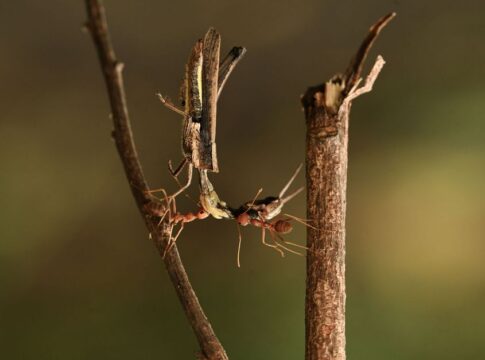
- Healthy ants recognize infected individuals and carry them far from the colony to prevent spread
- The fungus is species-specific, with different Ophiocordyceps strains targeting different ant species
The Bizarre Zombie Ants Begin Their Final Journey
When an Ophiocordyceps spore lands on a carpenter ant, it penetrates the exoskeleton and begins spreading through the body. Within days, the ant’s behavior changes dramatically. It abandons its normal foraging patterns and routine tasks within the colony. The infected ant becomes a wanderer, leaving the safety of its nest during daylight hours—unusual for nocturnal species.
The most striking change occurs in the final hours. The ant climbs vegetation to a height of roughly 25 centimeters above the forest floor, precisely where temperature and humidity create ideal conditions for fungal growth. This isn’t random wandering. The fungus has evolved to manipulate its host with surgical precision, ensuring optimal reproductive conditions. The ant then locks its mandibles onto a leaf vein or twig on the underside of a leaf, creating what researchers call the “death grip.”
Within hours of this final bite, the ant dies. But the fungus is just beginning its work. Over the next two weeks, it consumes the ant’s internal tissues while growing a stalk that erupts through the back of the head. This fruiting body releases spores that rain down onto the forest floor below, where other ants forage, continuing the cycle.
Nine Astonishing Discoveries About Fungal Mind Control
1. The Fungus Never Actually Infects the Brain
Scientists once assumed the fungus invaded the ant’s brain to control behavior. Research has revealed something far stranger. The Ophiocordyceps fungus forms a network throughout the ant’s body, wrapping around muscle fibers and connecting individual fungal cells into a coordinated web. The brain remains relatively untouched. Instead, the fungus appears to control muscles directly, essentially turning the ant into a puppet operated by fungal strings. This discovery challenges assumptions about how parasites manipulate host behavior.
2. The Death Grip Uses Six Times Normal Biting Force
When an infected ant clamps down on vegetation in its final act, it bites with extraordinary force—approximately six times stronger than a normal ant bite. This hypercontraction of jaw muscles creates a lock so tight that the ant’s mandibles leave permanent damage marks on leaves. Even after death and decomposition, the ant’s head often remains attached to the vegetation. This ensures the fungus stays positioned exactly where it needs to be for optimal spore dispersal, even as tropical rains and winds batter the forest.
3. Healthy Ants Have Evolved Sophisticated Defenses
Carpenter ant colonies don’t sit idle while this threat lurks. Workers can recognize infected nestmates, likely through chemical or behavioral cues. When they detect an infected individual, they perform a remarkable act of colony hygiene: they carry the zombie ant far away from the nest before it can complete its fatal climb. Some colonies also groom each other intensively, potentially removing spores before they penetrate the exoskeleton. This creates an evolutionary arms race between fungal infection strategies and ant defensive behaviors.
4. The Relationship Is Ancient Beyond Imagination
Fossilized leaves from the Messel Pit in Germany preserve evidence of this parasitic relationship dating back approximately 48 million years. The fossils show the characteristic bite marks and positioning that match modern zombie ant behavior exactly. This means Ophiocordyceps has been perfecting its mind-control techniques since before the Himalayas formed. The relationship predates the evolution of many modern mammal groups, revealing just how successful this strategy has been across geological time scales.
5. Each Fungus Species Targets Specific Ant Species
The Ophiocordyceps genus contains hundreds of species, and each typically infects only one or a few closely-related ant species. This specificity suggests highly specialized evolutionary adaptations. A fungus that zombifies one carpenter ant species cannot successfully infect another species living in the same forest. Researchers believe this specialization relates to the precise chemical and mechanical techniques needed to manipulate each host species’ unique physiology. The lock-and-key relationship between parasite and host demonstrates evolution’s capacity for extreme refinement.
6. Temperature and Humidity Must Be Perfect
The fungus manipulates its host to die at a very specific microclimate. The undersides of leaves roughly 25 centimeters above the forest floor maintain temperature around 20-30 degrees Celsius with humidity near 95 percent. Too high, and the fungus desiccates. Too low, and competing microorganisms outcompete it. This precision explains why zombie ants are primarily found in tropical rainforests where these conditions exist consistently. Climate change potentially threatens this delicate balance, though researchers are still studying the implications.
7. The Fungus Synchronizes Infections Across Colonies
In some regions, infected ants perform their death climbs at roughly the same time, creating graveyards of zombie ants clustered in small areas. This synchronization may help the fungus overwhelm ant colony defenses through sheer numbers. When many ants become infected simultaneously, healthy workers cannot remove all the zombies before they reach their death positions. This mass infection strategy increases the likelihood that spores will find new hosts, demonstrating a population-level adaptation beyond individual host manipulation.
8. Other Fungi Parasitize the Zombie Ant Fungus
Nature contains layers upon layers of parasitism. A hyperparasitic fungus called Ophiocordyceps myrmecophila infects Ophiocordyceps unilateralis, the zombie ant fungus itself. This hyperparasite prevents the zombie ant fungus from reproducing, essentially castrating it. The hyperparasite may help regulate zombie ant fungus populations, preventing them from devastating ant colonies entirely. This creates a three-way relationship between ants, their fungal parasites, and the parasites of those parasites—a reminder that ecosystems contain hidden complexity at every scale.
9. Compounds From These Fungi Show Medical Promise
Researchers have isolated numerous bioactive compounds from Ophiocordyceps species, some showing potential as antibiotics, immunosuppressants, and anti-cancer agents. The same chemical sophistication that allows these fungi to hijack ant nervous systems may provide tools for human medicine. While the zombie ant species themselves receive less attention than their medicinal cousins (like Ophiocordyceps sinensis, used in traditional Chinese medicine), they represent an untapped reservoir of complex molecules shaped by millions of years of evolutionary refinement.
Comparing Zombie Ant Fungi Species
| Fungus Species | Primary Host | Geographic Range | Death Position Height |
|---|---|---|---|
| Ophiocordyceps unilateralis | Camponotus leonardi | Southeast Asian rainforests | 25 cm above ground |
| Ophiocordyceps kimflemingiae | Camponotus castaneus | Southeastern United States | 10-30 cm above ground |
| Ophiocordyceps kniphofioides | Camponotus species | Tropical Americas | 20-40 cm above ground |
| Ophiocordyceps lloydii | Various Camponotus | Japan, eastern Asia | 15-25 cm above ground |
The Chemical Warfare Behind Behavioral Manipulation
How exactly does a fungus rewrite an ant’s behavioral programming? Researchers have identified several mechanisms. The fungus produces specialized metabolites that likely interfere with neurotransmitters, the chemical messengers that coordinate muscle movements. By flooding the ant’s body with these compounds, the fungus can trigger specific behaviors at specific times.
The precision is remarkable. The fungus must keep the ant alive and mobile during the journey to the death site, then trigger the death grip at exactly the right moment and location. Too early, and the ant dies in the wrong place. Too late, and the ant might be removed by nestmates. This requires the fungus to essentially “read” environmental cues through the ant’s sensory organs and respond accordingly—a feat of biological engineering that scientists are still working to fully understand.
Frequently Asked Questions
Can zombie ant fungi infect humans or other animals?
No. Ophiocordyceps species that infect ants are highly specialized and cannot infect humans, pets, or other mammals. Each fungus species has evolved to exploit the specific biology of its host ant species over millions of years.
Do zombie ants suffer during the infection?
Scientists cannot measure subjective experience in insects, but infected ants show no obvious signs of distress beyond altered behavior. The fungus likely manipulates the ant’s nervous system in ways that don’t trigger pain responses, as a suffering host would be less effective at completing the journey to the optimal death site.
Are zombie ant fungi dangerous to ant populations?
While dramatic at the individual level, these fungi typically don’t threaten entire ant populations. Healthy colonies have evolved effective defenses, and the fungi themselves may be regulated by hyperparasites and environmental factors that prevent unchecked spread.
Where can you observe zombie ants in nature?
Zombie ants are most common in tropical rainforests of Southeast Asia, Central and South America, and parts of Africa. They require specific humidity and temperature conditions found in these regions. Some species also occur in temperate forests with suitable microclimates.
The next time you walk through a forest, consider the invisible battles unfolding beneath your feet. Millions of years of evolutionary refinement have created these bizarre interactions, reminding us that nature’s creativity extends far beyond what we typically notice. The zombie ants march on, controlled by masters they can neither see nor resist.