
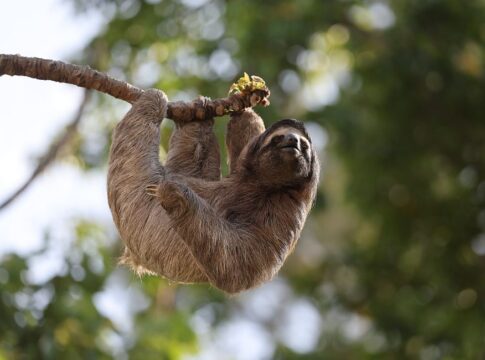
Why Sloths Move So Slowly: The Hidden Survival Strategy
By Trivia Daily, Animals Desk — Published August 4, 2026
Table of Contents
- Key Takeaways
- Why Sloths Move Slowly: The Metabolic Masterplan
- Invisibility Through Stillness: Avoiding Predators
- Comparing Sloth Species: Two-Toed vs. Three-Toed
- The Weekly Journey: Why Sloths Risk Ground Travel
- Energy Conservation: A Full-Body Adaptation
- Frequently Asked Questions
Watching a sloth in the wild feels like viewing life in extreme slow motion. These tree-dwelling mammals move so gradually that algae grows on their fur, turning them greenish. But here’s the surprising truth: sloths move slowly not because they’re lazy or weak, but because it’s one of the most effective survival strategies in the animal kingdom. Their glacial pace is actually a sophisticated energy-conservation system that has kept these creatures thriving for millions of years.
The slow-motion lifestyle of sloths is intimately connected to their unique digestive system and the nutrient-poor leaves they consume. Unlike most mammals that can quickly extract energy from food, sloths have evolved to survive on a diet that would starve most other animals. Their deliberate movements aren’t a disadvantage—they’re the key to their success in the rainforest canopy.
Key Takeaways
- Sloths have the slowest metabolism of any mammal, processing food so slowly that a single meal can take up to a month to digest completely.
- Their slow movement makes them nearly invisible to predators like harpy eagles and jaguars, which hunt primarily by detecting motion.
- Sloths consume only 160 calories per day on average, less than a single candy bar provides to humans.
- These animals sleep 15 to 20 hours daily and move at a top speed of roughly 0.17 miles per hour through trees.
- The algae growing on sloth fur provides camouflage and may even supply additional nutrients when groomed and ingested.
- Sloths descend from trees only about once per week to defecate, making them vulnerable during these rare ground visits.
Why Sloths Move Slowly: The Metabolic Masterplan
The answer to why sloths move so slowly begins in their stomach. These remarkable creatures survive almost entirely on leaves, which are notoriously difficult to digest and provide minimal nutritional value. To extract every possible calorie from this poor-quality diet, sloths have developed the slowest metabolic rate of any mammal on Earth. Their multi-chambered stomach hosts bacteria that ferment leaves over weeks, breaking down the tough cellulose that other animals can’t process.
This ultra-slow metabolism means sloths simply don’t have energy to burn. Their body temperature fluctuates more than typical mammals, sometimes dropping to match their surroundings—a trait more common in reptiles than warm-blooded creatures. By moving deliberately and sleeping most of the day, sloths conserve the minimal energy their leafy diet provides. It’s biological efficiency at its finest.
The species has essentially traded speed for sustainability. While a monkey might burn through calories quickly by leaping between branches, a sloth hangs in place, barely moving, requiring a fraction of the food. In an environment where nutritious food can be scarce, this strategy is brilliant. Sloths don’t compete with faster animals for high-energy fruits or protein-rich insects. They’ve carved out a niche where being slow is actually advantageous.
Invisibility Through Stillness: Avoiding Predators
Speed isn’t the only way to escape predators—sometimes the best defense is not being noticed at all. Sloths have mastered the art of camouflage through inactivity. Predators like harpy eagles and big cats rely heavily on movement to spot prey in the dense rainforest. A sloth hanging motionless in the canopy, covered in greenish algae, becomes virtually indistinguishable from the surrounding foliage.
This passive defense system works remarkably well. Studies of sloth behavior in their natural habitat show that remaining still dramatically reduces predation rates. When sloths do move, they do so with calculated deliberation, never making sudden gestures that might catch a predator’s eye. Even their facial expressions are limited—sloths lack the facial muscles for varied expressions, which further reduces detectable movement.
The algae growing in their fur enhances this camouflage effect. The greenish tint helps sloths blend seamlessly with moss-covered branches and leaves. Some researchers believe sloths may even cultivate this algae deliberately, as it provides both concealment and possibly supplemental nutrition when the sloth grooms itself.
Comparing Sloth Species: Two-Toed vs. Three-Toed
| Characteristic | Three-Toed Sloths | Two-Toed Sloths |
|---|---|---|
| Number of Species | Four species | Two species |
| Activity Pattern | Diurnal (day-active) | Nocturnal (night-active) |
| Diet Flexibility | Strict leaf-eaters | Eat fruits, insects, and leaves |
| Speed | Slower overall | Slightly faster |
| Tail | Small visible tail | No visible tail |
The Weekly Journey: Why Sloths Risk Ground Travel
One of the strangest behaviors in the animal kingdom is the sloth’s weekly descent to the forest floor. Despite being helpless on the ground and moving at their slowest, sloths climb down from the safety of the canopy approximately once per week to defecate at the base of their tree. This behavior has puzzled scientists for decades because it seems unnecessarily dangerous.
Several theories attempt to explain this risky ritual. The most compelling suggests that by fertilizing the base of their home tree, sloths improve the quality of the leaves they depend on. Another theory proposes that this behavior helps maintain the ecosystem of moths and beetles that live in sloth fur, which in turn support the algae growth. The moths lay eggs in the sloth’s dung, and when the larvae mature, they fly up to colonize the sloth’s fur.
Whatever the reason, this weekly ground visit represents the most vulnerable moment in a sloth’s life. Roughly half of all sloth deaths occur during these bathroom trips, when they’re exposed to ground predators and unable to escape quickly. Yet the behavior persists, suggesting it provides benefits that outweigh the considerable risks.
Energy Conservation: A Full-Body Adaptation
Every aspect of sloth anatomy supports their low-energy lifestyle. Their muscle mass is approximately half that of other mammals of similar size, reducing the energy needed for basic maintenance. Sloths have unusually long arms and curved claws that allow them to hang from branches with minimal muscular effort—they can remain suspended even while sleeping or after death.
Temperature regulation in sloths is equally unusual. Unable to generate much body heat through metabolism, they rely on behavioral thermoregulation. Sloths bask in sunny patches when they need warmth and retreat to shade when overheated. This reptilian approach to temperature control saves enormous amounts of energy compared to the constant internal heating most mammals maintain.
Even their digestive system reflects extreme energy conservation. The multi-chambered stomach can comprise up to 30 percent of a sloth’s body weight when full, slowly fermenting leaves over weeks. This patient approach extracts maximum nutrition from minimum-quality food, allowing sloths to thrive where faster, hungrier animals would starve.
Frequently Asked Questions
How slow do sloths actually move?
Sloths move at approximately 0.17 miles per hour when traveling through trees, and even slower on the ground at about 0.15 miles per hour. They typically cover less than 40 yards per day, making them one of the slowest mammals on Earth.
Can sloths move quickly if threatened?
Sloths cannot significantly increase their speed even when threatened. Their muscle composition and metabolic rate physically prevent rapid movement. Instead, they rely on camouflage and remaining motionless to avoid predators rather than fleeing.
Do sloths ever fall from trees?
Healthy adult sloths rarely fall because their curved claws lock around branches naturally, requiring no muscular effort to maintain grip. However, young sloths learning to navigate the canopy and sloths weakened by illness occasionally do fall, and they can survive drops from significant heights due to their slow metabolism and relaxed body state.
How long can a sloth hold its breath?
Sloths can hold their breath for up to 40 minutes by slowing their already-slow heart rate even further. This ability helps them when swimming between trees during seasonal floods in rainforest habitats, and surprisingly, sloths are competent swimmers despite their terrestrial clumsiness.
The sloth’s reputation for laziness couldn’t be further from the truth. These animals have perfected an existence that prioritizes efficiency over speed, invisibility over aggression, and patience over haste. In the competitive wildlife of the rainforest, where every creature fights for survival, sloths have found success not by running faster, but by barely moving at all. Sometimes the most extraordinary adaptations in nature are the ones that look like they’re doing nothing.