
Why Wolves Howl at the Moon: The Pack Behavior Truth
By Trivia Owl, Animals Desk — Published August 27, 2026
Table of Contents
- Key Takeaways
- Why Wolves Howl at the Moon: Communication, Not Lunar Worship
- The Acoustic Science Behind the Howl
- Comparing Wolf Vocalizations
- Debunking the Moon Connection
- What Wolf Behavior Reveals About Nature
- Frequently Asked Questions
Picture a wolf silhouetted against a full moon, head tilted back in a haunting howl. It’s one of nature’s most iconic images, reproduced on everything from movie posters to bedroom walls. But here’s the surprising truth: wolves don’t actually howl at the moon. They howl for reasons far more practical and fascinating than lunar worship, and understanding why wolves howl moon myths persist reveals much about both animal behavior and human storytelling.
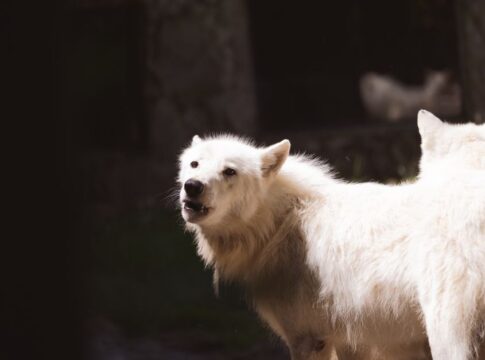
The association between wolves and the moon is pure coincidence of timing and human perception. Wolves are crepuscular and nocturnal creatures, meaning they’re most active during twilight and nighttime hours when the moon happens to be visible. When a wolf tilts its head back to howl, it’s optimizing the acoustics of its call, not gazing adoringly at Earth’s satellite. The posture simply allows the sound to travel farther across their habitat.
Key Takeaways
- Wolves howl to communicate with their pack over long distances, not because of the moon’s presence or phase.
- A single wolf’s howl can travel up to 10 miles across open terrain, making it one of nature’s most effective long-range communication systems.
- Howling serves multiple purposes: coordinating hunts, marking territory, strengthening social bonds, and locating separated pack members.
- Each wolf has a unique howl, allowing pack members to identify individuals by sound alone.
- Wolves are more likely to howl during dawn and dusk when they’re most active, regardless of lunar visibility.
- The head-back posture that created the moon myth is actually an acoustic optimization technique used by many canine species.
Why Wolves Howl at the Moon: Communication, Not Lunar Worship
Wolf howling is sophisticated wildlife communication, refined over millennia of evolution. These animals live in complex social structures called packs, typically consisting of a breeding pair and their offspring from multiple years. Maintaining cohesion across territories that can span hundreds of square miles requires reliable long-distance communication.
When pack members separate during hunts or patrols, howling serves as an auditory beacon. A wolf might howl to signal its location, and packmates respond to coordinate movements or reunite. This is especially critical in dense forests or mountainous terrain where visual contact is impossible. The behavior demonstrates remarkable animal intelligence and social organization.
Territory defense represents another crucial function. Wolf packs defend their ranges fiercely, and a chorus howl broadcasts a clear message to neighboring packs: this land is occupied. Research has shown that these territorial howls can prevent physical confrontations between packs, reducing injury and death. It’s a form of biological diplomacy conducted through sound.
Scientists have also documented what appears to be social howling, where pack members vocalize together without any immediate practical purpose beyond reinforcement of social bonds. These group sessions often occur before hunts or after successful kills, suggesting they serve to boost morale and unity. The emotional lives of these predators are richer than early naturalists assumed.
The Acoustic Science Behind the Howl
The distinctive head-back posture that spawned countless moon myths exists for purely physical reasons. When a wolf throws its head back, it’s creating a more direct pathway for sound waves to travel from the larynx outward. The elongated throat and opened airway function like a megaphone, projecting the howl with maximum efficiency.
Wolf howls typically range from 150 to 780 Hz in frequency, a sweet spot that travels exceptionally well through various environments. Lower frequencies penetrate vegetation and navigate around obstacles better than higher-pitched sounds. This is why wolves sound so different from coyotes, whose higher-pitched yips and barks reflect their smaller body size and different ecological niche.
The structure of a howl also carries information. Wolves modulate their vocalizations with harmonic variation, creating what acousticians call a “rich overtone structure.” Pack members can distinguish individuals by these subtle variations, much like humans recognize friends by voice. This individual signature prevents confusion when multiple wolves are howling across a landscape.
Comparing Wolf Vocalizations
| Vocalization Type | Primary Purpose | Typical Distance |
|---|---|---|
| Howl | Long-range communication, territory marking | Up to 10 miles |
| Bark | Alarm signal, warning to pack | Under 1 mile |
| Growl | Threat display, dominance assertion | Close-range only |
| Whimper | Submission, friendly greeting | Close-range only |
Debunking the Moon Connection
So where did the persistent myth originate? Human nature seeks patterns and stories, especially in phenomena we don’t immediately understand. Ancient peoples observed wolves howling at night and saw the moon as the most prominent nocturnal feature. The correlation became causation in folklore and mythology.
Cultural storytelling reinforced the connection. Werewolf legends across European cultures linked wolves, the moon, and transformation. These stories had staying power because they tapped into primal fears about the wilderness and creatures that thrived in darkness. By the time scientific understanding of animal behavior emerged, the association was deeply embedded in popular culture.
Modern studies tracking wolf activity across lunar cycles have found no correlation between moon phases and howling frequency. Wolves howl just as often during new moons as full moons. Their activity patterns are driven by hunger, territorial needs, and social dynamics, not celestial bodies.
What Wolf Behavior Reveals About Nature
The truth about wolf howling offers a window into broader principles of animal communication. Many species have evolved specialized vocalizations adapted to their ecological niche and social structure. Elephants use infrasound below human hearing range to communicate across miles. Whales sing complex songs that travel through ocean waters. Wolves exemplify how predators balance the need to communicate with the risk of revealing their location to prey and competitors.
Understanding authentic wolf behavior also matters for conservation. As apex predators, wolves play crucial roles in maintaining ecosystem balance. Their reintroduction to Yellowstone National Park demonstrated how predator presence can trigger trophic cascades affecting everything from deer populations to riverside vegetation. Public support for wolf conservation benefits when people appreciate these animals as complex, intelligent beings rather than mythological symbols.
The habitat requirements for wolves are substantial. Packs need large territories with sufficient prey populations, typically ungulates like deer, elk, or moose. Human encroachment on wilderness areas creates conflicts, making accurate public understanding of wolf nature essential for coexistence strategies.
Frequently Asked Questions
Do wolves only howl at night?
No, wolves howl during both day and night, though they’re more vocal during dawn and dusk when they’re most active. Nighttime howls are simply more noticeable to humans because ambient noise is lower and wolves are naturally more active after dark.
Can other animals hear wolf howls that humans cannot?
While the main frequency range of wolf howls is audible to humans, wolves can detect subtle variations and harmonics we might miss. Other canine species in the area, including domestic dogs, can hear these howls clearly and may respond to them.
Do lone wolves howl differently than pack wolves?
Yes, lone wolves often howl more frequently as they search for mates or new pack opportunities. Their howls may sound more plaintive or prolonged as they’re attempting to make contact across greater distances without the amplification effect of a chorus.
Why do domestic dogs sometimes howl at sirens or music?
Dogs retain the howling instinct from their wolf ancestors. Certain frequencies in sirens or music may trigger this response because they mimic the pitch and pattern of canine vocalizations, prompting dogs to “answer” what they perceive as another canine calling.
The next time you hear a wolf howl in a documentary or glimpse that iconic silhouette against the night sky, remember that you’re witnessing not mystical moon-worship but rather one of evolution’s elegant communication solutions. These remarkable animals are speaking a language refined over thousands of generations, and the moon is simply an innocent bystander to their conversation.