
Thunderbird Legends: 7 Native Tribes Who Saw Giant Birds
By Trivia Daily, Staff Writer — Published September 9, 2026
Table of Contents
- Key Takeaways
- Thunderbird Legends Native to Pacific Northwest Coastal Tribes
- The Lakota and Plains Tribes’ Wakinyan
- Anishinaabe Animikii and Great Lakes Traditions
- Menominee Four-Directional Thunderbirds
- Haida and Tlingit Coastal Giant Birds
- Pueblo and Southwest Desert Thunderbirds
- Passamaquoddy and Northeastern Woodland Traditions
- Frequently Asked Questions
Long before airplanes crossed the skies, Native peoples across North America told stories of massive birds whose wingbeats created thunder and whose eyes flashed lightning. These thunderbird legends native to dozens of tribes weren’t mere fantasy—they represented one of the most widespread and enduring mythological figures in indigenous culture. You might discover that these amazing creatures appeared in stories from the Pacific Northwest to the Great Lakes, each culture adding its own fascinating details to the legend of birds so large they could carry off whales or reshape mountains.
The consistency across distant tribes raises interesting questions about shared ancient experiences. Did separate cultures independently imagine similar giant birds, or did these legends preserve memories of enormous prehistoric birds that once soared over the continent? While scientists debate the origins, the cultural impact remains undeniable—thunderbird imagery appears in totem poles, pottery, and ceremonial objects spanning thousands of years.
Key Takeaways
- Thunderbird legends appear in tribes from the Pacific coast to the Great Plains, making them among the most widespread Native American myths.
- Many tribes describe the thunderbird as a protector spirit that battles underwater serpents or malevolent forces.
- Physical descriptions vary, but most traditions depict birds large enough to create storms with their wings.
- Some researchers suggest the legends may preserve cultural memories of extinct giant birds like teratorns that lived until roughly 10,000 years ago.
- Thunderbird imagery remains central to modern Native American art, ceremony, and cultural identity.
- The creatures typically represent power, protection, and the forces of nature rather than mere animals.
Thunderbird Legends Native to Pacific Northwest Coastal Tribes
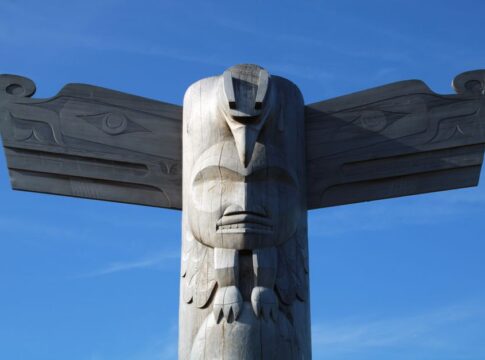
The Kwakwaka’wakw, Nuu-chah-nulth, and other Pacific Northwest peoples tell the most dramatic thunderbird stories. These coastal tribes describe birds powerful enough to hunt whales—not by swooping down like ordinary raptors, but by lifting entire orcas from the ocean in their talons. The thunderbird occupied the highest position on totem poles, literally and symbolically above all other creatures. When storms rolled in from the Pacific, elders explained that thunderbirds were battling with underwater beings or hunting for food.
The physical scale described in these traditions defies ordinary bird anatomy. Wings supposedly stretched wide enough to block the sun when the creature flew overhead. Lightning shot from its eyes or beak. Some accounts claim individual feathers measured longer than a canoe paddle. These weren’t gentle spirits—they represented raw natural power that demanded respect and could destroy the careless.
The Lakota and Plains Tribes’ Wakinyan
Lakota traditions call the thunderbird “Wakinyan,” describing it as a sacred being rather than simply a large bird. The Wakinyan appears during vision quests to warriors and spiritual leaders, often bringing messages or power. Unlike coastal versions focused on ocean hunting, Plains thunderbirds connect more directly to storms sweeping across grasslands. The beating of their wings creates thunder; the opening and closing of their eyes produces lightning flashes.
Interestingly, those struck by lightning in Lakota culture gained special status—they were “marked” by the thunderbird and often became healers or spiritual leaders. The Wakinyan wasn’t necessarily benevolent or malevolent, but existed beyond human moral categories as a force of nature itself. Warriors who dreamed of thunderbirds sometimes painted the symbol on their shields or bodies before battle.
Anishinaabe Animikii and Great Lakes Traditions
The Anishinaabe peoples around the Great Lakes know the thunderbird as Animikii, describing it as one of the most powerful manitous (spirits). Their traditions emphasize the creature’s role as a protector against underwater panthers—serpentine beings dwelling in lakes and rivers who represent opposite forces. This cosmic battle between sky and water, bird and serpent, appears in countless stories and explains natural phenomena from waterspouts to severe thunderstorms.
Great Lakes traditions often stress that humans shouldn’t look directly at the thunderbird during storms. The creature’s true form remains too powerful for mortal eyes. Some stories tell of people who glimpsed the bird and went blind or mad from the experience. This prohibition may reflect practical wisdom about not staring at lightning flashes, translated into mythological terms that ensured children and adults alike took storms seriously.
Menominee Four-Directional Thunderbirds
The Menominee people of Wisconsin describe not one thunderbird but four, each ruling a cardinal direction. The west thunderbird holds the greatest power, bringing the most violent storms. This four-fold division reflects a sophisticated understanding of weather patterns—storms approaching from different directions do indeed behave differently. Western systems typically bring the most severe weather to the Great Lakes region, exactly as the mythology suggests.
Each directional thunderbird supposedly has different coloring and temperament. The west thunderbird appears black or dark blue, matching storm clouds. The others take colors associated with their directions in Menominee cosmology. This systematic approach to thunderbird legends shows how indigenous peoples used mythology to encode genuine meteorological knowledge, creating memorable frameworks for understanding complex natural patterns.
Haida and Tlingit Coastal Giant Birds
Among the Haida and Tlingit peoples of the Pacific Northwest coast and Alaska, thunderbird stories intertwine with clan identities and social structures. Certain families claimed descent from thunderbirds or maintained special relationships with them. These weren’t casual claims—they determined rights to specific stories, ceremonial objects, and even fishing territories. A family’s thunderbird crest carried legal and social weight in traditional society.
The art these cultures produced shows remarkable consistency in thunderbird depiction. Curved beak, prominent eyes, outstretched wings with distinctive feather patterns—these design elements remained recognizable across generations. Modern DNA studies of Pacific Northwest peoples have confirmed that clan structures and oral histories accurately preserve relationships going back thousands of years, suggesting the thunderbird traditions may be equally ancient.
Pueblo and Southwest Desert Thunderbirds
Even in the arid Southwest, far from ocean-hunting narratives, Pueblo peoples incorporate thunderbird-like beings into their traditions. Here the emphasis shifts to rain-bringing rather than storm-making. Giant birds appear in kachina ceremonies, associated with the precious summer thunderstorms that make desert agriculture possible. The creatures become more explicitly beneficial, though still commanding fear and respect.
Pueblo traditions sometimes describe the thunderbird carrying water in containers or lakes on its back, releasing rain when it chooses. This adaptation of the broader thunderbird concept to Southwest ecology shows how different environments shaped the legend. The core idea—a massive bird connected to weather—remained constant while details shifted to match local concerns about drought and rainfall rather than ocean storms.
Passamaquoddy and Northeastern Woodland Traditions
The Passamaquoddy and related Wabanaki peoples of the Northeast tell thunderbird stories emphasizing the creature’s role in maintaining cosmic balance. Their traditions describe ongoing battles between thunderbirds and horned serpents, with human welfare depending on the birds’ victory. Some stories tell of times when serpents gained the upper hand, causing floods or droughts, until thunderbirds restored order.
Northeastern traditions often include more interaction between thunderbirds and humans than western versions. Stories tell of people who helped injured thunderbirds and received magical gifts in return, or warriors who borrowed thunderbird power for crucial battles. This more personal relationship may reflect the smaller scale of Northeastern geography compared to vast Pacific or Plains landscapes—everything feels closer, including the spirit world.
Frequently Asked Questions
Could thunderbird legends be based on real extinct birds?
Some researchers suggest the legends may preserve cultural memories of teratorns, enormous vulture-like birds with wingspans up to 12 feet that lived in North America until about 10,000 years ago. However, most scholars view thunderbirds as primarily spiritual and mythological rather than zoological.
Why do thunderbird legends appear in so many different tribes?
The widespread distribution likely reflects both cultural diffusion through trade and contact between tribes, and independent development of similar concepts to explain dramatic weather phenomena like thunderstorms, which occur across most of North America.
Are thunderbirds considered gods in Native American religions?
The classification varies by tribe. Some traditions treat thunderbirds as powerful spirits or manitous rather than gods in the Western sense. They represent natural forces and occupy important positions in cosmology but exist within complex spiritual systems rather than as supreme deities.
Do modern Native Americans still believe in thunderbirds?
Thunderbird imagery and stories remain culturally significant for many contemporary Native peoples, appearing in art, ceremony, and cultural identity. The relationship between literal belief and symbolic meaning varies among individuals and communities, just as it does with spiritual traditions worldwide.
The thunderbird’s persistence across centuries and cultures speaks to something deeper than simple myth-making. Whether preserving ancient encounters with extinct megafauna, encoding meteorological wisdom in memorable form, or expressing fundamental human awe at nature’s power, these legends continue to fascinate. The next time a summer thunderstorm rolls across the sky, you might understand why ancient peoples saw something more than mere weather—they saw wings.