
Why Owls Can Rotate Their Heads 270 Degrees
By Trivia Daily, Animals Desk — Published September 19, 2026
Table of Contents
- Key Takeaways
- Why Owls Rotate Heads: The Anatomy Behind the Adaptation
- The Eyes That Cannot Move
- Comparing Head Rotation Across Species
- Hunting Behavior and Survival in the Wild
- Debunking the 360-Degree Myth
- Frequently Asked Questions
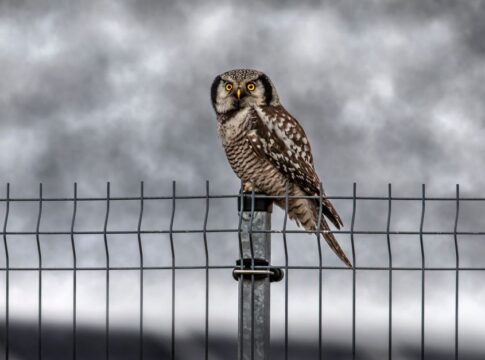
Picture a barn owl perched on a fence post at dusk, scanning the field for prey. Suddenly, without moving its body an inch, the bird swivels its head almost completely backward, tracking a sound behind it. This remarkable ability has captivated humans for centuries and sparked countless myths about these nocturnal hunters. Owls rotate heads with an astonishing range that would be impossible—and fatal—for most animals, including humans. The secret lies in specialized anatomy that evolved over millions of years to help these creatures survive in their habitat.
Unlike humans, who can only turn their heads about 90 degrees in either direction, owls have evolved a neck structure that allows them to rotate their heads roughly 270 degrees. That’s three-quarters of a full circle. This incredible adaptation compensates for a significant limitation: their eyes are fixed in their sockets and cannot move like ours can.
Key Takeaways
- Owls can rotate their heads approximately 270 degrees in either direction, allowing them to see almost completely behind themselves without moving their bodies.
- This species has 14 neck vertebrae—twice as many as humans—which provides exceptional flexibility while maintaining stability.
- Specialized blood vessel structures prevent strokes and brain damage during extreme head rotation, solving a problem that would kill most animals.
- The behavior compensates for tubular eyes that cannot move in their sockets, unlike the spherical eyes of most other wildlife.
- Owl neck bones have unique air pockets and enlarged openings that allow arteries to move freely without being pinched during rotation.
- This adaptation is crucial for hunting behavior, allowing these predators to locate prey using both vision and sound while remaining motionless.
Why Owls Rotate Heads: The Anatomy Behind the Adaptation
The owl’s remarkable head rotation begins with the neck. Where humans have seven cervical vertebrae, owls possess 14. This doubling of neck bones creates multiple pivot points that distribute the rotation smoothly across the entire neck rather than concentrating stress at one or two joints. Each vertebra can move just a little, but together they create an extraordinary range of motion.
But extra bones alone wouldn’t prevent a major problem: cutting off blood flow to the brain. When an owl twists its neck to extreme angles, the arteries running through the neck bones could easily become kinked or compressed, causing a stroke. Nature solved this engineering challenge with elegant precision.
The vertebral arteries that supply blood to an owl’s brain pass through holes in the neck vertebrae called transverse foramina. In owls, these holes are roughly ten times wider than the arteries passing through them. This extra space allows the blood vessels to slide and move without being pinched, even during extreme rotation. Think of it like a garden hose passing through a pipe much wider than necessary—the hose can shift and bend without blocking water flow.
The arteries themselves have evolved special adaptations. Small vessel connections called anastomoses create a network of alternative pathways for blood to reach the brain. If one route becomes temporarily restricted during a head turn, blood can detour through another channel. At the base of the skull, owls also have enlarged vessel cavities that pool blood, maintaining steady flow to the brain even when neck arteries are momentarily compressed.
The Eyes That Cannot Move
Understanding why owls need such extreme neck flexibility requires examining their unusual eyes. Unlike most animals, including humans and other birds, owls have tubular rather than spherical eyes. These elongated structures act like telephoto lenses, providing exceptional long-distance vision and superior light-gathering ability for night hunting.
The trade-off is complete immobility. An owl cannot glance to the side or look up and down by moving its eyes alone. The entire head must move to shift the gaze. For a predator that hunts in darkness and relies on spotting the slightest movement from prey, this would be a severe disadvantage without the compensating ability to rotate the head extensively.
This fixed-eye design is common among nocturnal hunters in nature. The large, forward-facing eyes provide binocular vision—both eyes see the same area, creating depth perception critical for judging distances when swooping down on a mouse or vole. The tubular shape maximizes the number of light-sensitive cells packed into the retina, essential for hunting in low-light conditions.
Comparing Head Rotation Across Species
| Animal | Maximum Head Rotation | Number of Neck Vertebrae |
|---|---|---|
| Owls | 270 degrees | 14 |
| Humans | 80-90 degrees | 7 |
| Pigeons | ~200 degrees | 14 |
| Cats | ~180 degrees | 7 |
| Horses | ~90 degrees | 7 |
Hunting Behavior and Survival in the Wild
The ability to rotate their heads serves owls in multiple ways beyond simply compensating for immobile eyes. When perched and hunting, an owl can remain completely still—critical for ambush predators—while scanning its entire surroundings for both prey and threats. Movement attracts attention in nature, and a motionless body with a slowly rotating head is far less conspicuous than a bird constantly shifting position.
Owls also rely heavily on sound to locate prey, especially species that hunt in complete darkness. Many owls have asymmetrical ear openings, with one positioned higher on the skull than the other. This arrangement allows them to pinpoint sounds in three dimensions with remarkable accuracy. The head rotation enables them to aim these sophisticated listening devices in any direction without telegraphing their position through body movement.
Different owl species use this adaptation across varied habitats worldwide. The great horned owl hunts in forests, grasslands, and deserts. The barn owl prefers open farmland and grasslands. The snowy owl thrives in Arctic tundra. Regardless of environment, the head-rotation ability remains a constant advantage for these diverse creatures.
Debunking the 360-Degree Myth
Despite popular belief and countless cartoons, owls cannot rotate their heads a full 360 degrees. The maximum range is approximately 270 degrees in either direction from center. This means an owl looking straight ahead can turn its head 135 degrees to the left or right. To see directly behind itself, an owl must choose which direction to rotate—it cannot complete a full circle.
This myth likely persists because 270 degrees is so extreme by human standards that it seems like a complete rotation. When you watch an owl turn its head to look behind itself, the motion appears impossibly fluid and complete. The bird can indeed see almost everything around it, but there’s a small blind spot directly behind that it can only view by choosing left or right rotation.
Frequently Asked Questions
Can owls really turn their heads all the way around?
No, owls cannot complete a full 360-degree rotation. They can turn their heads approximately 270 degrees in either direction, which allows them to look almost directly behind themselves but not quite complete a full circle.
Why don’t owls get dizzy from turning their heads so far?
Owls have specialized balance systems and blood vessel adaptations that maintain steady blood flow to the brain during extreme head rotation. Their vestibular system, which controls balance, has evolved to accommodate these movements without causing disorientation.
Do all owl species have the same head rotation ability?
Yes, all owl species share this adaptation, as it’s tied to their fundamental eye structure. All owls have tubular, fixed eyes that require exceptional neck flexibility to compensate for the inability to move their eyes in their sockets.
Could humans ever rotate their heads like owls?
No, human anatomy makes this impossible. We have half the number of neck vertebrae, our blood vessels lack the protective adaptations owls possess, and attempting such rotation would cause severe injury or death from arterial damage and stroke.
The next time you see an owl in nature or at a wildlife sanctuary, watch how it moves—or rather, how it doesn’t. The body remains perfectly still while the head swivels with eerie smoothness, scanning for the faintest rustle in the grass below. Millions of years of evolution solved a complex engineering problem, creating one of the animal kingdom’s most distinctive and mesmerizing adaptations.