
Did Phoenix Legends Come From Flamingo Migration Patterns
By Trivia Daily, Staff Writer — Published October 9, 2026
Table of Contents
- Key Takeaways
- How Did Phoenix Legends Come From Different Cultures
- The Flamingo Connection: Fact or Fascinating Speculation
- What Scientists and Historians Actually Say
- Comparing Real Birds to Phoenix Mythology
- Why Myths Matter More Than Their Origins
- Frequently Asked Questions
The phoenix—a mythical bird consumed by flames only to rise reborn from its own ashes—stands as one of humanity’s most enduring symbols of renewal. But did phoenix legends come from ancient observations of flamingos and their dramatic seasonal migrations? This surprising theory connects the fiery plumage of these real birds to the mythology that has captivated cultures for millennia. While no single origin can fully explain such widespread myths, the connection between flamingos and phoenix stories offers fascinating trivia that challenges how we think about ancient storytelling.
Flamingos possess qualities that ancient peoples might have interpreted as magical or supernatural. Their brilliant red-orange feathers, mass migrations that could see entire populations vanish and reappear, and unusual nesting behaviors on salt flats that resemble barren, fire-scorched landscapes all create an intriguing parallel to phoenix mythology. Exploring this connection reveals how nature’s wonders often inspire our most amazing legends.
Key Takeaways
- Flamingo feathers range from pale pink to deep crimson-red depending on their diet of carotenoid-rich algae and crustaceans, creating a flame-like appearance that ancient observers might have associated with fire.
- Phoenix myths appear independently in ancient Egyptian, Greek, Chinese, and Arabian cultures, suggesting multiple origins rather than a single source.
- Flamingos perform synchronized mass migrations, sometimes abandoning nesting sites for years before returning—a disappearing and reappearing pattern that mirrors the phoenix’s cyclical rebirth.
- The ancient Egyptian Bennu bird, considered a phoenix predecessor, was associated with the sun god Ra and depicted with heron-like features, though some scholars note similarities to flamingo behavior.
- Flamingos build cone-shaped mud nests on alkaline salt flats where temperatures can exceed 140°F (60°C), creating harsh, flame-scorched environments.
- No historical texts explicitly link phoenixes to flamingos, making this connection speculative but scientifically interesting as a case study in myth formation.
How Did Phoenix Legends Come From Different Cultures
Phoenix mythology didn’t originate in a single place. The ancient Egyptians revered the Bennu bird, a self-creating deity linked to the sun and rebirth cycles. Greek historians like Herodotus wrote about the phoenix in the 5th century BCE, describing it as a bird from Arabia that lived for 500 years before burning itself and emerging renewed. Chinese mythology features the Fenghuang, often translated as “phoenix,” though it represents different symbolic meanings related to virtue and harmony rather than literal rebirth through fire.
Arabian and Persian traditions also include phoenix-like birds. These parallel developments across distant cultures suggest humans independently created similar myths when trying to explain natural phenomena they witnessed. The question becomes: what real birds or events might have inspired such consistent imagery of fiery, immortal avians?
The Flamingo Connection: Fact or Fascinating Speculation
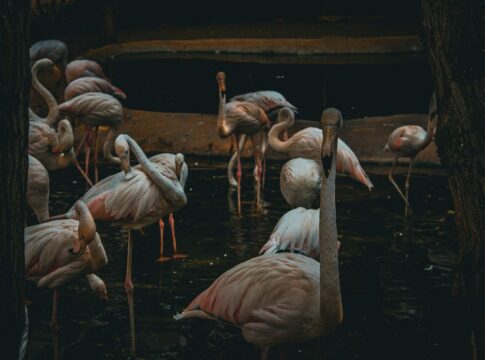
Flamingos exhibit several characteristics that align eerily well with phoenix descriptions. Their coloration comes from carotenoid pigments in their diet—the same compounds that make carrots orange. The more carotenoids a flamingo consumes, the more intensely red its feathers become. A flock of thousands of bright red flamingos taking flight would create a spectacular display resembling living flames dancing across the sky.
Their migration patterns add another layer. Flamingos don’t follow predictable annual routes like many birds. They respond to water levels, food availability, and breeding conditions, sometimes abandoning regions entirely for years. To ancient peoples without modern ornithology knowledge, flamingo populations could seem to vanish completely—only to mysteriously return generations later. This disappearance and reappearance mirrors the phoenix’s death and rebirth cycle.
The nesting behavior strengthens the parallel. Flamingos breed on caustic salt flats and alkaline lakes where few other creatures survive. These environments feature blinding white salt crusts, extreme heat, and an otherworldly appearance. The mud nests flamingos construct can resemble small pyres or mounds. When thousands of birds gather in these harsh, sun-baked landscapes, the scene could evoke associations with fire and resurrection to observers unfamiliar with the species.
What Scientists and Historians Actually Say
Most classical scholars trace phoenix origins to solar mythology and seasonal cycles rather than specific bird species. The Bennu bird was explicitly connected to the Egyptian sun god Ra and represented the daily solar cycle—death at sunset, rebirth at dawn. Greek writers borrowed and embellished these Egyptian concepts, adding details about Arabia, spices, and the 500-year lifespan.
No ancient text directly identifies flamingos as the phoenix’s inspiration. The Greek word “phoinix” relates to purple-red coloration and Phoenicia, not to any specific bird. However, the absence of explicit connections doesn’t disprove the flamingo theory—ancient peoples might not have distinguished individual species the way modern taxonomy does. They could have blended observations of multiple birds into composite mythical creatures.
The Bennu bird’s iconography shows heron-like features, particularly resembling the grey heron common in Egypt. Yet some researchers note that flamingos were present in the Mediterranean and North Africa in ancient times, and their more dramatic appearance could have influenced evolving mythology even if not the original inspiration.
Comparing Real Birds to Phoenix Mythology
| Phoenix Trait | Flamingo Reality | Other Candidate Birds |
|---|---|---|
| Fire-colored plumage | Red-orange feathers from carotenoids | Scarlet ibis, some parrots |
| Cyclical disappearance/return | Irregular mass migrations | Many migratory species |
| Association with harsh, fiery environments | Nests on scorching salt flats | Desert-dwelling raptors |
| Longevity | Can live 40+ years in wild | Parrots (50-80 years), albatrosses (50+ years) |
| Rebirth from ashes | Population renewal after absence | No direct parallel in nature |
Why Myths Matter More Than Their Origins
Whether flamingos inspired phoenix legends or not, the exercise reveals something profound about human imagination. We create stories to make sense of the world around us. Ancient peoples observed birds with extraordinary characteristics and wove them into narratives about immortality, transformation, and hope. The phoenix endures not because it accurately describes any real creature, but because it symbolizes universal human experiences—surviving hardship, emerging stronger from disaster, and the possibility of new beginnings.
The flamingo theory reminds us that myths often have roots in genuine observation, even when the conclusions drawn seem fantastical by modern standards. Without scientific frameworks, ancient peoples interpreted spectacular natural phenomena through the lens of their spiritual and cultural beliefs. A flock of crimson flamingos rising from a shimmering salt flat at dawn might genuinely look like fire taking wing.
Frequently Asked Questions
Do flamingos actually migrate in ways that could explain phoenix rebirth myths?
Yes, flamingos perform irregular migrations based on environmental conditions rather than fixed seasonal patterns. Entire populations can abandon breeding sites for years before returning, creating a disappearance-and-return cycle that ancient observers might have interpreted as death and rebirth.
What makes flamingos turn red or pink?
Flamingos get their color from carotenoid pigments in the algae, diatoms, and small crustaceans they eat. Birds with access to carotenoid-rich food develop more intense red-orange coloring, while those with limited access remain pale pink or even white.
Which culture created the original phoenix myth?
Ancient Egypt’s Bennu bird is the earliest known phoenix-like myth, dating to at least 3000 BCE. However, similar fire-bird legends developed independently in Greek, Chinese, Arabian, and other cultures, suggesting multiple origins rather than a single source.
Are there other birds besides flamingos that might have inspired phoenix legends?
Several birds could have contributed to phoenix mythology, including the scarlet ibis with its brilliant red plumage, various birds of paradise with exotic appearances, and even peacocks with their association with renewal through molting. The myth likely represents a composite of multiple observations and symbolic meanings.
The next time you see flamingos—whether in a zoo, documentary, or their natural habitat—imagine encountering them without modern knowledge. Those flame-colored birds rising en masse from a blinding white salt flat might just look like fire itself taking flight, mysterious and eternal.