
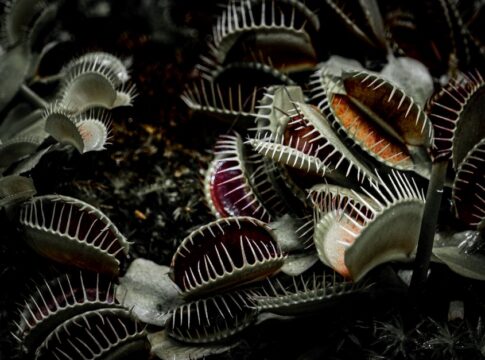
9 Bizarre Facts About Venus Flytraps Eating Insects
By Trivia Owl, Staff Writer — Published October 13, 2026
Table of Contents
- Key Takeaways
- Understanding These Bizarre Venus Flytraps and Their Hunting Methods
- The Nine Most Surprising Venus Flytrap Trivia Facts
- Comparing Venus Flytraps to Other Carnivorous Plants
- Frequently Asked Questions
The Venus flytrap is one of nature’s most captivating carnivores, a plant that seems to blur the line between the botanical and the predatory. While most people know these bizarre plants snap shut on unsuspecting flies, the mechanics and mysteries behind their hunting strategies reveal a world far stranger than you might imagine. From their ability to count to their surprising dietary preferences, these facts about Venus flytraps will transform how you see these green carnivores.
Native only to a tiny region of North and South Carolina, these remarkable plants have evolved mechanisms that would seem more at home in the animal kingdom. Let’s explore the fascinating, sometimes unsettling truths about how Venus flytraps capture and consume their prey.
Key Takeaways
- Venus flytraps can count to five and use mathematical precision to decide when to close their traps on prey.
- The plants digest insects using enzymes similar to those found in human stomachs, dissolving their prey over five to twelve days.
- Each trap can only close about four to seven times during its lifespan before it dies and falls off the plant.
- Venus flytraps are endangered in the wild and found naturally in only a small coastal region of the Carolinas.
- The snapping mechanism is one of the fastest movements in the plant kingdom, closing in less than one-tenth of a second.
- These carnivorous plants prefer spiders and crawling insects over flying ones, despite their common name.
Understanding These Bizarre Venus Flytraps and Their Hunting Methods
Venus flytraps didn’t evolve to eat insects because they’re aggressive or predatory by nature. They developed carnivory as a survival strategy in nutrient-poor soil. The boggy, acidic wetlands of the Carolinas lack nitrogen and phosphorus, essential nutrients most plants absorb through their roots. By capturing and digesting insects, Venus flytraps supplement what the soil cannot provide. This adaptation makes them less dependent on soil quality and more dependent on catching prey, a remarkable evolutionary trade-off that transformed them into botanical hunters.
The plant’s scientific name, Dionaea muscipula, references both a Greek goddess and the Latin word for mousetrap. Researchers have studied these plants extensively, uncovering behaviors that challenge our understanding of plant intelligence and sensory capabilities.
The Nine Most Surprising Venus Flytrap Trivia Facts
1. Venus Flytraps Can Count and Perform Mathematical Calculations
Perhaps the most astonishing discovery about Venus flytraps is their ability to count. Each trap contains tiny trigger hairs, and the plant won’t close unless these hairs are touched at least twice within about twenty seconds. This isn’t accidental—it’s a sophisticated counting mechanism that prevents the plant from wasting energy on false alarms like raindrops or debris. Once closed, the trap continues counting. If the trigger hairs are stimulated three more times, the trap seals tightly and begins releasing digestive enzymes. Five touches total signal a meal worth digesting. This mathematical precision in a brainless organism has fascinated researchers studying plant neurobiology and challenges conventional definitions of intelligence.
2. The Snap Happens Faster Than You Can Blink
The Venus flytrap’s closing mechanism ranks among the fastest movements in the plant kingdom, snapping shut in approximately one-tenth of a second. The trap doesn’t use muscles like animals do. Instead, it relies on a rapid change in cell shape and water pressure, essentially turning the leaf inside-out in a snap. Scientists compare this mechanism to a tensed spring suddenly released. The speed is crucial because insects can escape in milliseconds, and any slower closure would mean a missed meal. This explosive movement requires enormous energy, which partly explains why each trap has a limited number of closures before it exhausts itself and dies.
3. Each Trap Has a Death Sentence Built In
Every individual trap on a Venus flytrap plant can only close about four to seven times before it dies, blackens, and falls off. This limitation exists because the closing mechanism is metabolically expensive, and repeated use exhausts the trap’s cellular machinery. If the trap closes on nothing—triggered by a curious finger or falling twig—it wastes one of its precious closures. The trap can reopen within twelve to twenty-four hours if it determines there’s no meal inside, but it still counts as one closure toward its limit. This biological countdown means Venus flytraps are surprisingly vulnerable to interference and must be selective about when to spring their traps.
4. They Prefer Spiders Over Flies Despite Their Name
The common name “Venus flytrap” suggests these plants primarily catch flies, but research shows they actually capture more spiders, ants, and beetles than flying insects. Crawling insects are easier targets because they spend more time exploring the trap’s interior and are more likely to trigger the sensitive hairs multiple times. Flying insects often land briefly and escape before the trap closes. Studies of wild Venus flytraps have found that spiders and ants make up a significant portion of their diet, with flies being less common prey. The name persists from early observations, but it doesn’t reflect the plant’s true dietary preferences.
5. Digestion Takes Up to Twelve Days and Uses Human-Like Enzymes
Once a Venus flytrap confirms it has captured prey through repeated trigger hair stimulation, it seals the trap into an airtight chamber and floods it with digestive enzymes. These enzymes are remarkably similar to those found in animal digestive systems, including pepsin-like proteases that break down proteins. The digestion process takes between five and twelve days, during which the plant dissolves the soft tissues of the insect, absorbing nitrogen, phosphorus, and other nutrients. Only the hard exoskeleton remains, eventually discarded when the trap reopens. This sophisticated digestive system demonstrates convergent evolution, where plants and animals independently developed similar biochemical solutions to the same problem: breaking down protein-rich food.
6. They’re Critically Endangered in Their Native Habitat
Despite being widely available in garden centers and novelty shops, wild Venus flytraps are endangered and exist naturally only within a seventy-five-mile radius around Wilmington, North Carolina. Habitat destruction, fire suppression, and poaching have devastated wild populations. Venus flytraps depend on periodic fires to clear competing vegetation and maintain their open bog habitats. Without fire, trees and shrubs shade out the low-growing carnivorous plants. Poaching remains a serious problem, with collectors illegally harvesting plants from protected areas. Conservation organizations and botanical gardens work to protect remaining wild populations and educate the public about buying only cultivated plants.
7. The Red Interior Color Is a Deadly Lure
Many Venus flytraps display vivid red coloring inside their traps, and this isn’t just for show. The red pigmentation, which intensifies with exposure to bright light, attracts insects by mimicking the appearance of flowers or rotting flesh. Some insects are drawn to red hues, mistaking the trap’s interior for a food source or suitable habitat. The plant essentially uses visual deception as part of its hunting strategy. Interestingly, Venus flytraps grown in low light often remain green inside because producing the red anthocyanin pigments requires energy from photosynthesis. The coloration represents another metabolic investment the plant makes to improve its hunting success.
8. They Can Distinguish Between Living Prey and Dead Matter
Venus flytraps possess a remarkable ability to differentiate between living, struggling prey and non-nutritious debris. If an object triggers the trap but doesn’t continue moving and stimulating the trigger hairs, the trap will reopen within twelve to twenty-four hours without initiating digestion. This sensory discrimination saves the plant from wasting digestive enzymes on inedible material. The continued movement of trapped prey provides the additional trigger hair stimulations that signal “this is food worth digesting.” This ability to assess prey quality before committing resources to digestion shows a level of sensory sophistication that continues to intrigue researchers studying plant behavior and decision-making processes.
9. They Still Photosynthesize and Don’t Actually Need Insects to Survive
A common misconception is that Venus flytraps must eat insects to survive, but this isn’t quite true. These plants are fully capable of photosynthesis and can survive indefinitely without catching prey. Insect consumption is a supplement, not a requirement. Venus flytraps grown in nutrient-rich soil with adequate fertilizer can thrive without ever catching an insect, though they may grow more slowly than wild specimens that hunt regularly. In their natural nutrient-poor habitats, however, insect-derived nutrients provide a crucial competitive advantage. This dual strategy—photosynthesis plus carnivory—makes Venus flytraps remarkably adaptable and explains why they can be successfully cultivated in environments quite different from their native bogs.
Comparing Venus Flytraps to Other Carnivorous Plants
| Plant Type | Capture Method | Speed of Capture | Native Region |
|---|---|---|---|
| Venus Flytrap | Snap trap | 0.1 seconds | Carolinas, USA |
| Sundew | Sticky mucilage | Minutes to hours | Worldwide |
| Pitcher Plant | Pitfall trap | Passive | Various regions |
| Bladderwort | Suction trap | 0.002 seconds | Worldwide |
Frequently Asked Questions
Can Venus flytraps eat human fingers?
No, Venus flytraps cannot harm or eat human fingers. While they can close around a finger if you trigger the trap, they lack the strength or digestive capability to damage human tissue. Triggering traps unnecessarily does waste the plant’s limited closures and weakens it over time.
How long can a Venus flytrap live?
Venus flytraps can live for twenty years or more under proper care, though individual traps only last a few months. The plant continuously grows new traps to replace old ones. In the wild, plants can persist for decades if their habitat remains undisturbed.
Do Venus flytraps need to be fed if kept as houseplants?
Venus flytraps don’t require feeding when grown indoors, as they can survive through photosynthesis alone. However, occasionally offering them small insects can promote faster, healthier growth. Never feed them human food or meat, which will kill the trap.
Why is my Venus flytrap turning black?
Individual traps naturally turn black and die after several closures or at the end of their lifespan, which is normal. If the entire plant is blackening, it likely indicates overwatering, poor drainage, incorrect water quality, or inadequate light. Venus flytraps require distilled water and bright conditions.
The Venus flytrap stands as a testament to evolution’s creativity, transforming a simple plant into a sophisticated predator through millions of years of adaptation. These bizarre botanical carnivores remind us that intelligence and complex behavior aren’t exclusive to animals with brains—sometimes, the most alien consciousness might be growing quietly in a bog, counting to five and waiting for its next meal.