
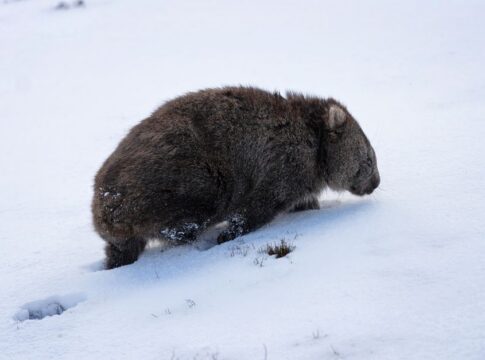
Why Wombats Poop Cubes Instead of Round Droppings
By Trivia Daily, Staff Writer — Published November 1, 2026
Table of Contents
- Key Takeaways
- Why Wombats Poop Cubes: The Anatomy Behind the Mystery
- The Evolutionary Advantage of Cubic Feces
- Scientific Research and Surprising Discoveries
- Comparing Wombat Species and Their Cubic Capabilities
- Interesting Facts About Wombat Digestion and Behavior
- Frequently Asked Questions
Among the most surprising facts in the animal kingdom is that wombats poop cubes. Not cylinders, not spheres, but near-perfect six-sided blocks of feces. This remarkable trivia has puzzled scientists for decades and delighted curious minds everywhere. The discovery that these Australian marsupials produce geometrically shaped droppings raises an obvious question: how on earth does a round intestine create cubic waste?
The answer involves a fascinating combination of anatomy, physics, and evolutionary strategy. Understanding why wombats poop cubes reveals amazing insights into how nature solves practical problems in unexpected ways.
Key Takeaways
- Wombats are the only known animals that produce cube-shaped feces, with each dropping measuring roughly two centimeters per side.
- The cubic shape forms in the last portion of the intestine through varying elasticity in the intestinal walls, not through a cube-shaped anus.
- Wombats stack their droppings on rocks and logs to mark territory, and the cubic shape prevents the feces from rolling away.
- Scientists discovered that the intestinal tissue has regions of different stiffness, creating flat edges and corners as material moves through.
- This unique digestive process takes approximately 14 to 18 days, making wombats among the slowest digesters in the animal kingdom.
- Researchers have studied this phenomenon to explore applications in manufacturing processes that create cubic shapes without molds.
Why Wombats Poop Cubes: The Anatomy Behind the Mystery
The cubic dropping mystery begins in the wombat’s extraordinarily long digestive system. These stocky marsupials extract every possible nutrient and water molecule from their food, a crucial adaptation to Australia’s often harsh and dry environment. Their intestines can be over nine meters long in an animal that weighs only about 25 kilograms.
The magic happens in the final section of the intestine. Research has revealed that wombat intestinal walls have varying elasticity. Some sections are stiffer, while others are more flexible. As fecal material slowly moves through this final stretch, the alternating stiff and flexible regions sculpt it into a cube.
The process works through differential tissue contraction. The more elastic sections of intestine stretch and bulge outward, while the stiffer sections remain relatively flat. This creates the edges and corners characteristic of a cube. By the time the material exits, it has been molded into its distinctive geometric form through purely mechanical means.
Importantly, the anus itself is not cube-shaped. This is a common misconception. The shaping occurs entirely within the intestine before the feces are expelled.
The Evolutionary Advantage of Cubic Feces
Nature rarely creates unusual features without purpose. Wombats use their droppings as territorial markers, depositing them in prominent locations like rocks, logs, and elevated surfaces. The cubic shape serves a brilliantly simple function: it doesn’t roll away.
Round droppings would tumble off these perches, rendering them useless as boundary markers. Cubes stay put. A wombat can stack them higher, creating more visible and odorous signals to other wombats. They typically deposit multiple cubes in a single location, sometimes up to 100 pieces per night across their territory.
This territorial marking is especially important because wombats have poor eyesight. They rely heavily on scent communication. Stable, elevated fecal markers maximize the spread of scent signals, helping wombats avoid conflicts and locate potential mates.
Scientific Research and Surprising Discoveries
For years, the cubic poop phenomenon was known but poorly understood. Researchers eventually conducted detailed studies examining wombat intestines and the mechanical properties of their digestive systems. The breakthrough came from analyzing the tissue structure and running mathematical models of how differently elastic materials behave under pressure.
Scientists discovered that the cube formation involves a two-dimensional contraction pattern. The intestinal muscles contract at varying rates, and the tissue stiffness varies around the circumference of the intestine. This creates flat surfaces where tissue is stiff and corners where two stiff regions meet.
The research has implications beyond understanding wombat biology. Engineers have become interested in the process as a potential method for manufacturing cubic shapes without traditional molding or cutting. The wombat intestine essentially acts as a soft-tissue mold that shapes material through controlled pressure and elasticity.
Comparing Wombat Species and Their Cubic Capabilities
| Wombat Species | Cube Production | Typical Habitat |
|---|---|---|
| Common Wombat | Produces distinct cubes | Forests and mountains of southeastern Australia |
| Southern Hairy-nosed Wombat | Produces distinct cubes | Semi-arid grasslands and scrublands |
| Northern Hairy-nosed Wombat | Produces distinct cubes | Limited range in Queensland (critically endangered) |
All three wombat species produce cubic feces, suggesting this trait evolved in their common ancestor. The consistency across species indicates strong evolutionary pressure maintaining this unusual characteristic.
Interesting Facts About Wombat Digestion and Behavior
Beyond their geometric droppings, wombats possess several other remarkable digestive and behavioral traits:
- Their extremely slow metabolism allows them to survive on relatively poor-quality vegetation that other animals cannot efficiently digest.
- Wombats produce some of the driest feces in the animal kingdom, containing very little moisture due to their exceptional water extraction.
- A single wombat may produce 80 to 100 cubic droppings per day, strategically placed throughout its territory.
- The animals are mostly nocturnal and emerge from their burrows at night to feed and mark territory.
- Wombat burrows can extend up to 30 meters and include multiple chambers and entrances.
These adaptations work together to help wombats thrive in environments where water and high-quality food are often scarce. The cube-shaped feces are just one piece of a comprehensive survival strategy.
Frequently Asked Questions
Do any other animals produce cube-shaped feces?
No, wombats are the only known animals that naturally produce cube-shaped droppings. This makes them truly unique in the animal kingdom and a subject of ongoing scientific curiosity.
How many sides does wombat poop actually have?
Wombat feces typically have six faces, forming a cube shape, though they are not perfectly geometric. Each dropping measures approximately two centimeters on each side, though size can vary based on diet and individual wombat size.
Can wombats control the shape of their poop?
No, the cubic shape is an automatic result of their intestinal anatomy and the mechanical properties of their digestive system. Wombats do not consciously create cubes; the shape forms naturally through the structure of their intestines.
Why don’t other animals with slow digestion produce cubes?
The cube shape requires the specific combination of extremely slow digestion, very dry fecal matter, and intestinal walls with varying elasticity arranged in a particular pattern. This unique combination of factors exists only in wombats.
The humble wombat reminds us that nature’s solutions often surpass human engineering in elegance and efficiency. A simple cube solves a complex communication problem, shaped by nothing more than tissue elasticity and evolutionary pressure. Next time you encounter a perfectly mundane cube in daily life, you might just think of an Australian marsupial and marvel at how the strangest facts often hide the most fascinating science.