
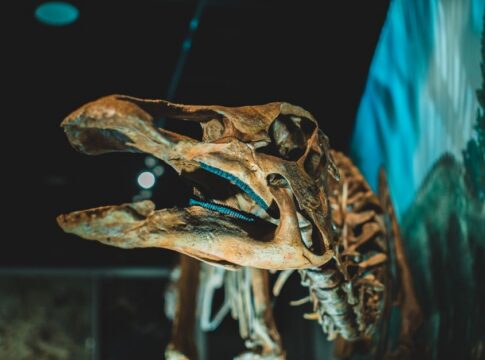
Did You Know Dragons Were Based on Dinosaur Fossils
By Trivia Owl, Staff Writer — Published November 14, 2026
Table of Contents
- Key Takeaways
- How Ancient Cultures Interpreted Dragons Based on Dinosaur Remains
- The Griffin Connection: When Fossils Create Hybrid Creatures
- Physical Evidence: Dragon Descriptions Match Dinosaur Anatomy
- Why Fire-Breathing Became Part of Dragon Lore
- When Science Caught Up: The Birth of Paleontology
- Frequently Asked Questions
Ancient peoples across the globe told stories of giant, scaly beasts with enormous bones buried deep in the earth. These legends of dragons may not have sprung purely from imagination—they likely grew from very real encounters with dinosaur fossils. Long before modern paleontology existed, people stumbled upon massive skulls, teeth, and bones weathering out of rock formations, and their attempts to explain these discoveries helped shape dragon mythology as we know it.
The theory that dragons were based on dinosaur fossils offers a fascinating glimpse into how ancient cultures made sense of the natural world. Without scientific frameworks to understand extinction or deep time, people created narratives that fit their worldview, transforming genuine fossil discoveries into legendary creatures that guarded treasure, breathed fire, and terrorized villages.
Key Takeaways
- Ancient civilizations regularly encountered dinosaur fossils and other prehistoric remains, which they interpreted as evidence of dragons and other mythical beasts.
- The word “dragon” derives from the Greek “drakon,” meaning serpent, and dragon myths appear independently in cultures worldwide, suggesting common inspiration from fossil discoveries.
- Protoceratops fossils in Central Asia may have inspired griffin legends, demonstrating how real bones shaped mythological creatures.
- Chinese “dragon bones” collected for traditional medicine were often dinosaur fossils, creating a direct link between paleontological specimens and dragon lore.
- The similarities between dragon anatomy in ancient art and actual dinosaur skeletons are too consistent to be coincidental.
- Before the 1800s, when paleontology emerged as a science, no other framework existed to explain enormous fossilized bones.
How Ancient Cultures Interpreted Dragons Based on Dinosaur Remains
When farmers in ancient Greece plowed their fields and unearthed gigantic bones, they had no concept of dinosaurs or extinction. The logical conclusion? These remains belonged to dragons, giants, or monsters from their mythology. The Greeks weren’t alone in this interpretation. Cultures separated by thousands of miles developed remarkably similar dragon legends, likely because they encountered similar fossils.
China provides some of the most compelling evidence for this connection. For centuries, Chinese apothecaries sold “dragon bones” as medicinal ingredients. These bones were often genuine dinosaur fossils from regions rich in Cretaceous deposits. The Chinese dragon—long, serpentine, often depicted with four legs—bears striking resemblance to the sauropod dinosaurs whose fossils dotted the landscape. Even today, paleontologists in China discover remarkable dinosaur specimens in areas where dragon legends have persisted for millennia.
European dragons typically featured wings, massive size, and reptilian characteristics. Pterosaur fossils, with their enormous wingspans and bizarre skulls, could easily inspire such descriptions. The massive bones of sauropods or the fearsome teeth of theropods would reinforce the image of terrifying beasts. Medieval Europeans who found these remains had no reason to doubt they belonged to the dragons described in their folklore and religious texts.
The Griffin Connection: When Fossils Create Hybrid Creatures
Not all fossil-inspired myths resulted in pure dragon legends. The griffin—a creature with the body of a lion and the head and wings of an eagle—may have originated from Protoceratops fossils found in the gold-rich regions of Central Asia. Ancient gold miners in the Gobi Desert region frequently encountered these dinosaur remains.
Protoceratops possessed a distinctive beaked skull and a large frill extending backward. To ancient observers unfamiliar with dinosaurs, this skull could easily resemble a bird’s head with a prominent beak. The four-legged body would suggest a quadruped like a lion. The association with gold came naturally—these fossils appeared in gold-mining regions, creating the legend that griffins guarded treasure.
This demonstrates how people combined what they saw in fossils with familiar animals to create hybrid creatures. The resulting myths weren’t random fantasy—they were attempts at rational explanation based on available evidence and cultural context.
Physical Evidence: Dragon Descriptions Match Dinosaur Anatomy
The anatomical details in dragon legends align surprisingly well with actual dinosaur features. Consider these parallels:
| Dragon Feature | Possible Fossil Source | Why It Fits |
|---|---|---|
| Massive size | Sauropod bones | Bones from dinosaurs like Diplodocus or Brachiosaurus could reach enormous dimensions |
| Sharp teeth | Theropod jaws | Carnivorous dinosaur teeth are large, serrated, and clearly designed for predation |
| Long tail | Complete fossil tails | Many dinosaurs possessed extremely long tails that would seem dragon-like |
| Reptilian skin | Fossilized skin impressions | Some fossils preserve scale patterns, suggesting reptilian creatures |
| Wings | Pterosaur remains | Flying reptile fossils show clear wing structures and massive wingspans |
Ancient artists depicting dragons often showed surprising anatomical accuracy in bone structure and proportions. Without access to comparative anatomy or paleontology, this accuracy suggests they were working from actual skeletal remains rather than pure imagination.
Why Fire-Breathing Became Part of Dragon Lore
While fossils explain dragons’ physical characteristics, they don’t account for fire-breathing. This element likely came from other sources. Volcanic activity in dragon-heavy regions like Iceland or parts of Asia could inspire associations between giant beasts and fire. The discovery of fossils near volcanic areas might strengthen this connection.
Natural gas seeps that could be ignited also existed in some fossil-rich areas. Ancient peoples observing flames emerging from the ground near giant bones might conclude the creatures themselves produced fire. The combination of physical evidence (fossils) and environmental phenomena (volcanic activity, gas seeps) created a complete mythology.
When Science Caught Up: The Birth of Paleontology
The formal study of dinosaur fossils didn’t begin until the early 1800s. Before this, dragon explanations filled the gap. When scientists like William Buckland and Richard Owen began systematically studying these remains, they realized they weren’t looking at dragons but at extinct reptiles that lived millions of years ago.
The word “dinosaur” itself wasn’t coined until 1842, when Owen created it from Greek roots meaning “terrible lizard.” Interestingly, this scientific name still echoes the dragon connection—both dragons and “terrible lizards” describe large, fearsome reptiles. The transition from mythology to science didn’t erase the dragon connection; it simply reframed it with evolutionary context.
Frequently Asked Questions
Are dragon myths found in cultures that had no contact with each other?
Yes, dragon legends appear independently in Chinese, European, Middle Eastern, and indigenous American cultures. This widespread distribution suggests a common inspiration—likely dinosaur and other prehistoric fossils that exist on every continent—rather than cultural diffusion.
Did ancient people actually find complete dinosaur skeletons?
Complete skeletons are rare, but ancient peoples certainly found partial remains including skulls, teeth, vertebrae, and limb bones. Even incomplete fossils weathering from rock faces would provide enough evidence to imagine massive creatures, especially when combined with cultural storytelling traditions.
What other mythical creatures might be based on fossils?
Beyond dragons and griffins, giant legends may stem from mammoth or elephant fossils, sea serpents from whale or mosasaur remains, and cyclops myths possibly from dwarf elephant skulls whose central nasal cavity resembles a single eye socket. Many mythological creatures likely have paleontological origins.
Do we still discover dinosaur fossils in areas with ancient dragon legends?
Absolutely. Regions with rich dragon mythology—including China, Mongolia, parts of Europe, and the Middle East—continue to yield significant dinosaur discoveries. This geographic correlation between legend and fossil abundance supports the connection between the two.
The next time you encounter a dragon in mythology, art, or literature, consider that its roots may lie not in pure fantasy but in genuine scientific discovery made by people who lacked our modern frameworks. Ancient observers were doing their best paleontology with the tools and knowledge they possessed, creating stories that have captivated humanity for thousands of years.