
11 Incredible Facts About Hummingbird Flight Mechanics
By Trivia Daily, Animals Desk — Published September 22, 2026
Table of Contents
- Key Takeaways
- Understanding Hummingbird Flight Mechanics
- Comparing Hummingbird Flight to Other Birds
- Frequently Asked Questions
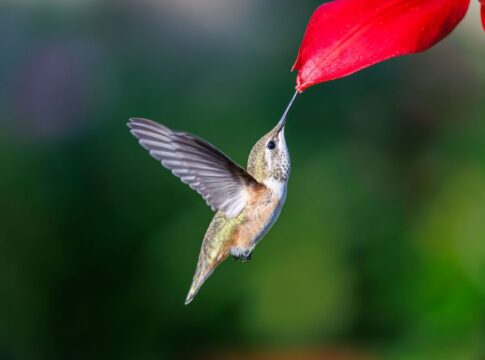
Hummingbirds defy the rules of conventional flight. These tiny creatures hover in midair, fly backward, and beat their wings so rapidly they become invisible blurs. What makes hummingbird flight mechanics so extraordinary isn’t just speed—it’s the unique anatomical adaptations and aerodynamic principles that allow these animals to perform aerial maneuvers no other bird can match. Their flight behavior represents one of nature’s most fascinating engineering marvels.
From rotating their wings in figure-eight patterns to achieving the highest metabolism of any vertebrate, hummingbirds have evolved specialized traits that push the boundaries of what’s possible in the animal kingdom. Understanding their flight reveals insights into physics, evolution, and the remarkable diversity of wildlife adaptations.
Key Takeaways
- Hummingbirds can beat their wings up to 80 times per second during courtship displays, producing the characteristic humming sound.
- They are the only birds capable of sustained backward flight, thanks to a unique shoulder joint structure.
- Their wings rotate nearly 180 degrees at the shoulder, creating lift on both forward and backward strokes.
- Hummingbirds can hover in place by generating equal lift and thrust in a horizontal figure-eight wing pattern.
- These species have the highest metabolic rate of any vertebrate animal relative to their body size.
- Some hummingbirds migrate over 500 miles nonstop across the Gulf of Mexico despite weighing less than a nickel.
Understanding Hummingbird Flight Mechanics
The foundation of hummingbird flight mechanics lies in wing structure and movement that differs fundamentally from other birds. While most birds generate lift primarily on the downstroke, hummingbirds produce lift during both the downstroke and upstroke. This happens because their wings rotate at the shoulder joint through an arc of roughly 180 degrees, allowing the wing to flip over and maintain the correct angle of attack throughout the entire stroke cycle.
Their wing bones are also dramatically different. The humerus (upper arm bone) is extremely short, while the hand bones are elongated. This configuration means the wing pivots almost entirely at the shoulder. Most of what appears to be the wing is actually the “hand” section, creating a structure that acts more like a rotating propeller than a traditional bird wing. The result? Precision control and the ability to generate thrust in any direction.
1. Wings Beat at Astonishing Speeds During Normal Flight
The typical hummingbird beats its wings between 50 and 80 times per second during normal flight, depending on the species. Smaller hummingbirds generally beat their wings faster than larger ones. The Ruby-throated Hummingbird, a common species in North America, averages around 53 beats per second. During courtship dives, males can exceed 200 beats per second for brief moments. This rapid movement creates the distinctive humming sound that gives these creatures their name, as the wings vibrate the air at frequencies within human hearing range.
2. Figure-Eight Wing Pattern Enables Hovering
When hovering, hummingbirds trace a horizontal figure-eight pattern with their wingtips. The wing moves forward with the leading edge tilted down, then rotates and moves backward with the leading edge still tilted down relative to the direction of motion. This ingenious motion generates lift during both strokes, essentially allowing the bird to “stand” on air. The wings remain nearly horizontal throughout, unlike other birds whose wings move in a more vertical arc. This behavior is energetically expensive but provides unmatched stability for feeding from flowers.
3. Backward Flight Is a Unique Capability
Hummingbirds are the only birds that can fly backward for extended periods. This ability stems from their ball-and-socket shoulder joint, which provides exceptional range of motion. By adjusting the angle of their wings during the figure-eight pattern, they can generate net thrust in reverse. Other birds have more restricted shoulder joints designed for efficient forward flight. This backward flight allows hummingbirds to smoothly retreat from flowers after feeding without the vulnerable moment of turning around in tight spaces where predators might lurk.
4. Muscle Mass Dominates Body Composition
Flight muscles comprise approximately 25 to 30 percent of a hummingbird’s total body weight—one of the highest proportions among all animals. The pectoralis major (the primary flight muscle) is particularly massive. For comparison, these muscles represent about 15 to 25 percent of body weight in other strong-flying birds like pigeons. This muscle density provides the power needed for their demanding flight style, but it comes at a cost: hummingbirds must feed almost constantly during waking hours to fuel these energy-hungry tissues.
5. Metabolic Rate Reaches Extreme Levels
During active flight, a hummingbird’s metabolic rate is the highest measured in any vertebrate. Their heart rate can reach over 1,200 beats per minute during flight, and they take approximately 250 breaths per minute. To sustain this metabolism, they consume roughly half their body weight in nectar daily and visit hundreds of flowers. At night, they enter a hibernation-like state called torpor, during which their metabolic rate can drop by up to 95 percent and body temperature can fall from around 105°F to as low as 48°F, conserving precious energy until dawn.
6. Wing Loading Is Remarkably Low
Wing loading—the ratio of body weight to wing area—is exceptionally low in hummingbirds compared to other birds. This means they have relatively large wing surface area for their body weight, which provides excellent maneuverability and the ability to generate sufficient lift at low speeds. Lower wing loading allows for tighter turns, faster acceleration, and the precise control needed to maintain position while feeding. This contrasts sharply with fast-flying birds like falcons, which have high wing loading optimized for speed rather than agility.
7. Tail Feathers Provide Critical Stability and Control
While wings generate lift and thrust, the tail plays an essential role in hummingbird flight mechanics. During hovering, the tail is spread and held at specific angles to provide stability and prevent the body from pitching forward or backward. During forward flight, the tail acts as a rudder for steering and as an air brake for rapid deceleration. Some species have elaborate tail feathers that produce sounds during courtship displays, with the feathers themselves vibrating at specific frequencies as air rushes past during high-speed dives.
8. Visual Processing Matches Flight Demands
Hummingbird brains process visual information extraordinarily quickly to coordinate their rapid flight behavior. Their eyes are proportionally large, and they possess excellent color vision, including the ability to see ultraviolet light that reveals nectar guides on flowers invisible to humans. The temporal resolution of their vision—how quickly they can process changing images—far exceeds that of humans, allowing them to navigate through dense vegetation at high speed without collision. This neural processing speed is essential for predators and prey interactions in their habitat.
9. Migration Feats Seem Impossible for Their Size
Several hummingbird species undertake remarkable migrations despite their diminutive size. The Ruby-throated Hummingbird migrates across the Gulf of Mexico, a nonstop journey of approximately 500 miles that takes roughly 20 hours. Before migration, these birds nearly double their body weight through fat storage. The Rufous Hummingbird travels up to 3,000 miles from Alaska to Mexico, one of the longest migration routes relative to body size of any bird species. These journeys demonstrate the efficiency of their flight mechanics under sustained load.
10. Wing Shape Varies Among Species for Different Niches
Not all hummingbird wings are identical. Species have evolved different wing shapes suited to their specific ecological niches and behavior. Hermit hummingbirds, which inhabit dense forest understories, tend to have shorter, more rounded wings for maneuverability in cluttered habitats. Species that defend feeding territories in more open areas often have longer, more pointed wings that favor speed and efficient forward flight. These variations reflect evolutionary adaptations to different environmental pressures and feeding strategies across diverse habitats throughout the Americas.
11. Aerodynamic Forces Differ from Conventional Bird Flight
Traditional aerodynamic theory developed for fixed-wing aircraft doesn’t fully explain hummingbird flight. These birds generate most of their lift through unsteady aerodynamic mechanisms, including leading-edge vortices that form and shed with each wingbeat. The wings move at high angles of attack that would cause stalling in conventional wings, but the rapid motion and flexibility of hummingbird wings create complex vortex structures that enhance lift. Researchers have used high-speed cameras and computational fluid dynamics to understand these phenomena, revealing principles that may inspire micro-drone design.
Comparing Hummingbird Flight to Other Birds
| Flight Characteristic | Hummingbirds | Most Other Birds |
|---|---|---|
| Hovering ability | Sustained, efficient hovering | Brief or no hovering capability |
| Backward flight | Capable of sustained backward flight | Cannot fly backward |
| Wing rotation | ~180 degrees at shoulder | Limited rotation, ~90 degrees |
| Lift generation | Both upstroke and downstroke | Primarily downstroke |
| Wingbeat frequency | 50-80 beats/second (up to 200) | 5-20 beats/second typically |
Frequently Asked Questions
How fast can hummingbirds fly forward?
Most hummingbird species can fly forward at speeds between 25 and 30 miles per hour during normal flight. During courtship dives, some males can reach speeds exceeding 60 miles per hour in short bursts, making them among the fastest animals relative to body length per second.
Why don’t hummingbird wings make a flapping sound like other birds?
Hummingbird wings beat so rapidly that they produce a continuous humming tone rather than discrete flapping sounds. The frequency of wingbeats falls within the range of human hearing (50-200 Hz), creating the characteristic hum. Larger birds flap slowly enough that you hear individual wing strokes rather than a sustained tone.
Can hummingbirds walk or hop on the ground?
Hummingbirds have extremely small, weak legs relative to their body size and cannot walk or hop effectively. Their legs are used primarily for perching and occasionally for scratching. When they need to move short distances, they fly rather than walking, as their entire anatomy is optimized for aerial rather than terrestrial locomotion.
Do all hummingbird species have the same flight capabilities?
While all hummingbirds share the basic flight mechanics that enable hovering and backward flight, there are species-specific differences in speed, maneuverability, and endurance based on wing shape, body size, and habitat. Larger species tend to have slightly slower wingbeat frequencies but greater endurance, while smaller species excel at rapid maneuvering in tight spaces.
The next time you see a hummingbird hovering at a flower, you’re witnessing millions of years of evolutionary refinement compressed into a creature weighing less than a penny. Their flight isn’t just beautiful—it’s a masterclass in biological engineering that continues to inspire scientists and engineers seeking to unlock the secrets of agile, efficient flight.