
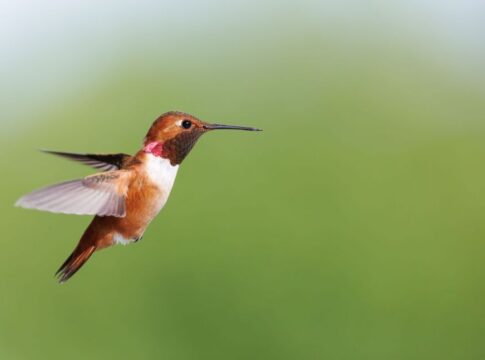
Hummingbird Flight: How They Hover and Fly Backwards
By Trivia Daily, Animals Desk — Published September 17, 2026
Table of Contents
- Key Takeaways
- The Mechanics of Hummingbird Flight Hover Ability
- Flying Backwards: A Unique Adaptation in the Animal Kingdom
- Comparing Hummingbird Species Flight Capabilities
- The Energy Cost of Extraordinary Flight
- How Evolution Shaped These Aerial Masters
- Frequently Asked Questions
Hummingbirds defy the ordinary rules of bird flight. While most birds can only fly forward, these tiny creatures hover in midair like helicopters and zip backwards with the same ease they fly ahead. The secret to hummingbird flight hover mechanics lies in wings that rotate in figure-eight patterns and muscles that power the fastest wing beats in the animal kingdom. No other bird species can match their aerial acrobatics, making hummingbirds some of the most remarkable animals in nature.
This extraordinary behavior isn’t just for show. Hummingbirds evolved these flight abilities to feed on flower nectar while staying perfectly still in front of blossoms. Their habitat demands precision flying, and evolution delivered wings that work more like insect wings than typical bird wings.
Key Takeaways
- Hummingbirds can beat their wings up to 80 times per second during normal flight, creating the distinctive humming sound that gives them their name.
- Their wings rotate in a full 180-degree arc, creating lift on both the forward and backward stroke—unlike other birds that only generate lift on the downstroke.
- Hummingbirds are the only bird species capable of sustained backward flight, making them unique among all wildlife.
- These creatures have proportionally the largest flight muscles of any bird, with their pectoral muscles making up roughly 25-30% of their total body weight.
- A hummingbird’s heart beats up to 1,200 times per minute during flight to fuel their incredible metabolism.
- Some hummingbird species can fly at speeds exceeding 30 miles per hour and dive at speeds approaching 60 miles per hour.
The Mechanics of Hummingbird Flight Hover Ability
Most birds fly by flapping their wings up and down, generating lift only on the downward stroke. Hummingbirds rewrote this blueprint entirely. Their wings connect to the body only at the shoulder joint, giving them rotational freedom that other birds lack. During each wing beat cycle, the wing traces a horizontal figure-eight pattern in the air.
On the forward stroke, the wing is angled to push air downward and backward. Then the wing rotates nearly 180 degrees at the end of the stroke and sweeps back in the opposite direction, still generating downward thrust. This means hummingbirds create lift throughout the entire wing beat cycle—both strokes contribute to staying aloft. The result? Perfect hovering with no net forward or backward movement.
The speed of these wing beats is staggering. Smaller species beat their wings faster than larger ones. The smallest hummingbirds can reach 80 beats per second, while larger species hover at around 12-15 beats per second. For comparison, a pigeon flaps its wings about 8 times per second.
Flying Backwards: A Unique Adaptation in the Animal Kingdom
Backward flight requires even more impressive wing control. To reverse direction, a hummingbird adjusts the angle of its wings during the figure-eight pattern, changing the direction of thrust. The wings still rotate through their full range of motion, but the angle of attack shifts to push air forward instead of backward.
Many insects can fly backwards—dragonflies, for instance, are masters of reverse flight. But among birds, hummingbirds stand alone. Other bird species might briefly flutter backward for a foot or two, but they cannot sustain controlled backward flight the way hummingbirds can. This behavior gives them crucial advantages when feeding, allowing them to back away from a flower after drinking nectar and immediately approach the next bloom without turning around.
The muscle power required is immense. Hummingbird pectoral muscles are exceptionally large relative to body size, and they’re built differently from other birds. Most birds have large muscles for the downstroke and smaller muscles for the upstroke. Hummingbirds have massive muscles for both strokes because both generate lift. This symmetry in muscle development is rare in nature and speaks to the evolutionary pressures these animals faced.
Comparing Hummingbird Species Flight Capabilities
| Species | Average Wing Beats Per Second | Top Forward Speed | Habitat Range |
|---|---|---|---|
| Ruby-throated Hummingbird | 53 | ~30 mph | Eastern North America |
| Anna’s Hummingbird | 40-50 | ~30 mph | Western North America |
| Bee Hummingbird | 80 | ~25 mph | Cuba |
| Giant Hummingbird | 12-15 | ~20 mph | South America |
The Energy Cost of Extraordinary Flight
Hovering is one of the most energy-intensive forms of locomotion in the animal world. Hummingbirds burn calories at a rate that would be unsustainable for most creatures. During active flight, their metabolic rate is the highest measured in any vertebrate. They must consume roughly half their body weight in nectar each day just to survive.
At night, when feeding is impossible, hummingbirds enter a state called torpor—a hibernation-like condition where their metabolism slows dramatically. Body temperature drops from around 105°F during the day to as low as 50°F. Heart rate plummets from over 1,000 beats per minute to fewer than 50. Without this adaptation, they would starve before morning.
The heart itself is a marvel. Relative to body size, hummingbirds have the largest hearts of any bird species. This oversized pump delivers oxygen-rich blood to flight muscles at rates that support their explosive energy demands. Their lungs are also proportionally larger and more efficient than those of other birds.
How Evolution Shaped These Aerial Masters
Hummingbirds evolved in South America roughly 22 million years ago. The fossil record for these tiny creatures is sparse—their delicate bones rarely fossilize—but genetic studies have traced their origins and diversification. As flowering plants radiated across the Americas, hummingbirds evolved alongside them in a classic example of co-evolution.
Flowers provided nectar, a high-energy food source that could support the metabolic demands of hovering flight. In return, hummingbirds became pollinators, carrying pollen from flower to flower. Many plant species in the Americas evolved tubular flowers specifically shaped for hummingbird bills. The relationship between these animals and their habitat is so tight that some flowers can only be pollinated by specific hummingbird species.
The wing structure itself shows clear evolutionary refinement. Hummingbird bones are thin and hollow, minimizing weight. The wing bones are short, with most of the wing’s length coming from elongated hand bones. This configuration allows for the rapid rotation needed for figure-eight flight patterns.
Frequently Asked Questions
Can hummingbirds walk or hop?
Hummingbirds have extremely small, weak feet and legs. They can perch on branches but cannot walk or hop like other birds. Their legs are used only for perching and scratching, and they must fly even to move a few inches along a branch.
How long can a hummingbird hover in one spot?
Hummingbirds can hover continuously for extended periods while feeding, often 30 seconds to a minute at a single flower. However, the energy cost is so high that they must feed frequently throughout the day and rest between feeding sessions.
Do baby hummingbirds learn to hover, or is it instinctive?
Hovering ability is largely instinctive. Young hummingbirds practice and refine their flight skills after leaving the nest, but the basic mechanics of figure-eight wing motion and hovering appear to be hardwired into their behavior from birth.
What is the smallest hummingbird species?
The Bee Hummingbird of Cuba holds the record as both the smallest hummingbird and the smallest bird in the world. Males weigh about 1.6 grams—less than a penny—and measure roughly 2 inches long, including the bill and tail.
Next time you see a hummingbird frozen in midair at a feeder, you’re watching biomechanics that took millions of years to perfect. These animals push the boundaries of what vertebrate flight can achieve, operating at the very edge of physical possibility every single day.