
The Truth About Fingerprints: Do Koalas Share Ours
By Trivia Daily, Staff Writer — Published September 8, 2026
Table of Contents
- Key Takeaways
- The Truth About Fingerprints and Koalas: An Evolutionary Mystery
- Why Fingerprints Exist at All
- Comparing Fingerprints Across Species
- The Crime Scene Curiosity
- What Makes Each Print Unique
- Frequently Asked Questions
Among the most surprising facts in the animal kingdom sits a curious truth: koalas possess fingerprints remarkably similar to human ones. Not just vaguely similar—so alike that they can confuse crime scene investigators. This amazing discovery reveals one of nature’s most interesting examples of convergent evolution, where unrelated species develop identical solutions to similar problems. The truth about fingerprints and koalas challenges what we thought we knew about uniqueness in the natural world.
Koalas, those eucalyptus-munching marsupials native to Australia, share this trait with only a handful of other creatures. Primates have fingerprints. Koalas have them too. Even more fascinating? Under a microscope, telling them apart becomes genuinely difficult.
Key Takeaways
- Koalas have fingerprints nearly identical to human fingerprints, featuring the same ridge patterns, whorls, and loops that make each print unique.
- Only primates (including humans), koalas, and some tree-dwelling mammals possess true fingerprints with these complex ridge patterns.
- Fingerprints evolved independently in koalas and primates—a classic example of convergent evolution solving the same problem in similar ways.
- The primary function of fingerprints in both species is improving grip on smooth surfaces and enhancing tactile sensitivity.
- Koala fingerprints are so similar to human prints that they could theoretically contaminate crime scenes, though no such case has been documented.
- Each koala’s fingerprint is unique, just like each human’s, with no two individuals sharing identical patterns.
The Truth About Fingerprints and Koalas: An Evolutionary Mystery
When scientists first examined koala paws under magnification, they encountered something unexpected. The fingerprints weren’t just similar—they displayed the same fundamental architecture as human prints. Ridges curve and loop. Patterns form whorls and arches. The spacing and depth mirror what forensic experts study daily.
This similarity becomes even more remarkable when you consider evolutionary distance. Humans and koalas last shared a common ancestor over 100 million years ago, long before either species developed fingerprints. Koalas are marsupials, carrying their young in pouches. Humans are placental mammals. The evolutionary paths diverged dramatically, yet both arrived at the same solution.
Convergent evolution explains this phenomenon. When different species face similar environmental challenges, natural selection sometimes favors identical adaptations. Wings evolved separately in birds, bats, and insects. Eyes developed independently across numerous lineages. Fingerprints represent another case where nature discovered the same answer twice.
Why Fingerprints Exist at All
The function of fingerprints puzzled scientists for decades. Early theories suggested they improved grip in wet conditions or helped channel water away from the fingers. Modern research points to two primary benefits: enhanced friction and improved tactile sensitivity.
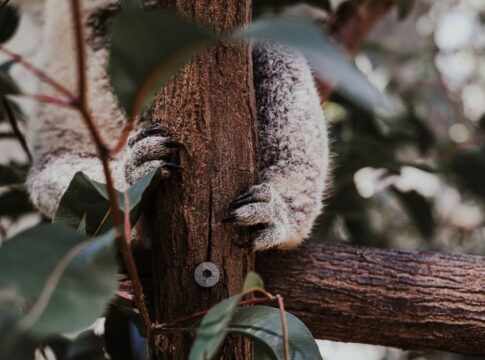
The raised ridges on fingertips increase surface area contact with objects. This creates more friction, making it easier to grip smooth or textured surfaces without slipping. For humans manipulating tools, this proves invaluable. For koalas climbing smooth eucalyptus bark and grasping leaves, the advantage becomes equally clear.
Beyond grip, fingerprints amplify touch sensitivity. The ridges act like tiny sensors, deforming under pressure and stimulating nerve endings beneath the skin. This allows both humans and koalas to detect fine textures and make precise movements. A koala selecting the most nutritious eucalyptus leaves benefits from this enhanced perception, just as humans benefit when handling delicate objects.
Comparing Fingerprints Across Species
| Species | Fingerprint Type | Primary Function | Unique Patterns |
|---|---|---|---|
| Humans | Complex dermal ridges | Tool manipulation, tactile sensitivity | Yes, each individual unique |
| Koalas | Complex dermal ridges | Gripping smooth bark, leaf selection | Yes, each individual unique |
| Chimpanzees | Complex dermal ridges | Climbing, object manipulation | Yes, each individual unique |
| Giant Pandas | Basic ridges on paws | Gripping bamboo stalks | Less complex patterns |
The Crime Scene Curiosity
Forensic experts have noted the theoretical possibility of koala fingerprints contaminating evidence at crime scenes in Australia. The similarity runs deep enough that casual examination might not distinguish between species. However, trained forensic analysts can spot differences. Koala prints show slightly different ridge density and spacing patterns when examined closely.
No documented case exists of a koala fingerprint actually confusing a criminal investigation. The scenario remains more theoretical than practical. Koalas rarely wander through human buildings, and their prints would need to be transferred to relevant surfaces at crime scenes—an unlikely chain of events.
Still, the possibility captures imaginations. It underscores just how precise evolution’s solutions can be. Two species, separated by vast evolutionary distance, developed security-system-grade biometric markers independently.
What Makes Each Print Unique
Both human and koala fingerprints form during fetal development through a complex interaction of genetic and environmental factors. As the fetus grows, skin cells multiply at different rates across the fingertip surface. Random variations in pressure, movement, and growth create unique ridge patterns.
This process means even identical twins have different fingerprints. The same holds true for koalas. Environmental factors during development—position in the pouch, movement patterns, pressure variations—ensure each individual develops distinct prints. Nature creates billions of unique identifiers without ever repeating a pattern.
The uniqueness serves no apparent evolutionary purpose. It’s a byproduct of how fingerprints form, not a selected trait. Yet this accidental uniqueness became invaluable for human forensic science and allows researchers to identify individual koalas in field studies.
Frequently Asked Questions
Can koala fingerprints really fool forensic experts?
While koala fingerprints are remarkably similar to human prints, trained forensic analysts can distinguish between them through careful examination of ridge density, spacing patterns, and other subtle characteristics. No actual case of confusion has been documented in criminal investigations.
Do any other animals besides koalas and primates have fingerprints?
Some tree-dwelling mammals show basic friction ridges, but only primates and koalas possess the complex dermal ridge patterns that create true fingerprints with whorls, loops, and arches. This makes fingerprints extremely rare in the animal kingdom.
Why did koalas evolve fingerprints if they’re marsupials?
Koalas evolved fingerprints independently because they face similar challenges to primates: gripping smooth surfaces (eucalyptus bark) and requiring enhanced tactile sensitivity for food selection. This is convergent evolution—different species developing identical solutions to similar problems.
Are koala fingerprints used to identify individual animals?
Yes, researchers can use fingerprints as one method to identify individual koalas in field studies, though other techniques like ear tags, microchips, and photographic identification of facial features and fur patterns are more commonly employed for wildlife monitoring.
The next time you press your finger against a smooth surface, consider the koala doing the same halfway around the world. Two species, one solution, millions of years apart. Evolution sometimes writes the same story twice, and the truth about fingerprints reminds us that nature’s creativity often lies in discovering what works—then discovering it again.