
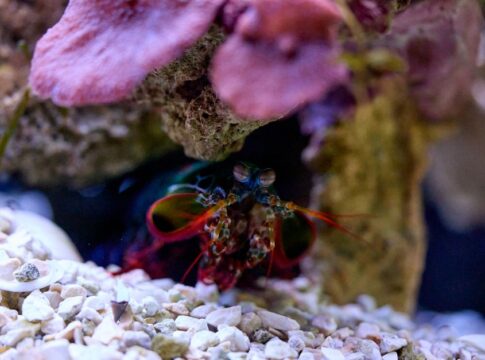
Why Mantis Shrimp Can Punch Hard Enough to Boil Water
By Trivia Daily, Staff Writer — Published November 26, 2026
Table of Contents
- Key Takeaways
- The Mechanics Behind the Mantis Shrimp Punch
- The Phenomenon of Cavitation
- Engineering Marvel: The Indestructible Club
- Smashers vs. Spearers: Two Hunting Strategies
- The Vision to Match the Weapon
- Frequently Asked Questions
Deep in the ocean, a creature the size of your thumb can throw a punch so powerful it creates a flash of light and a shock wave capable of killing prey instantly. The mantis shrimp punch is one of nature’s most astonishing feats of biomechanical engineering—and yes, the water around the strike really does reach boiling temperatures, if only for a fraction of a second. This colorful crustacean, despite its small size, has evolved one of the fastest and most devastating weapons in the animal kingdom, turning the physics of water and speed into a lethal hunting tool.
What makes this feat even more surprising is that mantis shrimp aren’t actually shrimp at all. They’re stomatopods, a distinct order of marine crustaceans that have been perfecting their punch for millions of years. Understanding how they generate such incredible force requires exploring the intersection of biology, physics, and materials science.
Key Takeaways
- Mantis shrimp can strike with speeds reaching approximately 50 miles per hour in water, making it one of the fastest movements in the animal kingdom.
- The strike creates cavitation bubbles that collapse with enough energy to produce temperatures around 7,000 degrees Fahrenheit—hotter than the sun’s surface—in a tiny localized area.
- Their specialized clubs or spears are made of a composite material tougher than most man-made ceramics, allowing them to withstand thousands of strikes without breaking.
- The punch delivers two impacts: the initial physical strike and a secondary shock wave from collapsing cavitation bubbles.
- Mantis shrimp possess the most complex eyes in the animal kingdom, with 16 types of color receptors compared to humans’ three.
- There are over 450 species of mantis shrimp, divided into “smashers” and “spearers” based on their hunting appendages.
The Mechanics Behind the Mantis Shrimp Punch
The secret to this devastating strike lies in a spring-loaded mechanism that would impress any engineer. Mantis shrimp don’t simply swing their appendages like a boxer throws a punch. Instead, they use a system called a “saddle”—a curved, spring-like structure made of chitin and minerals that stores elastic energy.
When a mantis shrimp prepares to strike, powerful muscles compress this saddle. A latch mechanism holds everything in place while the tension builds, much like cocking a crossbow. When the latch releases, the saddle snaps forward with explosive force, catapulting the striking appendage toward its target. This spring-loading system allows the mantis shrimp to generate far more speed and power than its muscles alone could produce.
The acceleration is mind-boggling. The appendage reaches peak velocity in just a few milliseconds, experiencing forces of more than 10,000 times the force of gravity. For comparison, astronauts experience about 3 times the force of gravity during a rocket launch. The strike happens so fast that it’s invisible to the naked eye—researchers need high-speed cameras operating at thousands of frames per second to capture the action.
The Phenomenon of Cavitation
Speed alone doesn’t explain the boiling water. The real magic happens because of cavitation, a physics phenomenon that occurs when an object moves through water faster than the water can flow out of the way. As the mantis shrimp’s club accelerates forward, it creates an area of extremely low pressure behind it. Water can’t fill this void fast enough, so vapor bubbles form.
These cavitation bubbles last only microseconds. When they collapse, they release enormous amounts of energy in an incredibly small space. The temperature inside a collapsing bubble can briefly reach several thousand degrees—hot enough to emit light in a process called sonoluminescence. This flash of light, though too brief and dim for most observers to see without specialized equipment, is real evidence of the extreme conditions created.
The collapsing bubbles also generate a secondary shock wave. Prey animals hit by a mantis shrimp’s strike experience a one-two punch: first the physical impact of the club itself, then a fraction of a second later, the shock wave from the cavitation. Even if the initial strike misses slightly, the shock wave can still stun or kill the target.
Engineering Marvel: The Indestructible Club
Striking hard objects at high speed thousands of times should destroy the mantis shrimp’s clubs, but evolution has crafted a remarkable solution. The club’s structure consists of three distinct regions, each optimized for a specific purpose. The impact region features a periodic arrangement of minerals and organic materials that distribute stress and prevent cracks from propagating. The internal striated region absorbs energy, while the outer region provides a hard, smooth striking surface.
Materials scientists have studied mantis shrimp clubs extensively, hoping to develop new composite materials for aerospace and military applications. The club’s architecture manages to be simultaneously hard enough to deliver devastating blows and tough enough to absorb the impact without shattering—a combination that’s difficult to achieve in human-engineered materials.
Smashers vs. Spearers: Two Hunting Strategies
Not all mantis shrimp hunt the same way. The group divides into two main categories based on their appendage design and prey preferences.
| Type | Appendage | Prey | Hunting Method |
|---|---|---|---|
| Smashers | Club-like hammers | Snails, crabs, mollusks | Pulverize hard shells with repeated strikes |
| Spearers | Sharp, barbed tips | Soft-bodied fish, worms | Impale prey with rapid stabbing motion |
Smashers are the ones famous for the boiling-water punch. They typically live in rocky crevices and hunt hard-shelled prey that need to be cracked open. Spearers tend to inhabit sandy or muddy burrows and ambush soft-bodied prey that can be caught and held with their barbed appendages. Both groups use incredibly fast strikes, but the physics and biological engineering differ based on their ecological niche.
The Vision to Match the Weapon
Mantis shrimp pair their remarkable striking ability with equally extraordinary eyes. Each eye can move independently and contains 16 types of photoreceptors—compared to the three types humans possess. This allows them to detect colors, polarized light, and even circular polarized light, which no other animal can see.
Their visual system processes information differently than ours. Rather than comparing signals from different receptors to determine color, each photoreceptor type appears to work more independently. This may allow for faster visual processing—an advantage when you need to identify prey and strike in milliseconds. The eyes sit on mobile stalks, giving mantis shrimp excellent depth perception and the ability to scan their environment without moving their body.
Frequently Asked Questions
Can a mantis shrimp hurt a human?
Yes, larger mantis shrimp species can deliver painful strikes capable of breaking through fingernails or even aquarium glass. Divers and aquarium handlers treat them with respect, and they’ve earned the nickname “thumb splitters” among those who work with marine life.
How long do mantis shrimp live?
Mantis shrimp typically live between 3 and 6 years in the wild, though some larger species may live up to 20 years. They spend most of their lives in burrows or rock crevices, emerging primarily to hunt.
Where do mantis shrimp live?
These creatures inhabit tropical and subtropical waters worldwide, from shallow coral reefs to depths of several hundred feet. They’re most diverse in the Indo-Pacific region, particularly around coral reefs and rocky coastal areas.
What is the biggest mantis shrimp species?
The largest species can reach lengths of about 15 inches, though most species measure between 4 and 6 inches. The peacock mantis shrimp, one of the most colorful and commonly studied species, typically grows to about 7 inches long.
The mantis shrimp reminds us that nature’s engineering often surpasses our own. In solving the problem of how to crack open hard-shelled prey in an underwater environment, evolution produced a creature that weaponizes the very physics of water itself—turning speed, pressure, and heat into a hunting tool that continues to fascinate scientists and inspire new technologies.