
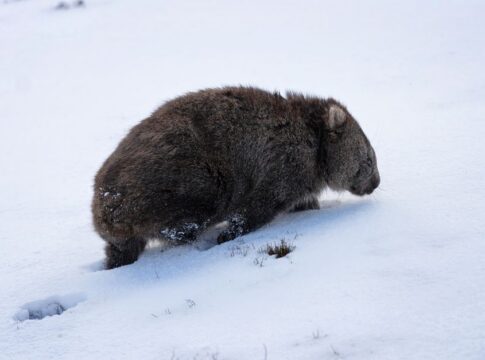
The Hidden Story of Why Wombats Poop Cubes Not Spheres
By Trivia Daily, Staff Writer — Published November 27, 2026
Table of Contents
- Key Takeaways
- The Hidden Story of Wombats: How Evolution Shaped a Square Solution
- The Intestinal Engineering Behind Nature’s Cubes
- Comparing Wombat Species and Their Cubic Capabilities
- Why This Discovery Matters Beyond Trivia
- Busting Common Myths About Wombat Droppings
- Frequently Asked Questions
In the animal kingdom, most creatures produce waste that’s round, cylindrical, or formless. But wombats? They’re nature’s geometric engineers, depositing perfectly cube-shaped droppings across the Australian landscape. This hidden story of wombats and their peculiar bathroom habits has puzzled scientists for decades and sparked curiosity among anyone who discovers this amazing fact. The answer isn’t just trivia—it’s a fascinating tale of biology, physics, and survival strategy rolled into one surprising package.
These stocky marsupials produce between 80 and 100 cube-shaped pellets every night. Each cube measures roughly two centimeters per side. You might wonder how any animal manages to form such precise geometric shapes through a biological process, and that’s exactly what makes this one of nature’s most interesting mysteries.
Key Takeaways
- Wombats are the only animals known to produce cube-shaped feces, depositing 80-100 pellets nightly to mark their territory.
- The cube shape forms in the final portion of the intestine, where varying elasticity in the intestinal walls creates flat sides and sharp corners.
- Cube-shaped droppings serve a practical purpose: they don’t roll away, making them ideal territorial markers on rocks and logs.
- Research published by scientists studying wombat intestines revealed the process takes approximately 14-18 days from digestion to excretion.
- The discovery has inspired engineers exploring new ways to mold materials without traditional cube-forming techniques.
- All three wombat species—common, southern hairy-nosed, and northern hairy-nosed—share this remarkable cubic capability.
The Hidden Story of Wombats: How Evolution Shaped a Square Solution
Wombats face a unique challenge in their Australian habitat. These territorial creatures need to communicate boundaries to other wombats, but they live in areas with sloped terrain, rocky outcrops, and uneven surfaces. A round dropping would simply roll away. A cylindrical one might tumble off a log or rock. Evolution’s answer? Create a shape that stays put.
The cube shape serves as nature’s perfect non-rolling marker. Wombats strategically place their droppings on elevated surfaces—fallen logs, rocks, and prominent spots—where other wombats will notice them. It’s their version of a “No Trespassing” sign. The geometric precision ensures these territorial messages remain exactly where they’re placed, even on steep inclines or windy nights.
But why cubes specifically? The answer lies in a compromise between stability and biological feasibility. A perfect cube has flat faces and sharp edges that prevent rolling in any direction. Yet it’s still simple enough for an animal’s body to produce without conscious effort. Nature rarely creates perfect right angles, making this achievement all the more remarkable.
The Intestinal Engineering Behind Nature’s Cubes
Scientists studying wombat anatomy discovered that the secret lies in the final eight percent of the intestine. Unlike most mammals, whose intestinal walls have uniform elasticity, wombats possess intestines with alternating sections of stiff and flexible tissue. Think of it like a series of grooves and ridges that gradually mold the waste as it moves through.
The process works through differential contraction. As the intestinal muscles rhythmically squeeze, the stiffer sections compress the waste into flat planes while the more elastic regions allow slight bulging at the corners. Over the course of digestion—which takes about two weeks—the waste slowly transforms from a formless mass into a distinct cube with surprisingly sharp edges.
Researchers at institutions including the Georgia Institute of Technology have examined wombat intestines to understand this biomechanical marvel. They found that the varying thickness and elasticity of the intestinal tissue creates zones of different pressure. These pressure zones literally sculpt the feces into shape, one contraction at a time.
The final product emerges dry and firm. Wombats have extremely efficient digestive systems that extract nearly all available moisture and nutrients from their fibrous diet of grasses, roots, and bark. This dryness helps the cubes maintain their shape after excretion, unlike the softer waste of many other herbivores.
Comparing Wombat Species and Their Cubic Capabilities
| Wombat Species | Conservation Status | Cube Production Rate | Primary Habitat |
|---|---|---|---|
| Common Wombat | Least Concern | 80-100 per night | Southeastern Australia, Tasmania |
| Southern Hairy-Nosed Wombat | Near Threatened | 80-100 per night | Southern Australia, semi-arid regions |
| Northern Hairy-Nosed Wombat | Critically Endangered | 80-100 per night | Queensland, limited range |
Why This Discovery Matters Beyond Trivia
The wombat’s cubic droppings aren’t just a curious fact for party conversations. Engineers and materials scientists have taken notice. The ability to form cubes through soft-tissue manipulation—without molds, cutting, or external shaping—offers potential insights for manufacturing processes.
Traditional cube-making requires rigid molds or cutting from larger blocks. But the wombat achieves this through controlled pressure and strategic tissue elasticity. Researchers are exploring whether similar principles could apply to manufacturing processes, particularly for materials that are difficult to mold using conventional methods.
The discovery also highlights how much we still don’t know about common animals. Wombats have lived in Australia for millions of years, yet scientists only recently understood the mechanism behind their cubic feces. It’s a reminder that nature holds countless secrets waiting to be explored, even in creatures we think we know well.
Busting Common Myths About Wombat Droppings
Several misconceptions have circulated about how wombats create their distinctive waste. Some people assume the shape forms at the moment of excretion, like toothpaste squeezed through a square-shaped opening. Wrong. The anus is round, just like most mammals. The cubes form well before reaching the exit.
Another myth suggests wombats consciously shape their droppings or that the process causes them discomfort. There’s no evidence for either claim. The cube formation happens naturally through digestive processes, requiring no more effort than any other animal expends during elimination.
Some have wondered if diet affects cube formation. While wombats do eat various plant materials depending on availability, all wombats produce cubes regardless of their specific menu. The shape comes from intestinal structure, not food choice.
Frequently Asked Questions
Do baby wombats produce cube-shaped poop from birth?
Young wombats develop the ability to produce cubes as their digestive systems mature. Joeys initially produce softer, less geometric waste, with the distinctive cube shape becoming more pronounced as they grow and their intestinal structure fully develops.
How many sides does a wombat dropping actually have?
Wombat droppings are true cubes with six faces, twelve edges, and eight corners. While not geometrically perfect, they exhibit remarkably flat sides and distinct edges that clearly distinguish them from the rounded waste of other animals.
Can other animals produce cube-shaped feces?
No other known animal produces cube-shaped droppings. Wombats hold the unique distinction in the animal kingdom, making them the sole practitioners of this peculiar biological feat among all documented species.
How long do wombat cube droppings last in the environment?
Due to their dry composition and firm structure, wombat cubes can persist in the environment for months or even years in dry conditions. This durability enhances their effectiveness as long-lasting territorial markers.
The next time you encounter a fun fact about unusual animal behaviors, remember the wombat. In a world where nature constantly surprises us, these Australian marsupials remind us that evolution solves problems in ways we’d never imagine—one perfect cube at a time.