
Medusa Myths: The Greek Origin Behind the Snake-Haired Gorgon
By Trivia Daily, Staff Writer — Published September 27, 2026
Table of Contents
- Key Takeaways
- The Gorgon Sisters: Not All Created Equal
- Perseus and the Impossible Quest
- The Head That Kept on Killing
- Gorgoneion: When Monsters Become Guardians
- Blood, Poison, and Healing
- Frequently Asked Questions
One of mythology’s most terrifying figures turns people to stone with a single glance. Medusa, the snake-haired monster from ancient Greek lore, has haunted imaginations for thousands of years. But the medusa myths Greek storytellers passed down reveal surprising layers beneath the horror—tales of beauty transformed, divine punishment, and a mortal woman caught between gods. What fascinating trivia hides in the coils of her serpentine hair?
The story you think you know about Medusa likely misses crucial details. Many assume all three Gorgon sisters were born monsters, or that Medusa always possessed her deadly gaze. Discover the real origins of this legendary figure and explore how ancient Greeks used her myth to explain everything from protective amulets to the birth of flying horses.
Key Takeaways
- Medusa was the only mortal among the three Gorgon sisters, making her uniquely vulnerable to death.
- According to later Greek sources, Medusa began as a beautiful priestess before her transformation into a monster.
- Her severed head retained its petrifying power even after death, becoming a weapon for heroes.
- The winged horse Pegasus sprang from Medusa’s neck when Perseus beheaded her.
- Ancient Greeks commonly used Medusa’s face—the Gorgoneion—as a protective symbol on shields, temples, and household items.
- Perseus used a polished shield as a mirror to avoid Medusa’s deadly gaze during their confrontation.
The Gorgon Sisters: Not All Created Equal
Greek mythology tells of three Gorgon sisters: Stheno, Euryale, and Medusa. The first two were immortal, born as monsters with brass hands, golden wings, and serpents for hair. Medusa stood apart. She alone was mortal, which raises an interesting question—why would one sister receive such different treatment from the gods?
The answer lies in competing versions of her origin story. The earliest Greek sources, including the poet Hesiod, describe Medusa as born monstrous. Later writers, particularly the Roman poet Ovid, introduced a more tragic backstory. In this version, Medusa began as a beautiful maiden, a priestess in Athena’s temple. After Poseidon violated her in the sacred space, Athena punished Medusa by transforming her lovely hair into venomous serpents and making her face so hideous that anyone who looked upon it turned to stone.
Whether born a monster or transformed into one, Medusa’s mortality sealed her fate. Heroes cannot slay immortal beings, after all.
Perseus and the Impossible Quest
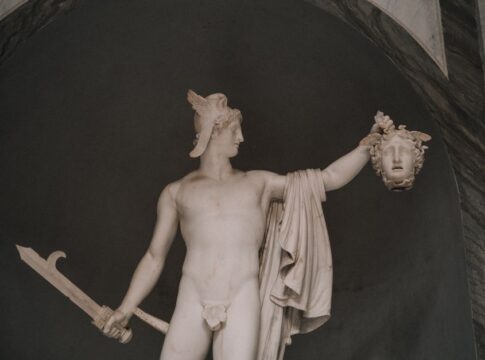
The hero Perseus received what seemed like a suicide mission: bring back Medusa’s head. King Polydectes, who desired Perseus’s mother, designed this quest hoping the young man would never return. But Perseus had divine parentage—Zeus was his father—and the gods equipped him for success.
He received remarkable gifts from various deities. Athena provided a polished bronze shield. Hermes contributed winged sandals and a sword sharp enough to cut through Medusa’s scales. The nymphs gave him Hades’s cap of invisibility and a special bag to carry the severed head. These weren’t mere accessories. Each tool solved a specific problem in confronting a creature whose very appearance meant death.
The polished shield proved most clever. Perseus approached Medusa while she slept, watching her reflection in the shield’s surface rather than looking directly at her. This allowed him to aim his sword without meeting her petrifying gaze. When he struck, two astonishing beings emerged from her severed neck: Pegasus, the winged horse, and Chrysaor, a giant wielding a golden sword. Both were children of Poseidon, conceived before Medusa’s transformation.
The Head That Kept on Killing
Medusa’s power survived her death. Perseus discovered that the severed head retained its ability to turn living creatures to stone, making it an incredibly potent weapon. He used it strategically on his journey home.
When the Titan Atlas refused Perseus hospitality, the hero showed him Medusa’s face, transforming Atlas into the mountain range that still bears his name in North Africa. Perseus later used the head to rescue his future wife, Andromeda, by petrifying the sea monster threatening her. Finally, when he returned home to find King Polydectes harassing his mother, Perseus unveiled the Gorgon’s head at the king’s court, turning Polydectes and his supporters to stone.
Eventually, Perseus gave the head to Athena, who mounted it on her aegis—a shield or breastplate depending on the source. The goddess wore this ultimate defensive weapon into battle, her enemy’s face serving as her protection.
Gorgoneion: When Monsters Become Guardians
Ancient Greeks didn’t just tell stories about Medusa—they painted, carved, and wore her image everywhere. The Gorgoneion, or Medusa’s face, became one of the most popular protective symbols in the ancient Mediterranean world.
These weren’t always terrifying depictions. Early Gorgoneions often appeared grotesque and exaggerated, with bulging eyes, protruding tongue, and wild serpents. Later artistic representations sometimes made her beautiful, emphasizing the tragedy of her transformation. Either way, the purpose remained constant: apotropaic magic, the use of frightening images to ward off evil.
| Location | Purpose | Symbolic Meaning |
|---|---|---|
| Temple pediments | Protect sacred spaces | Divine guardianship |
| Warriors’ shields | Frighten enemies | Psychological warfare |
| Household ovens | Ward off misfortune | Domestic protection |
| Coins and currency | Prevent theft or fraud | Economic safeguarding |
The logic was simple yet powerful: if Medusa’s actual face turned people to stone, surely her image could freeze evil intentions before they manifested. Citizens of ancient Athens, Corinth, and countless other city-states trusted her monstrous visage to protect their homes, temples, and treasures.
Blood, Poison, and Healing
Greek myths credited Medusa’s blood with contradictory properties. Blood drawn from her left side supposedly contained deadly venom, capable of killing instantly. Blood from her right side could raise the dead or cure any disease. This duality reflects a common theme in Greek thought—the same source yielding both destruction and salvation depending on how it’s used.
The physician-god Asclepius reportedly received vials of Medusa’s blood from Athena. He used the healing blood to resurrect the dead, a power that ultimately led Zeus to strike him down with a thunderbolt. Even divine medicine had limits in the Greek worldview. Bringing back the dead upset the natural order that separated mortals from gods.
Frequently Asked Questions
Why was Medusa the only mortal Gorgon?
Ancient sources don’t explicitly explain why Medusa alone was mortal while her sisters Stheno and Euryale were immortal. This distinction was necessary for the Perseus myth, as Greek heroes typically couldn’t kill immortal beings. Some scholars suggest her mortality relates to her transformation from human to monster in later versions of the story.
Could Medusa turn herself to stone by looking in a mirror?
Greek myths don’t address this directly, but Perseus’s use of a reflective shield suggests reflections didn’t carry the petrifying curse. The shield showed Medusa’s image without transmitting her deadly power, implying the magic required direct eye contact with the actual Gorgon rather than her reflection.
What happened to Medusa’s sisters after Perseus killed her?
According to myth, Stheno and Euryale pursued Perseus after he beheaded their sister, but he escaped using Hades’s cap of invisibility and Hermes’s winged sandals. As immortals, the two surviving Gorgons presumably continued existing, though they disappear from most mythological narratives after this point.
Did ancient Greeks actually believe Medusa was real?
Religious belief in ancient Greece was complex and varied by region and time period. Many Greeks likely viewed myths as symbolic stories containing moral and cultural truths rather than literal historical events. However, the widespread use of Gorgoneion protective symbols suggests genuine faith in Medusa’s apotropaic power, even if not her physical existence.
The serpent-crowned Gorgon reminds us that ancient myths rarely offer simple monsters or straightforward heroes. Medusa embodies transformation, vulnerability, and the dangerous intersection of beauty and power. Her story continues resonating because it asks uncomfortable questions about punishment, victimhood, and who truly deserves to be called monstrous. Even thousands of years later, we’re still looking—carefully, like Perseus with his shield—trying to understand what her reflection reveals about ourselves.