
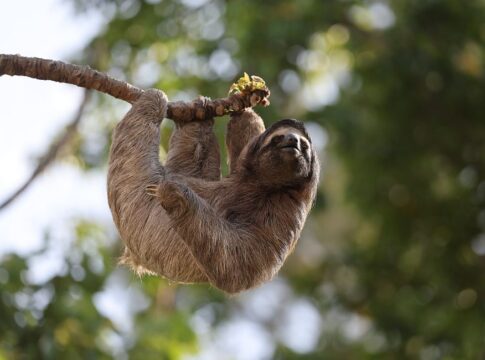
Why Sloths Move So Slowly: The Evolutionary Advantage
By Trivia Daily, Animals Desk — Published September 28, 2026
Table of Contents
- Key Takeaways
- The Metabolic Blueprint: Why Sloths Move Slowly
- Camouflage Through Stillness
- Comparing Sloth Species and Their Speeds
- Energy Conservation as Survival Strategy
- Ancient Relatives and Modern Adaptations
- Frequently Asked Questions
Sloths move slowly—not because they’re lazy, but because millions of years of evolution shaped them into masters of energy conservation. While most animals sprint, climb, or swim with speed and agility, sloths have perfected the art of extreme slow motion, traveling at a maximum speed of about 0.15 miles per hour through the rainforest canopy. This deliberate sluggishness isn’t a disadvantage. It’s a brilliant survival strategy that has allowed these remarkable creatures to thrive in their habitat for over 64 million years.
The secret behind why sloths move slowly lies in their extraordinarily low metabolic rate—among the lowest of any mammal on Earth. This unique physiology transforms what looks like a weakness into one of nature’s most successful adaptations.
Key Takeaways
- Sloths have the lowest metabolic rate of nearly any mammal, burning calories at roughly half the rate expected for their body size.
- Their slow movement makes them nearly invisible to predators like harpy eagles and jaguars, which hunt by detecting motion.
- A sloth’s diet of leaves provides so little energy that rapid movement would be metabolically impossible to sustain.
- Sloths descend from their trees only about once per week to defecate, minimizing exposure to ground predators.
- These animals sleep 15 to 20 hours daily, further conserving precious energy reserves.
- Six sloth species exist today, divided into two-toed and three-toed varieties, all native to Central and South American rainforests.
The Metabolic Blueprint: Why Sloths Move Slowly
At the heart of sloth behavior lies an astonishingly slow metabolism. These creatures process food so gradually that a single meal can take up to a month to digest completely. Their stomach operates more like a fermentation chamber, relying on symbiotic bacteria to break down tough, fibrous leaves that would be indigestible to most animals. This extended digestion timeline means that a sloth’s stomach can account for up to 30 percent of its body weight.
The leaves that make up their diet provide minimal nutritional value and very few calories. Unlike fruits or protein-rich foods, leaves are essentially low-energy roughage. To survive on this meager fuel source, sloths evolved to do everything in slow motion. Quick movements would burn through their limited energy reserves faster than they could replenish them through eating.
Their body temperature fluctuates more than most mammals, sometimes dropping to match their surroundings—a trait more commonly associated with reptiles than warm-blooded wildlife. This thermoregulation flexibility saves enormous amounts of energy that would otherwise go toward maintaining a constant internal temperature.
Camouflage Through Stillness
In the wild rainforest, motion attracts attention. Predators like harpy eagles possess exceptional eyesight designed to spot movement in the dense canopy. Jaguars and ocelots patrol the forest floor, watching for any animal foolish enough to move quickly. Sloths have turned this hunting strategy against their predators by simply refusing to move at detectable speeds.
Their fur hosts a unique ecosystem of algae, giving them a greenish tint that blends seamlessly with the foliage. Moths, beetles, and other insects live permanently in their coat, creating a mobile habitat. This living camouflage, combined with glacial movements, renders sloths nearly invisible. A predator might look directly at a sloth and perceive only another clump of leaves and moss.
When danger does approach, a sloth’s best defense remains absolute stillness. They can hang motionless for hours, their powerful grip locked onto branches even while sleeping. This behavior proves so effective that researchers sometimes struggle to locate sloths during field studies, despite knowing roughly where to look.
Comparing Sloth Species and Their Speeds
| Species Type | Number of Species | Maximum Speed (mph) | Primary Habitat |
|---|---|---|---|
| Three-toed sloths | 4 species | 0.15 | Rainforest canopy |
| Two-toed sloths | 2 species | 0.17 | Rainforest canopy |
| Ground sloths (extinct) | Multiple species | Variable | Ground-dwelling |
Energy Conservation as Survival Strategy
Every aspect of sloth anatomy reflects their energy-saving lifestyle. Their muscle mass represents only about 25 percent of their total body weight, compared to roughly 40 to 45 percent in most mammals. Less muscle means less tissue demanding constant fuel. The muscles they do possess contain specialized slow-twitch fibers designed for endurance and grip strength rather than explosive power.
Sloths even conserve energy in their bathroom habits. Descending to the forest floor to defecate—their weekly ritual—represents one of the most dangerous activities they undertake. On the ground, they’re vulnerable and awkward. Yet they make this risky journey anyway, possibly to fertilize the trees they depend on or to facilitate their symbiotic relationship with sloth moths. The infrequency of these trips minimizes both energy expenditure and predator exposure.
Their low-energy lifestyle extends to reproduction and growth. Baby sloths develop slowly, clinging to their mothers for months while learning which leaves are safe to eat. This extended childhood allows young sloths to master the art of efficient movement and optimal feeding without wasting precious calories on trial and error.
Ancient Relatives and Modern Adaptations
Today’s tree-dwelling sloths represent a tiny fraction of sloth diversity throughout evolutionary history. During the Ice Age, massive ground sloths roamed the Americas, some reaching the size of modern elephants. These extinct giants included species that weighed several tons and stood upright to browse on high vegetation. Unlike their diminutive descendants, many ground sloths likely moved with considerably more speed and power.
The transition from ground to trees occurred millions of years ago, driven by competition and predation pressures. Tree-dwelling offered safety and a relatively untapped food source, but it required radical anatomical changes. Modern sloths developed their distinctive long, curved claws—perfect for hanging but nearly useless for walking. Their shoulder joints rotated to allow 360-degree arm rotation, enabling them to reach leaves in any direction without repositioning their entire body.
This arboreal specialization locked them into their slow-motion existence. The same adaptations that make them supreme tree-dwellers render them helpless on solid ground, where they must drag themselves along in an awkward crawl.
Frequently Asked Questions
How slow do sloths actually move?
Sloths travel at a maximum speed of approximately 0.15 miles per hour in trees and even slower on the ground. They typically move only about 40 yards per day, making them one of the slowest mammals on Earth.
Can sloths move quickly if they need to escape danger?
Sloths cannot significantly increase their speed even in emergencies due to their low muscle mass and metabolic constraints. Their defense strategy relies on camouflage and stillness rather than flight, though they can swim somewhat faster than they move through trees.
Do sloths ever come down from trees?
Sloths descend to the forest floor approximately once per week to defecate. This is one of their most vulnerable moments, as they’re much slower and more awkward on the ground than in the canopy where they’re adapted to live.
Are sloths endangered due to their slow movement?
Several sloth species face threats from habitat loss rather than their slow speed. The pygmy three-toed sloth is critically endangered, while other species are classified as vulnerable or of least concern depending on their range and population stability.
The sloth’s evolutionary gamble on slowness has paid off for tens of millions of years. In a world that often celebrates speed and aggression, these gentle creatures prove that sometimes the best strategy is to simply take life one leisurely movement at a time. Their continued survival in an ever-changing world reminds us that nature rewards many different approaches to the challenge of staying alive.