
Why Sloths Risk Their Lives to Poop on the Ground Weekly
By Trivia Daily, Animals Desk — Published September 7, 2026
Table of Contents
- Key Takeaways
- Why Sloths Risk Their Lives During Their Weekly Bathroom Routine
- The Moth Connection: An Unusual Partnership
- Living Gardens: How Algae Benefits Sloths
- Comparing Sloth Species and Their Bathroom Behaviors
- The Extreme Slowness That Makes Weekly Pooping Possible
- Frequently Asked Questions
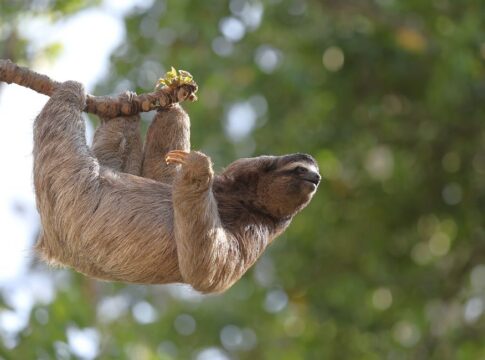
Sloths are among the strangest creatures in the animal kingdom, and their bathroom habits might be the oddest thing about them. These slow-moving mammals spend nearly their entire lives hanging in trees, yet once a week they descend to the forest floor to defecate—a journey that makes them vulnerable to predators and costs them roughly 8 percent of their body weight in energy. Scientists have puzzled over why sloths risk their lives for this weekly ritual when they could simply go from the safety of the canopy.
The answer involves moths, algae, and one of nature’s most unusual symbiotic relationships. This bizarre behavior showcases how evolution creates solutions that seem counterintuitive but serve essential survival purposes in the complex web of tropical ecosystems.
Key Takeaways
- Sloths descend from trees approximately once per week to defecate on the ground, exposing themselves to predators like jaguars and harpy eagles that kill up to half of all adult sloths.
- The ground-pooping behavior allows specialized moths to lay eggs in sloth dung, and these moths later return to live in the sloth’s fur as adults.
- Moths in sloth fur contribute nitrogen when they die, fertilizing algae that grows in the animal’s coat and provides both camouflage and a supplemental food source.
- Three-toed sloths have the slowest metabolic rate of any non-hibernating mammal, processing food so slowly they only need to defecate about once per week.
- Sloths can lose up to 30 percent of their body weight during a single bathroom trip when they release stored waste.
- This species performs a distinctive “poo dance” by wiggling back and forth while gripping a tree trunk, possibly to help stimulate bowel movements.
Why Sloths Risk Their Lives During Their Weekly Bathroom Routine
The sloth’s descent represents one of the most dangerous moments in its life. These animals evolved for life in the canopy, where their slow movement actually helps them avoid detection by predators that hunt by tracking motion. On the ground, however, sloths become easy targets. They move at speeds of just 6 to 8 feet per minute on land—far too slow to escape a jaguar or ocelot.
Predation accounts for a significant portion of sloth deaths. Big cats patrol the forest floor, and the distinctive behavior of a sloth climbing down, digging a small hole with its tail, defecating, covering the waste, and climbing back up creates a predictable pattern that predators can exploit. The entire process takes about 30 minutes, during which the sloth is exceptionally vulnerable.
Given these risks, the logical question becomes: why bother? Howler monkeys, spider monkeys, and most other arboreal mammals simply defecate from the trees. The waste falls to the forest floor without requiring the animal to risk its life. Yet sloths persist in this dangerous weekly ritual, suggesting powerful evolutionary advantages must offset the substantial costs.
The Moth Connection: An Unusual Partnership
The answer lies partly with moths. Several species of pyralid moths have evolved to live exclusively in sloth fur, and these insects depend on the sloth’s ground-pooping behavior to complete their lifecycle. When a sloth defecates on the forest floor, female moths fly from the fur to lay their eggs in the fresh dung. The moth larvae develop in the nutrient-rich waste, eventually emerging as adults that fly up into the canopy to find another sloth host.
Some individual sloths host over 120 moths in their fur at any given time. This creates a mobile ecosystem—the sloth becomes a habitat unto itself. But the relationship goes deeper than simple hitchhiking. The moths play a crucial role in maintaining the algae gardens that grow in sloth fur, which brings us to the second part of this ecological puzzle.
Living Gardens: How Algae Benefits Sloths
Sloth fur grows in the opposite direction from most mammals—from belly to back—allowing water to run off efficiently in the rainforest environment. The grooved structure of each hair creates ideal conditions for algae growth, giving sloths their characteristic greenish tinge. This isn’t accidental. The algae provides valuable camouflage, helping sloths blend into the foliage and avoid visual predators like harpy eagles.
Research has revealed that sloths actively consume algae growing in their own fur, gaining lipids and other nutrients. The algae essentially functions as a supplemental food source, enriching the sloth’s low-calorie leaf diet. Here’s where the moths become critical: when moths die in the fur, their decomposing bodies release nitrogen and other nutrients that fertilize the algae, promoting more abundant growth.
By descending to poop on the ground, sloths maintain their moth populations. More moths mean better-fertilized algae gardens. Better algae means improved camouflage and nutrition. The dangerous weekly journey becomes an investment in this three-way symbiotic relationship between sloth, moth, and algae.
Comparing Sloth Species and Their Bathroom Behaviors
| Species | Defecation Frequency | Moth Population | Ground Descent Behavior |
|---|---|---|---|
| Three-toed sloths | Once per week | High (often 100+ moths) | Always descends to ground |
| Two-toed sloths | Variable | Low (few moths) | Often defecates from trees |
The difference between three-toed and two-toed sloths highlights how this behavior specifically benefits certain species. Three-toed sloths, which follow the ground-pooping ritual religiously, host significantly more moths and display greener, algae-rich fur than their two-toed cousins. This suggests the behavior evolved as part of an integrated survival strategy rather than a random quirk.
The Extreme Slowness That Makes Weekly Pooping Possible
Sloths can manage a weekly bathroom schedule because their entire physiology operates in extreme slow motion. Their metabolic rate ranks among the lowest of any mammal, running at just 40 to 45 percent of what would be expected for an animal of their size. This allows them to survive on a diet of leaves, which provide minimal nutrition and take an extraordinarily long time to digest.
Food moves through a sloth’s multi-chambered stomach so slowly that full digestion can take up to a month. The stomach can account for up to 30 percent of the animal’s body weight when full. This glacial digestive pace means waste accumulates slowly, making weekly elimination sufficient. Other leaf-eating mammals like koalas must defecate daily despite similar diets, but their faster metabolisms demand more frequent waste removal.
The sloth’s slow metabolism also means it burns very few calories, which helps offset the energy cost of the dangerous ground descent. For a faster animal, weekly trips to the forest floor might be unsustainable. For sloths, the energy budget somehow balances, though just barely.
Frequently Asked Questions
How often do sloths poop?
Three-toed sloths typically defecate once every five to seven days. Their exceptionally slow metabolism and digestive process allows them to accumulate waste over this extended period, eliminating the need for more frequent bathroom trips that would increase predation risk.
Why don’t sloths just poop from the trees?
Sloths descend to poop on the ground to maintain populations of specialized moths in their fur, which fertilize algae that provides camouflage and supplemental nutrition. This symbiotic relationship appears to provide survival benefits that outweigh the substantial predation risks of ground descent.
What percentage of sloths die from predators during bathroom trips?
Researchers estimate that predation accounts for roughly half of all adult sloth deaths, with many of these attacks occurring during vulnerable ground descents for defecation. The weekly bathroom ritual represents one of the most dangerous regular activities in a sloth’s life.
Do all sloth species poop on the ground?
No, primarily three-toed sloths consistently descend to defecate on the forest floor. Two-toed sloths often defecate from trees and host fewer moths in their fur, suggesting this behavior is more important to certain species than others.
The sloth’s risky bathroom behavior reminds us that evolution doesn’t always optimize for safety—sometimes survival depends on maintaining complex ecological relationships that require dangerous compromises. Next time you encounter a sloth hanging peacefully in a tree, remember that beneath that serene exterior lives an animal hosting its own miniature ecosystem, one that demands a weekly pilgrimage to the forest floor no matter the cost.