
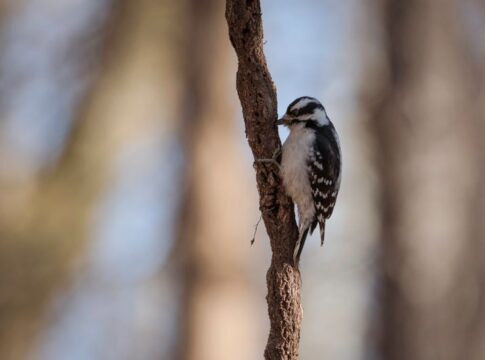
Why Woodpeckers Do Not Get Concussions from Pecking Trees
By Trivia Daily, Animals Desk — Published November 28, 2026
Table of Contents
- Key Takeaways
- The Physics of Woodpeckers Concussions Pecking
- Anatomical Adaptations That Prevent Brain Injury
- Comparing Woodpecker Species and Their Pecking Behavior
- Additional Protective Mechanisms
- What Scientists Have Learned from Wildlife Research
- Frequently Asked Questions
Imagine slamming your head into a solid surface at high speed up to 12,000 times a day. For most creatures, this would result in catastrophic brain injury within minutes. Yet woodpeckers perform this seemingly self-destructive act throughout their lives without suffering any apparent harm. The question of why woodpeckers avoid concussions from pecking has fascinated scientists for decades, revealing one of nature’s most remarkable examples of evolutionary engineering.
These remarkable birds hammer away at trees to find food, establish territory, and excavate nesting cavities. Each peck generates forces that would knock a human unconscious. The secret lies in an extraordinary suite of anatomical adaptations that work together as a sophisticated shock-absorption system, protecting the woodpecker’s brain from the relentless impacts that define its daily existence.
Key Takeaways
- Woodpeckers strike trees at speeds of 15 to 20 miles per hour, experiencing deceleration forces up to 1,200 times the force of gravity with each impact.
- A specialized skull structure with spongy bone between the outer and inner layers acts as a natural shock absorber, distributing impact forces away from the brain.
- The hyoid bone—a ribbon-like structure that wraps around the skull—functions as a safety belt, stabilizing the brain and cushioning it during impacts.
- Woodpeckers have very little cerebrospinal fluid surrounding their brains, which prevents the brain from sloshing around inside the skull during repeated impacts.
- The bird’s brain sits in a tightly fitted skull cavity with minimal space for movement, preventing the rotational forces that cause concussions in humans.
- Perfectly timed head movements ensure the woodpecker strikes at a precise perpendicular angle, avoiding twisting motions that would damage brain tissue.
The Physics of Woodpeckers Concussions Pecking
To understand how woodpeckers avoid brain injury, we first need to grasp the extreme forces involved. When a woodpecker pecks, its head decelerates from full speed to zero in mere milliseconds. The bird’s beak strikes wood with an impact velocity comparable to a car crash. For perspective, humans experience concussions at forces around 60 to 100 times the force of gravity. Woodpeckers routinely endure forces ten to twenty times greater.
The key difference lies in the type of force. Human concussions typically result from rotational acceleration—the brain twisting inside the skull and stretching or tearing neural tissue. Woodpeckers have evolved to eliminate rotation almost entirely. Their pecking motion follows a perfectly straight line, with the beak, skull, and body aligned along a single axis. This linear impact distributes force more evenly across the skull rather than concentrating stress in vulnerable areas.
The speed and repetition are equally remarkable. A single woodpecker may peck between 8,000 and 12,000 times in one day during peak seasons. This animal behavior represents one of the most physically demanding activities in the natural world, yet the species has thrived across diverse habitats on every continent except Australia and Antarctica.
Anatomical Adaptations That Prevent Brain Injury
The woodpecker’s skull is a masterpiece of biological engineering. Unlike human skulls, which have sutures that allow some flexibility, adult woodpecker skulls feature thick, plate-like bones with a spongy interior layer. This spongy bone contains tiny air pockets that compress upon impact, absorbing energy that would otherwise reach the brain. Think of it as built-in bubble wrap surrounding one of nature’s most valuable organs.
Perhaps the most unusual adaptation involves the hyoid bone. In most birds, this bone supports the tongue. In woodpeckers, it extends far beyond the tongue, wrapping around the entire skull and anchoring near the nostril. During each peck, this bone acts as a shock-absorbing harness, distributing impact forces across a wider area. Some researchers compare it to the crumple zones in modern vehicles, which protect passengers by absorbing collision energy.
The brain itself sits in an extraordinarily tight-fitting skull cavity. Most animals have cerebrospinal fluid that cushions the brain and allows it to float slightly within the skull. Woodpeckers have minimal fluid, meaning the brain cannot bounce around during impacts. While this might seem counterintuitive, it prevents the brain from gaining momentum and crashing into the skull wall—the very mechanism that causes most concussions in other creatures.
Comparing Woodpecker Species and Their Pecking Behavior
| Species | Pecks Per Second | Primary Habitat | Pecking Purpose |
|---|---|---|---|
| Pileated Woodpecker | 15–20 | Mature forests | Excavating large cavities for carpenter ants |
| Downy Woodpecker | 13–15 | Woodland edges, suburbs | Foraging for insects in softer wood |
| Acorn Woodpecker | 10–15 | Oak woodlands | Creating storage holes for acorns |
| Northern Flicker | 8–12 | Open woodlands, grasslands | Ground foraging and territory drumming |
Different woodpecker species have evolved slight variations in skull structure depending on their preferred habitat and pecking behavior. Species that excavate harder wood tend to have more pronounced shock-absorption features, while those that peck softer materials or spend more time foraging on the ground show less extreme adaptations.
Additional Protective Mechanisms
Beyond skull structure, woodpeckers possess several complementary adaptations. Their neck muscles are exceptionally strong and precisely coordinated, allowing the bird to control the angle and force of each strike with remarkable accuracy. These muscles contract just before impact, further stabilizing the head and preventing any sideways motion that could cause rotational injury.
The bird’s beak also plays a crucial role. The upper and lower mandibles are slightly different lengths, with the lower beak being marginally longer and stronger. This asymmetry ensures that the lower beak absorbs the initial shock of impact, directing force away from the skull. The beak grows continuously throughout the woodpecker’s life, compensating for wear from constant use.
Even the woodpecker’s eyelids contribute to protection. A specialized third eyelid, called a nictitating membrane, closes milliseconds before each impact. This prevents wood chips from injuring the eye and may also help stabilize the eyeball within its socket during the extreme deceleration forces.
What Scientists Have Learned from Wildlife Research
Research into woodpecker biomechanics has applications beyond understanding animal behavior. Engineers have studied these birds to design better protective equipment for humans, including improved helmet technology for athletes and military personnel. The principles of linear impact absorption and tight-fitting protective structures have influenced designs for everything from shock-absorbing materials to automotive safety systems.
Scientists have used high-speed cameras and CT scans to map the exact distribution of forces through a woodpecker’s skull during pecking. These studies confirm that the bird’s adaptations work synergistically—no single feature provides complete protection, but together they create an almost perfect defense against brain injury. The research has also revealed that different areas of the skull absorb different amounts of force, with the strongest bone positioned at points of maximum impact.
Some researchers initially hypothesized that woodpeckers might experience subclinical brain damage that accumulates over time. However, examinations of brain tissue from wild woodpeckers have found no evidence of the protein tangles or other markers associated with repetitive head trauma in mammals. The bird’s protective mechanisms appear to be genuinely effective, not merely delaying inevitable injury.
Frequently Asked Questions
Do woodpeckers ever get headaches from pecking?
There is no scientific evidence that woodpeckers experience headaches or any pain from normal pecking behavior. Their nervous system and pain receptors appear to be adapted to their lifestyle, and they show no behavioral signs of discomfort after pecking sessions.
How fast does a woodpecker’s head move when pecking?
A woodpecker’s head reaches speeds of 15 to 20 miles per hour during each peck, decelerating to zero in approximately one millisecond. This creates forces exceeding 1,200 times the force of gravity—far beyond what would cause severe injury in humans or most other animals.
Can other bird species peck wood without injury?
Some birds occasionally peck wood, but they lack the specialized adaptations of true woodpeckers and cannot sustain the repetitive, high-force impacts. Species like nuthatches tap wood gently to probe for insects but avoid the powerful excavation pecking that defines woodpecker behavior in their natural habitat.
Are baby woodpeckers born with these protective adaptations?
Young woodpeckers hatch with the basic skull structure already in place, though their bones strengthen as they mature. They instinctively peck with proper technique from an early age, and their protective features develop fully as they transition to independent foraging and territory establishment.
The woodpecker stands as a testament to evolution’s problem-solving capabilities. These creatures have transformed what should be a catastrophic activity into a daily routine, all through incremental anatomical refinements over millions of years. Next time you hear that distinctive drumming echoing through the trees, you’re witnessing one of nature’s most impressive feats of biological engineering in action.