
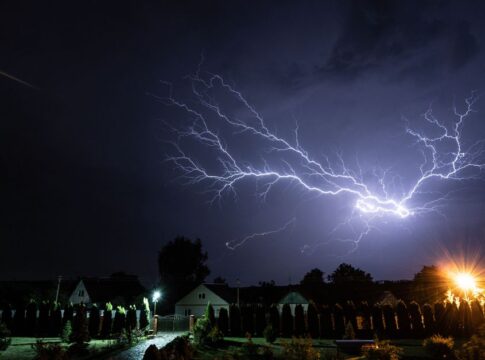
Why Lightning Creates Glass When It Strikes Sand
By Trivia Daily, Staff Writer — Published September 23, 2026
Table of Contents
- Key Takeaways
- How Lightning Creates Glass: The Science Behind Fulgurites
- What Fulgurites Look Like and Where They’re Found
- Comparing Fulgurites to Manufactured Glass
- Scientific Value and Historical Significance
- Common Myths About Lightning and Sand
- Frequently Asked Questions
When a bolt of lightning slams into a sandy beach or desert, it unleashes temperatures hotter than the surface of the sun—around 30,000 degrees Celsius. That intense heat does something surprising: it melts the sand instantly and fuses the grains into a twisted, glassy sculpture. These natural glass formations are called fulgurites, and they’re one of nature’s most amazing curiosities. The process that lightning creates glass reveals a fascinating intersection of geology, physics, and the raw power of electrical storms.
Fulgurites aren’t just interesting trivia—they’re actual fossils of lightning strikes, preserving the exact path electricity took through the ground. You might discover them after thunderstorms in sandy areas, though they’re fragile and often buried. Let’s explore the science behind these remarkable objects and uncover some surprising facts about what happens when 100 million volts meets silicon dioxide.
Key Takeaways
- Lightning can heat sand to over 30,000 degrees Celsius, instantly melting and fusing sand grains into hollow glass tubes called fulgurites.
- The glass formed by lightning strikes is primarily composed of silica, the same basic ingredient in manufactured glass.
- Fulgurites can extend several meters underground, following the branching path of the electrical discharge through the sand.
- These natural glass formations are extremely fragile and often shatter when excavated from their sandy tombs.
- Fulgurites have been found on every continent and provide scientists with valuable data about ancient lightning strikes and soil conditions.
- The interior of a fulgurite is typically smooth and glassy, while the exterior remains rough and coated with sand particles.
How Lightning Creates Glass: The Science Behind Fulgurites
The transformation from sand to glass happens in a fraction of a second. When lightning strikes sandy soil, it creates an electrical channel that can carry between 100 million and 1 billion volts. This enormous energy discharge generates extreme temperatures that far exceed what’s needed to melt sand—silica melts at roughly 1,700 degrees Celsius, but lightning produces heat nearly 20 times hotter.
The sand grains along the lightning’s path instantly liquefy. As the electrical current travels downward and outward through the ground, it creates a branching network of molten material. The surrounding sand acts as insulation, containing the heat just long enough for the melted silica to fuse together. Then, almost as quickly as it formed, the glass cools and solidifies into a permanent structure.
What makes fulgurites particularly interesting is their hollow, tube-like structure. The lightning doesn’t melt a solid column of sand. Instead, it vaporizes moisture and air in the soil, creating a channel that the molten glass forms around. The result is a delicate, twisted tube with a rough exterior (where unmelted sand adhered to the molten glass) and a smooth, glassy interior.
What Fulgurites Look Like and Where They’re Found
Fulgurites vary dramatically in size and appearance. Some are just a few centimeters long and as thin as a pencil. Others extend several meters underground with diameters exceeding several centimeters. The color depends on the composition of the sand—fulgurites can be tan, brown, black, green, or even translucent white.
These lightning fossils form wherever lightning strikes sandy or silica-rich soil. Beaches, deserts, and sand dunes are prime locations. The Sahara Desert, beaches along the Atlantic coast, and the sand hills of the American Midwest have all yielded specimens. Mountain peaks with sandy soil also produce fulgurites, though they’re harder to find in rocky terrain.
The fragility of fulgurites makes them challenging to collect. Many shatter during excavation or crumble when exposed to air after being buried for years. Successful extraction requires careful digging and often involves pouring plaster around the fulgurite to stabilize it before removal. Museums and private collectors prize well-preserved specimens, particularly those showing extensive branching patterns.
Comparing Fulgurites to Manufactured Glass
| Property | Fulgurite (Lightning Glass) | Manufactured Glass |
|---|---|---|
| Formation Time | Less than one second | Hours of controlled heating and cooling |
| Temperature | Up to 30,000°C | 1,400–1,600°C |
| Structure | Hollow tubes with irregular shapes | Uniform sheets, bottles, or shaped objects |
| Purity | Contains impurities from soil | Refined and controlled composition |
| Strength | Extremely fragile | Varies; can be strengthened through treatment |
Scientific Value and Historical Significance
Fulgurites aren’t just natural curiosities—they’re valuable scientific records. Geologists study them to understand soil composition and lightning strike patterns. Because fulgurites preserve the exact moment of formation, they can reveal information about ancient environments. Some fulgurites found in archaeological sites are thousands of years old.
The study of fulgurites has contributed to our understanding of both lightning physics and glass formation. Scientists have analyzed the molecular structure of fulgurite glass to learn how rapid cooling affects silica. This research has applications in materials science and helps explain natural glass formations found in other extreme environments, such as impact sites where meteorites have struck sandy ground.
Ancient cultures occasionally incorporated fulgurites into tools or ornaments, though they likely didn’t understand their origin. Some indigenous peoples considered them sacred objects, possibly recognizing their connection to thunderstorms. Today, fulgurites occasionally appear in jewelry, though their fragility limits practical use.
Common Myths About Lightning and Sand
One widespread misconception is that lightning always creates glass when it strikes sand. In reality, the sand must have the right composition and moisture content. Clay-heavy soil or extremely dry sand may not produce well-formed fulgurites. The lightning must also be powerful enough and strike with sufficient duration to melt and fuse the grains.
Another myth suggests that fulgurites are rare. They’re actually more common than many people realize, but they’re difficult to spot. Most remain buried underground, and those exposed on the surface quickly erode or break apart. Beachcombers occasionally find fragments without recognizing what they’ve discovered.
Some people believe fulgurites are radioactive or possess unusual properties. They’re simply natural glass—no more dangerous or magical than a windowpane. The only special property is their origin story, frozen in their twisted forms.
Frequently Asked Questions
Can you make glass from sand using regular heat?
Yes, sand can be melted into glass using high-temperature furnaces at around 1,700 degrees Celsius. This is exactly how commercial glass is manufactured, though the process requires sustained heat and controlled cooling, unlike the instantaneous formation of fulgurites.
How long do fulgurites last in nature?
Fulgurites can persist for thousands of years when buried in stable sand deposits, but exposed specimens are fragile and typically erode or break within years or decades due to weathering, temperature changes, and physical disturbance.
Are fulgurites valuable?
Well-preserved fulgurites have scientific and collector value, with prices ranging from a few dollars for small fragments to hundreds of dollars for large, intact specimens with interesting branching patterns. Their rarity and fragility contribute to their value.
Has anyone ever witnessed a fulgurite forming?
While countless people have seen lightning strike sandy areas, witnessing the actual formation and immediately excavating a fresh fulgurite is extremely rare. Most fulgurites are discovered hours, days, or years after formation, buried beneath the surface where the lightning traveled.
The next time you walk along a beach after a thunderstorm, consider that beneath your feet might lie a glassy sculpture created in a microsecond by one of nature’s most powerful forces. These fragile tubes of fused sand remind us that extraordinary transformations happen all around us, often hidden just below the surface, waiting to be discovered.