
Did You Know Elephant Seals Dive Over 5000 Feet Deep
By Trivia Daily, Animals Desk — Published November 12, 2026
Table of Contents
- Key Takeaways
- How Elephant Seals Dive to Extraordinary Depths
- The Behavior and Habitat of Deep-Diving Seals
- Comparing Deep-Diving Marine Mammals
- Life at the Surface: When Elephant Seals Come Ashore
- Conservation and Research on These Remarkable Creatures
- Frequently Asked Questions
When elephant seals dive beneath the ocean’s surface, they plunge into a world of crushing pressure and total darkness that would kill most mammals in minutes. These massive marine creatures routinely descend more than 5,000 feet—deeper than most submarines can safely travel—and they do it dozens of times every single day. The northern and southern elephant seal species hold the record for the deepest diving of any seal, transforming their bodies into biological submarines that can withstand conditions we’re only beginning to understand.
What makes these animals so remarkable isn’t just the depth. It’s that they spend most of their lives at sea, diving continuously for months on end, surfacing only for brief two-minute breaks before plunging back down. They’re hunting in complete blackness, holding their breath for up to two hours, and doing it all while their heart rate drops to just three beats per minute.
Key Takeaways
- Elephant seals regularly dive to depths exceeding 5,000 feet, with recorded dives reaching nearly 7,000 feet below the surface.
- These marine mammals can hold their breath for up to two hours during deep dives, far longer than any other seal species.
- Their heart rate slows from about 60-120 beats per minute at the surface to as low as 3 beats per minute during deep dives.
- Elephant seals spend approximately 90% of their time at sea submerged, performing continuous dive cycles with only brief surface intervals.
- They collapse their lungs during descent to avoid nitrogen buildup and the bends, a condition that would be fatal for human divers.
- These creatures store oxygen in their blood and muscles rather than their lungs, allowing them to dive deeper than air-breathing animals should theoretically survive.
How Elephant Seals Dive to Extraordinary Depths
The physiology of elephant seals represents millions of years of evolution solving one specific problem: how to hunt fish and squid in the deep ocean while still breathing air. Their bodies have developed several remarkable adaptations that make these extreme dives possible.
First, their blood. Elephant seals have an unusually high volume of blood relative to their body size—about twice as much as terrestrial mammals. This blood is packed with hemoglobin and myoglobin, proteins that bind and store oxygen. While humans store roughly 36% of their oxygen in their lungs, elephant seals store only about 5% there. The rest goes into blood and muscle tissue, creating a portable oxygen reservoir that sustains them during long dives.
Their lungs actually collapse as they descend. This might sound dangerous, but it’s brilliant engineering. By collapsing the lungs, elephant seals force air into their rigid windpipe and nasal passages, preventing nitrogen from dissolving into their bloodstream. Human divers who breathe compressed air at depth risk decompression sickness—the bends—when nitrogen bubbles form in their blood during ascent. Elephant seals sidestep this problem entirely through lung collapse.
The bradycardia response kicks in moments after submersion. Heart rate plummets from resting levels to single digits, redirecting blood flow away from non-essential organs and toward the brain and heart. Peripheral blood vessels constrict. The liver acts as a blood reservoir, releasing oxygen-rich blood slowly throughout the dive. It’s a total metabolic shutdown of everything except critical functions.
The Behavior and Habitat of Deep-Diving Seals
Elephant seals spend most of the year far from land, migrating thousands of miles across open ocean. Northern elephant seals, found along the Pacific coast from Alaska to Baja California, make biannual migrations that can exceed 13,000 miles. Southern elephant seals inhabit sub-Antarctic and Antarctic waters, ranging across the Southern Ocean.
Their diving behavior follows distinct patterns. During foraging migrations, they perform continuous dive cycles: descend, hunt, ascend, breathe for two to three minutes, then dive again. This pattern repeats day and night for months. They’re not leisurely exploring—they’re working. Each dive is a hunting expedition into the mesopelagic zone, that twilight region between 650 and 3,300 feet where sunlight fades to nothing.
What are they hunting down there? Primarily deep-sea fish and squid. These prey species migrate vertically in the water column, rising toward the surface at night and descending during the day. Elephant seals follow them, timing their deepest dives to coincide with prey movements. In total darkness, they rely on their sensitive whiskers to detect vibrations from fleeing prey.
Comparing Deep-Diving Marine Mammals
| Species | Maximum Dive Depth | Maximum Dive Duration | Typical Prey |
|---|---|---|---|
| Elephant Seal | ~7,000 feet | ~120 minutes | Deep-sea fish, squid |
| Sperm Whale | ~10,000 feet | ~90 minutes | Giant squid, deep-sea fish |
| Beaked Whale | ~10,000 feet | ~140 minutes | Deep-sea squid, fish |
| Weddell Seal | ~2,000 feet | ~82 minutes | Antarctic fish |
While sperm whales and certain beaked whales dive deeper than elephant seals, these seals remain the champion divers among pinnipeds—the group that includes seals, sea lions, and walruses. No other seal comes close to their combination of depth and duration.
Life at the Surface: When Elephant Seals Come Ashore
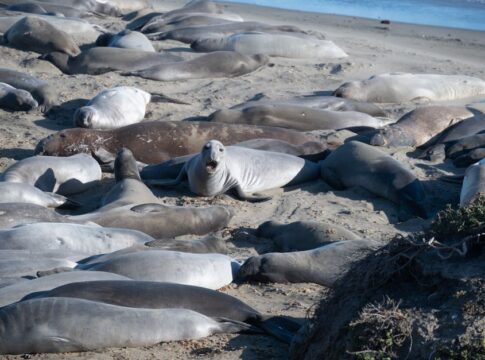
Despite their aquatic mastery, elephant seals must return to land for two critical life events: breeding and molting. During breeding season, adult males—which can weigh up to 5,000 pounds—haul out onto beaches and establish territories through violent combat. The largest males, called alpha bulls, control harems of dozens of females.
The contrast between their ocean grace and land clumsiness is striking. These creatures that glide effortlessly through water become awkward, blubbery masses on sand. They can barely lift their enormous bodies. Yet this terrestrial phase is essential. Females give birth to pups conceived the previous year, nurse them for about a month, then mate again before returning to sea.
The annual molt is equally demanding. Elephant seals shed not just fur but the top layer of skin in large patches—a process called catastrophic molting. They must remain on land during this vulnerable period, fasting for weeks while their new coat grows in. Only after molting do they return to the ocean for another months-long foraging migration.
Conservation and Research on These Remarkable Creatures
Northern elephant seals were hunted nearly to extinction in the 19th century for their blubber, which was rendered into oil. By the 1890s, fewer than 100 individuals survived. Legal protection allowed the population to rebound dramatically, and today roughly 200,000 northern elephant seals exist—a remarkable conservation success story.
Scientists study elephant seals using sophisticated tags that record depth, temperature, and location data. These animals have become unwitting oceanographers, collecting data from ocean regions rarely sampled by research vessels. Their diving behavior provides insights into deep-ocean ecosystems and how climate change affects prey distribution.
Research institutions including the Smithsonian and NOAA have tracked individual seals for years, revealing migration routes and diving patterns that would be impossible to observe otherwise. Some seals make round-trip journeys exceeding 20,000 miles annually, diving thousands of times along the way.
Frequently Asked Questions
How deep can elephant seals actually dive?
Elephant seals routinely dive to depths of 5,000 to 6,000 feet, with recorded maximum dives reaching approximately 7,000 feet. These depths place them among the deepest-diving air-breathing animals on Earth.
How long can elephant seals hold their breath underwater?
Elephant seals can hold their breath for up to two hours during deep dives, though typical dives last 20 to 30 minutes. This extraordinary breath-holding ability comes from specialized oxygen storage in their blood and muscles.
Why do elephant seals dive so deep?
They dive to extreme depths to hunt deep-sea fish and squid that live in the mesopelagic and bathypelagic zones. These prey species are abundant but exist far below the ocean surface, requiring seals to make repeated deep dives to feed.
What happens to an elephant seal’s body during a deep dive?
Their heart rate drops from 60-120 beats per minute to as low as 3 beats per minute, their lungs collapse to prevent nitrogen absorption, and blood flow redirects to essential organs only. These adaptations allow them to survive crushing pressure and oxygen deprivation that would kill most mammals.
Every time an elephant seal vanishes beneath the waves, it enters an alien environment that pushes the absolute limits of what mammalian biology can endure. That they do this not once as a spectacular feat, but thousands of times throughout their lives, transforms the extraordinary into their everyday reality—a reminder that nature still holds wonders that challenge everything we think we know about what’s possible.