
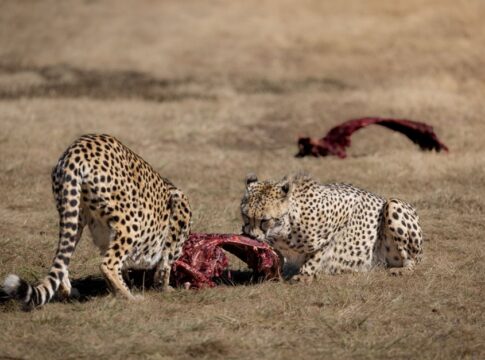
The Truth About Cheetahs Being Too Fast to Turn Sharply
By Trivia Daily, Animals Desk — Published November 7, 2026
Table of Contents
- Key Takeaways
- The Truth About Cheetahs’ Turning Ability and Speed
- The Tail: Nature’s Steering Mechanism
- Comparing Cheetah Agility to Other Predators
- The Flexible Spine and Stride Mechanics
- Why the Myth Persists
- Frequently Asked Questions
Among the most persistent myths in wildlife lore is the idea that cheetahs, nature’s fastest land animals, are essentially prisoners of their own speed—supposedly unable to make sharp turns while sprinting. The truth about cheetahs’ turning ability, however, tells a very different story. These remarkable creatures aren’t just built for straight-line speed; they’re precision-engineered pursuit predators capable of breathtaking agility at velocities that would send most animals tumbling head over heels.
The misconception likely stems from a misunderstanding of physics and animal behavior. Yes, turning at high speeds presents challenges for any creature. But cheetahs have evolved specialized adaptations that make them arguably the most maneuverable high-speed predators on Earth.
Key Takeaways
- Cheetahs can execute sharp turns while running at speeds up to 60 mph, contradicting the myth that they’re limited to straight-line chases.
- Their semi-retractable claws act like track spikes, providing exceptional grip during high-speed maneuvers.
- The cheetah’s long, muscular tail functions as a dynamic counterbalance, shifting position to stabilize the body during rapid directional changes.
- Studies show cheetahs decelerate and accelerate more rapidly than any other land animal, reaching top speed in just three seconds.
- During hunts, cheetahs match their prey’s evasive zigzagging rather than relying purely on superior straight-line velocity.
- Their flexible spine allows for extreme body rotation, with some turns exceeding 180 degrees in a single stride.
The Truth About Cheetahs’ Turning Ability and Speed
Cheetahs reach speeds of approximately 70 mph during short bursts, making them the fastest land animals. But speed alone doesn’t win hunts in the African savanna and scattered habitats of Iran where these big cats live. Prey species like gazelles and impalas are themselves swift runners with one critical advantage: unpredictability. They dart left and right, executing sudden direction changes that would theoretically give them an edge against a predator that can only run straight.
Except cheetahs don’t run straight. Research tracking wild cheetahs during actual hunts reveals something extraordinary: these animals rarely maintain top speed for more than a few seconds. Instead, they spend most of a chase making rapid adjustments—slowing down, speeding up, and turning sharply to mirror their prey’s movements. The hunt is less a linear sprint and more a high-speed game of shadowing.
What makes this possible? The cheetah’s body is a masterclass in biomechanical engineering. Unlike other big cats, cheetahs have a relatively lightweight frame with long, slender legs. Their claws don’t fully retract like those of lions or leopards, providing constant traction similar to cleats on a track athlete’s shoes. This might seem like a minor detail, but it’s transformative when you’re trying to push off the ground while cornering at 50 mph.
The Tail: Nature’s Steering Mechanism
Perhaps no single feature better illustrates the cheetah’s turning prowess than its tail. Measuring up to 30 inches long and heavy with muscle, the tail isn’t just along for the ride. It’s an active rudder.
Watch footage of a cheetah in pursuit, and you’ll notice the tail whipping dramatically from side to side, sometimes appearing to move independently of the rest of the body. This isn’t random. As the cheetah shifts direction, the tail swings to the opposite side, creating a counterbalance that prevents the animal from rolling or losing stability. Think of it as a tightrope walker’s balancing pole, but one that responds instantaneously to changing conditions.
The physics are elegant: when turning left at speed, the cheetah’s body wants to continue moving right due to inertia. By swinging its tail right, the cheetah redistributes its center of mass, allowing the legs and claws to grip and redirect momentum without catastrophic loss of balance. It’s a solution that human engineers might appreciate in designing high-performance vehicles.
Comparing Cheetah Agility to Other Predators
| Species | Top Speed | Turning Radius at Speed | Primary Hunting Strategy |
|---|---|---|---|
| Cheetah | ~70 mph | Extremely tight (body can rotate 180°) | High-speed pursuit with rapid direction changes |
| Lion | ~50 mph | Moderate | Ambush and short chase |
| Leopard | ~45 mph | Good at low speeds | Stealth and pouncing |
| African Wild Dog | ~44 mph | Good, with pack coordination | Endurance pursuit over long distances |
The Flexible Spine and Stride Mechanics
Another key to cheetah agility lies in the spine itself. Cheetahs possess an exceptionally flexible backbone that curves and extends with each stride, effectively lengthening the animal’s reach. During a full sprint, all four paws leave the ground twice per stride—once with the legs extended, once with them bunched beneath the body. This creates a bounding motion that covers roughly 25 feet per stride at top speed.
But here’s where it gets interesting for turning: that same spinal flexibility allows the cheetah to twist its body mid-stride. The front and rear halves can rotate somewhat independently, letting the animal adjust trajectory without breaking its gait. It’s analogous to how a slalom skier keeps their upper body facing downhill while their legs pivot beneath them.
The muscular system supports this with fast-twitch muscle fibers that provide explosive power. Cheetahs can decelerate from 60 mph to a near-stop in just a few bounds, then accelerate back to high speed in roughly three seconds. This rapid speed modulation is actually more important to hunting success than raw top-end velocity.
Why the Myth Persists
So where did the “can’t turn” myth originate? Part of it stems from early wildlife observations that emphasized the cheetah’s remarkable speed without fully understanding the complexity of actual hunts. Observers saw the blur of acceleration and assumed the physics of high-speed travel would limit maneuverability, just as a sports car needs more room to corner than a compact vehicle.
The reality is more nuanced. While it’s true that any animal faces increased difficulty turning as velocity rises, cheetahs have evolved specifically to overcome this limitation within their ecological niche. They’re not trying to make 90-degree turns at 70 mph—no land animal could survive that. Instead, they make continuous micro-adjustments and sharper turns at moderate speeds (30-50 mph), which is precisely where most prey encounters occur.
Conservation challenges facing cheetahs in their natural habitat have nothing to do with biomechanical limitations. These animals are threatened by habitat loss, human-wildlife conflict, and genetic bottlenecks in their populations, not by an inability to catch dinner.
Frequently Asked Questions
Can cheetahs really make sharp turns while running at full speed?
Yes, cheetahs can execute sharp turns at high speeds, though they typically make the sharpest maneuvers at moderate velocities (30-50 mph) rather than absolute top speed. Their specialized anatomy, including their semi-retractable claws, flexible spine, and muscular tail, enables exceptional agility during pursuit.
How does a cheetah’s tail help with turning?
The cheetah’s long, heavy tail acts as a dynamic counterbalance during high-speed turns, swinging in the opposite direction of the turn to redistribute the animal’s center of mass. This prevents rolling and maintains stability, functioning similarly to a rudder on a boat or aircraft.
Are cheetahs faster than their prey in a straight line?
Yes, cheetahs are considerably faster than most prey species in straight-line sprints, but hunts rarely involve simple linear chases. Prey animals like gazelles rely on agility and unpredictable direction changes, which is why cheetahs evolved superior turning ability rather than just speed.
What percentage of cheetah hunts are successful?
Cheetah hunting success rates vary by region and prey availability, but studies generally show success rates around 40-50%, which is relatively high compared to other big cats. Their combination of speed and agility contributes significantly to this effectiveness.
The next time you hear someone claim cheetahs are “too fast to turn,” you’ll know the real story. These animals represent evolution’s answer to a specific challenge: how to catch agile prey in open terrain. The solution wasn’t just speed—it was speed plus precision, wrapped in one of nature’s most elegant packages.