
Did Humans Actually Evolve From Apes or Share Ancestors
By Trivia Daily, Staff Writer — Published October 6, 2026
Table of Contents
- Key Takeaways
- Did Humans Actually Evolve From Today’s Apes?
- The Timeline of Human and Ape Divergence
- What the Common Ancestor Actually Looked Like
- Why Modern Apes Still Exist
- The Evidence Supporting Shared Ancestry
- Frequently Asked Questions
One of the most persistent misconceptions about evolution involves humans and apes. You’ve probably heard someone say “humans evolved from monkeys” or “if we came from apes, why are there still apes?” These questions reveal a fascinating gap in how we understand our evolutionary history. The truth is more interesting than the myth: humans didn’t actually evolve from modern apes. Instead, we share a common ancestor with them, branching off millions of years ago on separate evolutionary paths.
This distinction might seem small, but it’s crucial for understanding how evolution works. When scientists say humans and chimpanzees share about 98-99% of their DNA, they’re pointing to our shared heritage, not suggesting one came from the other. Think of it like cousins sharing a grandparent rather than one cousin being the parent of another.
Key Takeaways
- Humans and modern apes (chimpanzees, gorillas, orangutans) share common ancestors but evolved along separate branches of the evolutionary tree.
- The last common ancestor between humans and chimpanzees lived approximately 6 to 7 million years ago in Africa.
- Humans are classified as great apes within the Hominidae family, making us relatives rather than descendants of modern apes.
- The fossil record shows numerous intermediate species between our common ancestor and modern humans, including Australopithecus and various Homo species.
- Both humans and modern apes continue to evolve today, though evolution operates over timescales far longer than human lifetimes.
- Genetic evidence from DNA analysis confirms evolutionary relationships more precisely than fossil evidence alone.
Did Humans Actually Evolve From Today’s Apes?
The short answer is no. Modern chimpanzees, gorillas, and orangutans are not our ancestors. They’re our evolutionary cousins. This distinction trips up many people because the popular phrase “humans evolved from apes” omits critical context. We share ancestry with apes, but we didn’t descend from the ones alive today.
Here’s what actually happened: millions of years ago, a population of ancient primates lived in Africa. Over time, this population split into different groups that evolved separately. Some lineages led to modern gorillas. Others led to chimpanzees and bonobos. Still another branch eventually led to humans. The original common ancestor no longer exists—it went extinct long ago, leaving only its descendants scattered across different evolutionary branches.
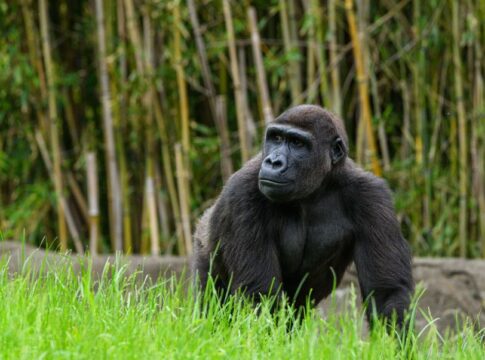
Humans belong to the taxonomic family Hominidae, commonly called the great apes. This family includes orangutans, gorillas, chimpanzees, bonobos, and humans. We’re all great apes, which makes the question “did we evolve from apes?” somewhat circular. We are apes. The better question asks which ancient ape species represent our last common ancestors with other living apes.
The Timeline of Human and Ape Divergence
Understanding when different lineages split helps clarify our evolutionary relationships. The fossil record and genetic evidence paint a remarkably consistent picture of these divergence points, though scientists continue refining the exact dates.
| Divergence Event | Approximate Time | Species Involved |
|---|---|---|
| Orangutan lineage splits | 12-16 million years ago | Ancestors of orangutans diverge from African apes |
| Gorilla lineage splits | 8-10 million years ago | Ancestors of gorillas diverge from human-chimp line |
| Human-chimpanzee split | 6-7 million years ago | Last common ancestor of humans and chimps |
| Chimp-bonobo split | 1-2 million years ago | Chimpanzees and bonobos diverge from each other |
These timelines come from multiple sources of evidence. Geneticists compare DNA sequences and calculate mutation rates to estimate when populations diverged. Paleontologists examine fossils to identify transitional species. When these independent methods agree, confidence in the timeline increases.
What the Common Ancestor Actually Looked Like
Scientists don’t have a complete fossil of the last common ancestor between humans and chimpanzees. That’s not surprising—fossilization is rare, and conditions in tropical forests where these ancestors likely lived don’t preserve bones well. But researchers can make educated inferences based on fossils from around that time period and by comparing modern species.
The common ancestor probably lived in trees and on the ground, was roughly chimpanzee-sized, and had features intermediate between modern chimps and humans. It wasn’t identical to modern chimpanzees because chimps have also been evolving for 6 to 7 million years since the split. Both lineages changed over time.
Fossils like Sahelanthropus tchadensis (about 7 million years old) and Ardipithecus ramidus (about 4.4 million years old) offer glimpses of early human ancestors. These species show a mix of ape-like and human-like characteristics, exactly what evolutionary theory predicts for transitional forms.
Why Modern Apes Still Exist
The question “if humans evolved from apes, why are there still apes?” reveals a fundamental misunderstanding of how evolution works. Evolution doesn’t require ancestral species to go extinct when new species emerge. Species split and diverge; they don’t transform wholesale into something else.
Consider this analogy: Americans descended from Europeans, yet Europeans still exist. Immigration and population splitting don’t erase the original population. Evolution works similarly. When a population splits geographically or ecologically, each group faces different environmental pressures and evolves along separate paths.
Modern apes continue to exist because they’re well-adapted to their environments. Chimpanzees thrive in certain African forest habitats. Orangutans are specialized for life in Southeast Asian rainforests. Gorillas occupy their own ecological niches. These species evolved successful survival strategies just as humans did, though in different directions.
The Evidence Supporting Shared Ancestry
Multiple lines of evidence confirm the shared ancestry of humans and other great apes. DNA comparisons show humans and chimpanzees share approximately 98-99% of their genetic material. Gorillas share slightly less, and orangutans less still—exactly matching the predicted pattern if species diverged at different times.
Anatomical similarities provide another layer of evidence. All great apes share similar skeletal structures, organ systems, and developmental patterns. Humans have tailbones (coccyx) despite lacking tails, matching the tail-less condition in all great apes. Our shoulder structure, designed for overhead arm movement, resembles that of other apes adapted for climbing and swinging.
The fossil record documents numerous transitional species between our common ancestor and modern humans. Species like Australopithecus afarensis (including the famous Lucy fossil) walked upright but had smaller brains than modern humans. Homo habilis showed increased brain size and tool use. Homo erectus spread across Africa and Asia. Each fossil fills in details of our evolutionary journey.
Frequently Asked Questions
Are humans still evolving today?
Yes, humans continue to evolve, though the changes occur over many generations and aren’t obvious within a human lifetime. Recent evolutionary changes include lactose tolerance in some populations and genetic adaptations to high-altitude living in Tibetan populations.
Which ape is our closest living relative?
Chimpanzees and bonobos are equally our closest living relatives. We share a more recent common ancestor with both chimp species than with any other living animal, having diverged approximately 6 to 7 million years ago.
How many human species have existed?
At least 20 species in the genus Homo have been identified in the fossil record, including Homo habilis, Homo erectus, Homo neanderthalensis, and Homo sapiens. Some of these species coexisted at the same time in different regions.
Can humans and other apes interbreed?
No, humans cannot interbreed with other great apes. The genetic differences and chromosomal incompatibilities are too great. Humans have 46 chromosomes while chimpanzees have 48, making viable reproduction impossible.
The next time someone asks why apes still exist if humans evolved from them, you’ll know the question itself contains a false premise. We didn’t evolve from modern apes—we share a family tree with them, branching from common roots that stretch back millions of years. That shared heritage makes our relationship with other great apes one of kinship rather than descent, a reminder that evolution creates diversity through branching, not linear transformation.