
7 Surprising Facts About Medusa and Gorgon Mythology
By Trivia Daily, Staff Writer — Published September 18, 2026
Table of Contents
When most people think of Medusa, they picture a monster with snakes for hair who turns anyone who looks at her into stone. But the real medusa gorgon mythology runs far deeper and stranger than popular culture suggests. This snake-haired figure from ancient Greece has been misunderstood, reinterpreted, and transformed across millennia, and the original stories contain twists that might surprise even mythology enthusiasts.
The Gorgons weren’t always villains, Medusa wasn’t always monstrous, and the symbolism behind these figures reveals fascinating insights into ancient Greek culture, gender dynamics, and the evolution of storytelling itself.
Key Takeaways
- Medusa was originally a beautiful mortal woman before her transformation into a monster, according to the most famous version of her story.
- The Gorgons were three sisters, not a single creature, and only Medusa was mortal while her sisters were immortal.
- Ancient Greeks used Gorgon imagery as protective symbols on shields, temples, and even ovens to ward off evil.
- Perseus never looked directly at Medusa but used his polished shield as a mirror to avoid her petrifying gaze.
- Medusa’s blood possessed contradictory magical properties, with one side healing and the other killing instantly.
- The Gorgon myth likely has roots in ancient protective deities that predate classical Greek civilization.
Interesting Facts About Medusa Gorgon Mythology
1. Medusa Was the Only Mortal Among the Three Gorgon Sisters
The Gorgons were three sisters named Medusa, Stheno, and Euryale, daughters of the ancient sea gods Phorcys and Ceto. While Stheno and Euryale were immortal and invulnerable, Medusa alone could be killed. This crucial difference made her the target of Perseus, who needed a Gorgon’s head but could only obtain one from the mortal sister. Ancient sources suggest that Stheno was the fiercest of the three, while Euryale was known for her bellowing cries, but Medusa became the most famous precisely because of her vulnerability. The name “Medusa” itself comes from the Greek word meaning “guardian” or “protectress,” hinting at a deeper protective role these figures originally played in ancient belief systems.
2. Medusa’s Transformation Was Punishment for Being Assaulted
The Roman poet Ovid tells us that Medusa wasn’t born a monster. She began as a beautiful mortal woman with gorgeous hair who served as a priestess in Athena’s temple. According to Ovid’s account in the Metamorphoses, the sea god Poseidon assaulted Medusa inside Athena’s sacred temple. Rather than punishing Poseidon, Athena transformed Medusa into a hideous creature with snakes for hair and a gaze that turned living beings to stone. This disturbing narrative reflects ancient attitudes about defilement and purity, where the victim bore the consequences of violation. Modern interpretations have reexamined this myth through different lenses, seeing Medusa as a symbol of female rage and survival rather than simple monstrosity.
3. Gorgon Faces Served as Powerful Protective Symbols Throughout Ancient Greece
The terrifying Gorgon face, known as a Gorgoneion, appeared everywhere in ancient Greek society as an apotropaic device—a symbol meant to ward off evil and protect against harm. Warriors painted Gorgon faces on their shields, architects carved them above doorways and on temple pediments, and craftspeople decorated everyday objects from coins to cooking vessels with these fierce visages. The most famous example adorned the aegis, the protective cloak or shield associated with both Zeus and Athena. This widespread use suggests that Gorgons represented protective power rather than pure evil. The logic was simple: if Medusa’s face could turn enemies to stone, her image might frighten away threats and malevolent spirits. Archaeological evidence shows these protective symbols persisted for centuries across the Mediterranean world.
4. Perseus Used Five Divine Gifts to Defeat Medusa
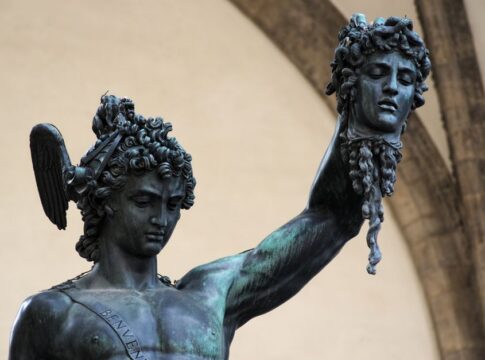
Perseus didn’t face Medusa armed with only courage. The gods equipped him with an arsenal of magical items specifically for this dangerous quest. Athena gave him a polished bronze shield that he used as a mirror to view Medusa’s reflection without meeting her petrifying gaze directly. Hermes provided winged sandals for swift flight and a adamantine sickle sharp enough to cut through Medusa’s neck. Hades contributed his helmet of invisibility, while the nymphs supplied a special bag called a kibisis to safely carry the severed head. This divine assistance highlights how impossible the task would have been for an ordinary mortal and emphasizes the gods’ investment in Medusa’s destruction. The polished shield technique became one of mythology’s most famous problem-solving moments, showing that indirect approaches sometimes succeed where direct confrontation fails.
5. Medusa’s Blood Had Opposite Magical Properties on Each Side of Her Body
After Perseus beheaded Medusa, her blood became a substance of contradictory powers. According to ancient sources, blood taken from the left side of her body was a deadly poison that could kill instantly, while blood from the right side possessed miraculous healing properties and could even resurrect the dead. Athena collected this blood and gave portions to Asclepius, the god of medicine, who used the healing blood to cure diseases and bring people back to life. This dual nature reflects Greek philosophical concepts about the thin line between remedy and poison—a theme that resonates in the origin of the word “pharmacy,” derived from the Greek word for both drug and poison. The contradictory properties of Medusa’s blood suggest she embodied both destructive and generative forces, making her a more complex figure than a simple monster.
6. Pegasus and Chrysaor Sprang from Medusa’s Severed Neck
When Perseus cut off Medusa’s head, two remarkable offspring emerged from her neck: Pegasus, the famous winged horse, and Chrysaor, a giant or warrior with a golden sword. Both were children of Poseidon, conceived during the assault in Athena’s temple. Pegasus went on to become one of mythology’s most celebrated creatures, eventually serving the hero Bellerophon and being transformed into a constellation. Chrysaor’s story is less developed in surviving myths, though some sources describe him as the father of the three-bodied giant Geryon. This bizarre birth scene—divine beings springing fully formed from a decapitated neck—demonstrates the generative power attributed to Medusa even in death. The image reinforces her connection to ancient fertility and creation symbolism that predated her portrayal as pure monster.
7. The Gorgon Myth Likely Evolved from Ancient Protective Deities
Scholars have traced Gorgon imagery to sources far older than classical Greek mythology. Similar fierce female faces with protruding tongues, wild hair, and apotropaic functions appear in art from ancient Egypt, the Near East, and pre-Greek Aegean cultures. Some researchers connect the Gorgons to ancient mother goddess figures or protective household deities that guarded against evil and chaos. The transformation from protective deity to defeated monster may reflect cultural shifts as newer pantheons replaced older religious systems. Archaeological evidence from Minoan Crete and other Bronze Age sites shows Gorgon-like imagery predating the classical Greek period by centuries. This suggests that Medusa and her sisters inherited characteristics from much older traditions, later reinterpreted through the lens of Greek heroic mythology where male heroes conquered female monsters as symbols of civilization triumphing over chaos.
Frequently Asked Questions
Why did Medusa have snakes for hair?
According to Ovid’s account, Athena transformed Medusa’s beautiful hair into serpents as part of her punishment after Poseidon assaulted Medusa in Athena’s temple. Snakes carried symbolic weight in Greek culture, associated with both danger and regeneration, making them a fitting element for this transformed protective-yet-terrifying figure.
Could Medusa turn herself to stone by looking in a mirror?
Ancient sources don’t address this paradox directly, but the logic of the myth suggests her power worked on others, not herself. Perseus safely used his polished shield as a mirror to view her reflection, which indicates the petrifying effect required direct eye contact between Medusa and her victim, not merely seeing her image.
What happened to Medusa’s head after Perseus killed her?
Perseus used Medusa’s severed head as a weapon several times, turning enemies to stone, including the sea monster threatening Andromeda. He eventually gave the head to Athena, who placed it on her aegis (shield or breastplate), where it remained as a permanent protective emblem. Some traditions say it was later buried under the marketplace in Athens.
Were there other Gorgons besides the three sisters?
Classical Greek mythology consistently describes exactly three Gorgons: Medusa, Stheno, and Euryale. However, the term “gorgon” in lowercase sometimes referred more generally to frightening female monsters or protective faces used in art, leading to some confusion. The canonical number remains three sisters, daughters of the primordial sea deities Phorcys and Ceto.
The story of Medusa continues to evolve in modern retellings, with contemporary writers and artists reclaiming her narrative as one of survival, transformation, and female power. What began as a cautionary tale in ancient Greece has become a symbol with meanings its original tellers never imagined, proving that the most enduring myths are those we never stop reinterpreting.