
The Truth About Mermaids Being Confused Manatees
By Trivia Owl, Staff Writer — Published November 5, 2026
Table of Contents
- Key Takeaways
- The Truth Mermaids Confused: What Columbus Actually Saw
- The Scientific Connection: Why They’re Called Sirenia
- Comparing Mermaids and Manatees: Reality vs. Myth
- The Nursing Behavior That Fooled Sailors
- Why the Mermaid Myth Is Older Than Manatee Contact
- Other Animals Mistaken for Mythical Creatures
- Frequently Asked Questions
For centuries, sailors returned from long voyages with tales of beautiful mermaids singing in the waves. These stories captivated imaginations and spawned countless legends. But the truth mermaids confused with mythical creatures might actually be something far more mundane—and considerably less glamorous. The leading theory suggests that many historical mermaid sightings were actually encounters with manatees, those gentle, rotund marine mammals that look nothing like the sirens of legend. This surprising explanation raises an intriguing question: how could anyone mistake a thousand-pound sea cow for an enchanting half-woman, half-fish?
The answer reveals fascinating facts about human perception, the hardships of maritime life, and the real animals that inspired our most enduring myths. What you’re about to discover might forever change how you think about both mermaids and manatees.
Key Takeaways
- Christopher Columbus reported seeing mermaids during his 1493 voyage to the Caribbean, describing them as “not as pretty as they are depicted” — likely manatees.
- Manatees belong to the order Sirenia, named after the mythical sirens precisely because of their historical association with mermaid legends.
- Sailors spending months at sea suffered from scurvy, dehydration, and exhaustion, conditions that could impair judgment and vision.
- Manatees nurse their young while holding them with their flippers, sometimes floating upright in a vaguely humanoid posture.
- The earliest mermaid myths predate European contact with manatees by thousands of years, suggesting multiple origins for these legends.
- Dugongs, close relatives of manatees found in the Indian Ocean, were similarly mistaken for mermaids by ancient mariners.
The Truth Mermaids Confused: What Columbus Actually Saw
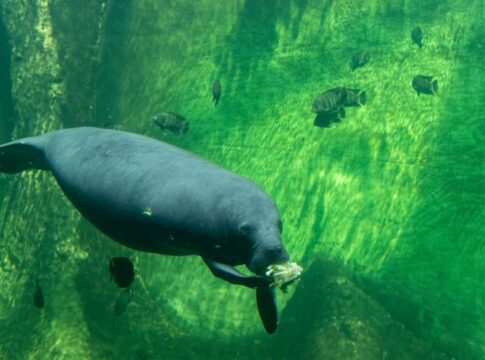
When Christopher Columbus sailed near what is now the Dominican Republic in January 1493, he recorded seeing three “mermaids” rise from the water. His journal entry noted they were “not half as beautiful as they are painted.” This disappointing observation makes perfect sense if he was looking at manatees. These marine mammals can weigh up to 1,200 pounds, have wrinkled gray skin, and possess whiskered snouts designed for grazing on seagrass—hardly the stuff of romantic fantasy.
The confusion wasn’t limited to Columbus. Sailors across the Caribbean, along the coasts of West Africa, and throughout the Indian Ocean reported similar sightings for hundreds of years. The pattern suggests a consistent misidentification rather than mass hallucination. Manatees and their close cousins, dugongs, inhabit warm coastal waters precisely where many mermaid sightings were concentrated.
But why would experienced sailors make such a seemingly absurd mistake? The answer lies in the brutal reality of life at sea. Months without fresh food led to vitamin C deficiency and scurvy, which affects mental clarity. Dehydration was constant. Heat exhaustion common. Viewing conditions from the deck of a pitching wooden ship were far from ideal. Add poor eyesight—common in an era before corrective lenses were widely available—and glimpses of unfamiliar animals through sea spray begin to look very different.
The Scientific Connection: Why They’re Called Sirenia
Scientists recognized the historical link between these marine mammals and mermaid mythology when they classified them. The taxonomic order Sirenia takes its name directly from the sirens of Greek mythology—those dangerous creatures whose songs lured sailors to their doom. The scientific community essentially acknowledged that these animals were the likely source of countless legends.
Sirenia includes four living species: three types of manatees (West Indian, Amazonian, and West African) and the dugong. A fifth species, Steller’s sea cow, was hunted to extinction in the 18th century, just 27 years after its discovery by Europeans. All sirenians are fully aquatic herbivores, spending their entire lives in water and surfacing regularly to breathe. This surfacing behavior, combined with their occasional upright postures, created fleeting impressions that tired, hopeful sailors could easily misinterpret.
Comparing Mermaids and Manatees: Reality vs. Myth
| Characteristic | Mythical Mermaid | Actual Manatee |
|---|---|---|
| Appearance | Beautiful woman’s upper body, fish tail | Large gray marine mammal, paddle-shaped tail |
| Weight | Human-sized (100–150 lbs) | 800–1,200 lbs average |
| Behavior | Singing, combing hair, sitting on rocks | Grazing on seagrass, surfacing to breathe |
| Habitat | Open ocean, rocky outcrops | Shallow coastal waters, rivers, estuaries |
| Nursing young | Not applicable | Cradles calf with flippers while floating upright |
The Nursing Behavior That Fooled Sailors
One of the most compelling pieces of evidence for the manatee theory involves maternal behavior. Female manatees nurse their calves while holding them close with their flippers. During nursing, a mother manatee sometimes floats in a semi-upright position with her head and upper body above water. Her flippers cradle the nursing calf against her chest in a distinctly mammalian, almost human gesture.
From a distance, through ocean haze, this scene could resemble a woman holding a child. The manatee’s flexible flippers can appear arm-like in certain positions. Their ability to rotate their heads and make eye contact adds to the anthropomorphic impression. For sailors who had been months at sea, desperately homesick and familiar with mermaid legends from childhood, the leap from “strange animal” to “mythical creature” wasn’t as far as it might seem.
Why the Mermaid Myth Is Older Than Manatee Contact
While manatees explain many historical sightings, they don’t account for the origin of mermaid legends themselves. The ancient Assyrians worshipped Atargatis, a mermaid goddess, around 1000 BCE—long before European sailors encountered manatees in the Americas. Greek mythology featured sirens and Nereids centuries before Columbus. Japanese folklore includes ningyo, Chinese myths speak of the Jiaoren, and Celtic traditions describe merrows.
These diverse cultures developed mermaid myths independently, suggesting that the concept taps into something deeper than misidentified animals. Water has always held mystery and danger for humans. Creating humanoid water spirits may reflect universal psychological patterns. However, once these myths existed, real animals like manatees and dugongs provided convenient “evidence” that seemed to confirm ancient stories. The myths primed sailors to see mermaids; the manatees gave them something to see.
Other Animals Mistaken for Mythical Creatures
Manatees aren’t the only real animals that fueled legendary creatures. This pattern of misidentification repeats throughout history:
- Narwhal tusks were sold as unicorn horns in medieval Europe, fetching enormous prices for their supposed magical properties
- Giant squid sightings likely inspired the Kraken legends of Scandinavian sailors
- Rhinoceros descriptions from travelers morphed into European unicorn legends when filtered through multiple retellings
- Gorillas were considered mythical monsters in Western accounts until specimens were obtained in the 19th century
- Oarfish, which can grow over 20 feet long, probably explain many sea serpent reports
The National Oceanic and Atmospheric Administration has documented how unfamiliar marine animals continue to spark monster reports even today. The pattern is clear: humans have always tried to fit unfamiliar observations into familiar mythological frameworks.
Frequently Asked Questions
Did sailors really think manatees were mermaids?
Yes, historical records including Columbus’s journals explicitly describe mermaid sightings in areas where manatees are common. The combination of poor viewing conditions, exhaustion, and preexisting beliefs made misidentification likely.
Are manatees the only explanation for mermaid legends?
No, mermaid myths existed independently in cultures worldwide long before contact with manatees. However, manatees and dugongs likely reinforced these existing beliefs and explained many specific historical sightings.
Why are manatees called sea cows?
Manatees earned the nickname “sea cows” because they’re large, slow-moving herbivores that graze on underwater vegetation much like cattle graze on grass. Their gentle, placid temperament also resembles domestic cattle.
Do manatees actually make sounds that could be mistaken for singing?
Manatees do vocalize, producing squeaks, chirps, and whistles to communicate, especially between mothers and calves. However, these sounds are quite different from human singing and unlikely to be the source of siren song legends.
The next time you see a manatee lazily grazing in shallow water, consider what a sleep-deprived, homesick sailor might have seen through the spray and distance of the open ocean. Our most enchanting myths often have surprisingly ordinary explanations—but that somehow makes the real story even more interesting. After all, the fact that we once mistook 1,200-pound sea cows for beautiful sirens tells us as much about human nature as it does about marine biology.